
A worker’s first hour on site shapes how they behave for the rest of their time there. A well-run safety induction checklist gives that hour structure, so no one walks past a hazard they were never told about. Most serious incidents involving new arrivals do not come from recklessness. They come from unfamiliarity with the layout, the equipment, the rules, or the emergency arrangements.
This article walks through what a complete safety induction checklist should cover, how it differs for contractors, employees, and visitors, where inductions commonly go wrong, and how safety induction software can turn a paper exercise into a reliable, auditable process.
What Is a Safety Induction Checklist?
A safety induction checklist is a structured list of the topics, rules, and procedures that every person must be briefed on before they begin work or enter a controlled area. It works as both a teaching guide for the trainer and a verification record for the organization. Each item is explained, understood, and signed off before access is granted.
The checklist is distinct from role-specific training. Induction covers what anyone on the premises needs to know to stay safe and keep others safe. Task training, such as operating a forklift or working at height, follows once the foundation is in place.
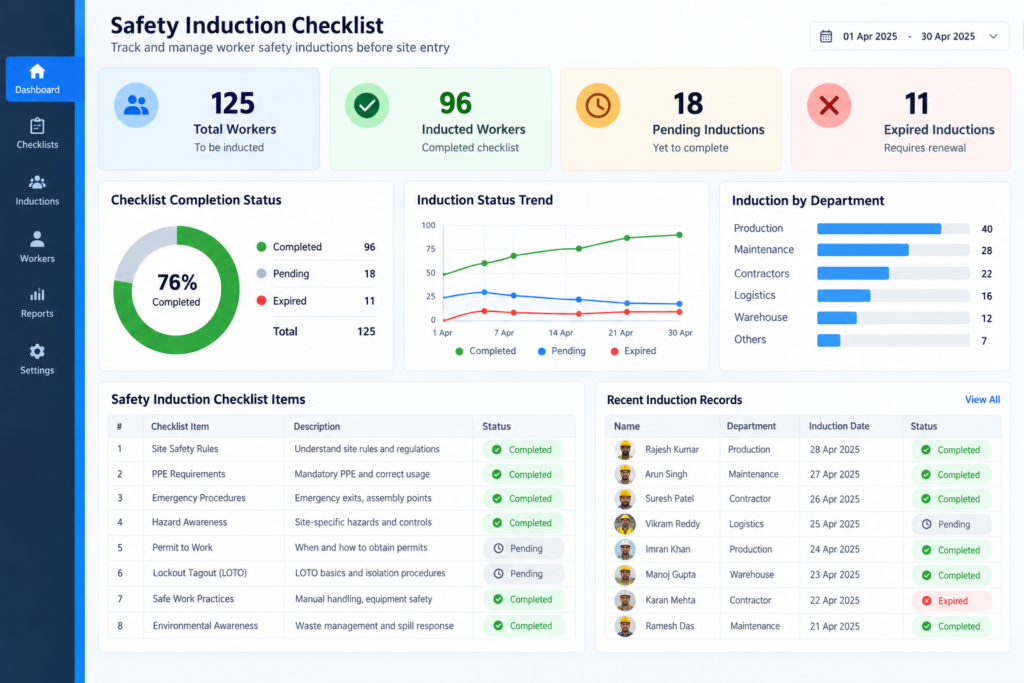
Why a Safety Induction Checklist Matters
Newly arrived workers and short-term contractors face the highest risk on a site because they do not yet know its restricted zones, alarm signals, or evacuation routes. A safety induction checklist matters because it closes that knowledge gap before exposure begins, making sure the same essentials reach every entrant no matter who delivers the session or how busy the day is. Without it, induction depends on memory and goodwill, and gaps tend to surface only after an incident. It also serves a legal purpose, since employers must provide workers with the information and instruction they need to work safely, and a signed checklist is the evidence that this duty was met. Just as importantly, a structured induction tells new arrivals from the first hour that safety is a condition of work, which shapes whether they report near misses, follow permits, and speak up when something is unsafe.
Safety Induction Checklist: What Every Worker Should Know Before Entering a Site
The items below form the core of a practical safety induction checklist. Adapt the depth to your industry, but treat each topic as non-negotiable.
- Site overview and layout. Show workers the boundaries, access routes, restricted zones, vehicle and pedestrian segregation, parking, and welfare facilities. A site map walk-through, ideally on foot, helps people connect the drawing to the real environment.
- Hazard awareness. Explain the principal hazards of the site, including moving machinery, work at height, confined spaces, electrical systems, noise, and traffic. Link each hazard to the control measures in place so workers understand the reason behind each rule.
- Personal protective equipment. Specify the minimum PPE for the site and any additional requirements by area. Cover how to wear, inspect, and replace equipment, and make clear who supplies it and what happens when it is damaged.
- Emergency procedures. Brief workers on alarm signals, evacuation routes, assembly points, roll-call arrangements, and who to contact. People should leave the induction able to describe what they would do in a fire, a spill, or a medical emergency without looking at a sign.
- First aid and medical facilities. Identify the location of first aid kits, eyewash stations, defibrillators, and the site clinic. Name the trained first aiders and explain how to summon help, including the site’s emergency number and nearest hospital.
- Permit to Work and LOTO awareness. Explain which activities require a permit, such as hot work, confined space entry, and work at height, and what a valid permit looks like. Introduce lockout/tagout so workers never remove another person’s lock or start isolated equipment.
- Chemical safety. Cover how hazardous substances are labelled, stored, and handled, and where Safety Data Sheets are kept. Workers should know how to read hazard pictograms and what to do after a spill or exposure.
- Incident and near-miss reporting. Describe how to report injuries, near misses, unsafe conditions, and unsafe acts, and to whom. Stress that reporting is expected and that near misses are treated as learning opportunities rather than grounds for blame.
- Site rules and conduct. Set out speed limits, mobile phone restrictions, smoking areas, rules on alcohol, photography limits, and the disciplinary consequences of serious breaches.
- Housekeeping and waste disposal. Show how waste is segregated, where skips and bins are located, and why clear walkways matter. Poor housekeeping drives slips, trips, falls, and fire loads, so it deserves more than a passing mention.
- Fire prevention. Cover ignition sources, hot work controls, storage of flammables, and the location and use of extinguishers. Reinforce that preventing a fire is far easier than responding to one.
Role-Specific Additions to the Checklist
The core topics apply to everyone, but each group carries different risks and responsibilities. A good safety induction checklist includes short additions for each.
- Contractors. Contractors often arrive with their own methods and equipment, so the induction should cover pre-qualification documents, method statements and risk assessments, tool and equipment inspection requirements, the permit system, and the chain of command for supervision. Clarify who is responsible for what when contractor and site activities overlap.
- Employees. Permanent staff need the broader picture, including the management system, their duties under company policy, health surveillance, consultation and safety committee arrangements, and how their role connects to site-wide risk controls. Employees also benefit from a documented follow-up at thirty or sixty days to confirm that the induction has translated into practice.
- Visitors. Visitors typically stay briefly and are escorted, so the induction should be short and focused on essentials: escort requirements, restricted areas, minimum PPE, alarm signals, and the assembly point. Keep it clear enough that someone with no industrial background can follow it.
Common Mistakes in Safety Induction
Even organizations with a documented process fall into predictable traps. Recognizing them helps you fix the weak points before an incident exposes them.
- Treating it as a formality. When induction is rushed so that work can begin, people sign the form without absorbing the content. The result is a record that looks complete and a workforce that is not prepared.
- Generic content. An induction that could apply to any workplace fails to address the actual hazards of yours. Workers disengage quickly when examples do not match what they will see on the floor.
- No comprehension check. Delivering information is not the same as confirming it landed. Without a short quiz, practical demonstration, or verbal check, there is no evidence that anyone understood the key messages.
- Weak record keeping. Paper sign-in sheets get lost, filed inconsistently, or filled out illegibly. When an auditor or investigator asks who was inducted and when, a missing record is treated as a missing induction.
- No refresher cycle. Site conditions, processes, and regulations change, and memory fades. An induction delivered once and never revisited leaves people working from outdated assumptions.
Best Practices for an Effective Safety Induction
Improving induction rarely requires a complete redesign. A handful of habits make the largest difference.
- Keep it practical. Pair the briefing session with a guided site walk, show real PPE, and point to actual emergency equipment. People retain what they see and handle far better than what they hear in a slide presentation.
- Make physical training mandatory. Hands-on practice should be a required part of every induction, not an optional extra. Workers should fit and adjust their own PPE, locate and operate a fire extinguisher, and walk the evacuation route to the assembly point. Skills practiced in person are the ones people can recall under pressure.
- Verify understanding. Use a brief assessment, scenario questions, or a demonstration to confirm that each person grasps the critical points. Set a pass mark, and repeat the session for anyone who does not reach it.
- Review on a schedule. Revisit the content at least annually, and whenever there is a significant change, such as new equipment, a process modification, or a major incident. Set refresher intervals for returning workers and long-term contractors.
- Update for onboarding and process changes. When the onboarding procedure or a site process changes, revise the induction content and brief everyone affected again. This applies equally to contractors, visitors, and employees, since each group works from the version of the rules they were last given, and outdated instructions create gaps that no one notices until something goes wrong.
- Make it accessible. Deliver the induction in the languages your workforce speaks, use plain wording and visuals, and accommodate differences in literacy and ability. An induction that some workers cannot follow does not meet its purpose.
How Safety Induction Software Improves the Process
Spreadsheets and paper forms can support a small site, but they strain under the volume and variety of a larger operation. Safety induction software brings consistency and visibility to every stage, and the same applies to induction training software and employee induction software used across a multi-site business.
- Digital checklists and records. Every induction is captured in a standard format with timestamps, trainer details, and the worker’s acknowledgment. Records are searchable and cannot be misplaced, which removes much of the administrative burden.
- Training and competence tracking. The system links induction completion to broader training records and certifications. Managers can see at a glance who has completed which modules and whose competencies are about to expire.
- Access control integration. Gate and badge systems can be configured to admit only people with a valid, current induction. This closes the gap between policy and practice by making it impossible to enter without completing the required steps.
- Reporting and audit readiness. Dashboards and exportable reports show completion rates, overdue inductions, and trends by contractor, department, or site. When an auditor arrives, evidence is available in minutes rather than days.
- Induction calendar. A shared calendar lets coordinators schedule sessions, assign trainers, and manage capacity for batches of new joiners or contractor mobilizations. It also avoids last-minute clashes that lead to shortened sessions.
- Pending induction notification. Automated alerts remind workers, supervisors, and contractors of upcoming and overdue inductions and refreshers. Gaps are flagged before they turn into compliance failures.
- Induction certificates. Once a worker completes the induction and passes any assessment, the system issues a certificate or digital pass with a validity date. Supervisors can verify status instantly, and workers carry proof of their induction without relying on paperwork.
Conclusion
A safety induction checklist is the quickest way to give every person on site the knowledge they need to work safely from the first minute. The strongest programs cover the core topics, tailor content for contractors, employees, and visitors, confirm understanding rather than assuming it, and refresh content on a defined cycle.
Where volumes are high or sites are spread out, safety induction software removes the manual effort and fills the gaps that paper cannot, from scheduling and reminders to certificates, access control, and audit-ready reporting. Start by auditing your current induction against the checklist above, fix the weakest points first, and build a process that holds up on the busiest day as well as the quietest.