
What Is a Fire Safety Register?
A Fire Safety Register is a structured documentation system that manufacturing plants use to track the location, condition, inspection status, and maintenance history of fire safety equipment, including extinguishers, hydrants, alarm panels, sprinkler systems, and emergency lighting across the shop floor, warehouses, and production lines. For a safety manager, it acts as a single command center for fire safety data, replacing scattered shift logs with one accessible source that shows exactly which equipment is due for servicing or hasn’t been inspected recently. Many plants are now moving from manual logbooks to digital registers built into fire safety management software, which support automated reminders, a built-in fire safety inspection checklist, and real-time reporting. But whether paper-based or digital, the goal stays the same: keep the facility’s fire protection infrastructure ready to perform when it matters most while supporting broader fire safety compliance and fire risk management efforts.
How Can a Fire Safety Register Make a Safety Drill Successful?
A fire safety drill is only as effective as the equipment and systems backing it up, and this is where a Fire Safety Register plays a direct role in the outcome. Before a drill, safety managers can consult the register to confirm that alarms, extinguishers, emergency lighting, and evacuation routes in the drill area are fully functional, avoiding a scenario where a drill exposes a failure that should have been caught earlier. During the drill, the register’s documented locations and equipment status help coordinators verify that response times and equipment access match what’s expected on paper. Afterward, any gaps observed, such as a jammed exit door, a malfunctioning alarm zone, or a missing extinguisher, can be logged directly into the register as corrective actions with clear ownership and follow-up timelines. In this way, the Fire Safety Register turns each drill into more than a compliance exercise; it becomes a feedback loop that continuously strengthens the plant’s actual emergency readiness.
List of Fire Safety Register
A typical Fire Safety Register used in a manufacturing facility covers a range of equipment and system records, including:
- Fire extinguisher register: location, type, inspection date, and refill/replacement status
- Fire hydrant and hose reel register: pressure checks, physical condition, and accessibility
- Fire alarm and detection system register: panel testing, sensor checks, and false alarm logs
- Sprinkler system register: flow tests, valve checks, and coverage verification
- Emergency and exit lighting register: battery backup checks and functionality tests
- Evacuation route and signage register: clear access, signage visibility, and obstruction checks
- Fire drill and training register: drill dates, participation, and observed corrective actions
- Electrical and hot work safety register: periodic checks on high-risk equipment and processes
Together, these individual registers form the complete Fire Safety Register for the facility, giving safety managers a single, organized view of every fire-related asset and activity across the plant.
Why Is a Fire Safety Register Important?
Tracks Fire Safety Equipment
Manufacturing plants typically have fire safety equipment spread across multiple zones, including production floors, warehouses, control rooms, loading docks, and administrative areas. A Fire Safety Register maintains a complete record of extinguishers, hydrants, alarms, sprinklers, emergency lights, and other systems installed throughout these zones. For a safety manager, this means never having to wonder whether a piece of equipment near a high-risk machine or storage area has been accounted for.
Ensures Regular Inspections
Given the pace of production and shift-based operations, inspections can easily slip through the cracks without a formal tracking mechanism. The register helps safety teams monitor whether fire equipment near machinery, electrical rooms, and material storage is inspected and maintained on schedule, regardless of which shift or supervisor is responsible on a given day.
Improves Emergency Preparedness
On a production floor where workers, contractors, and visitors may be present at any given time, emergency preparedness is critical. The register ensures emergency systems and evacuation arrangements, from alarm functionality to clear egress routes around heavy equipment, are periodically checked, so the plant’s emergency response plan holds up when it’s actually needed.
Reduces Fire-Related Risks
Manufacturing environments inherently carry elevated fire risk due to machinery, electrical systems, chemicals, flammable materials, and hot work processes such as welding and cutting. For safety managers, proactive fire prevention isn’t optional; it’s central to protecting workers and keeping operations running. A Fire Safety Register supports this by keeping every risk factor under continuous observation.
Provides Audit-Ready Records
Manufacturing facilities are frequently subject to internal audits, customer audits, insurance assessments, and regulatory inspections. A well-maintained Fire Safety Register, especially one built into fire safety management software, gives EHS teams clear documentation they can present immediately, without scrambling to reconstruct records from memory or disconnected files. This is often the difference between a smooth fire safety audit and one that raises red flags.
Schedule Register
Within a manufacturing plant’s Fire Safety Register, the schedule register component lays out the planned timeline for inspections, servicing, and maintenance across all equipment and zones. For safety managers coordinating with maintenance teams and production schedules, this forward-looking view helps align fire safety tasks with plant downtime and shift planning, avoiding last-minute or missed inspections.
Configurable Register Book
Every manufacturing facility has its own layout, equipment mix, and risk profile. A chemical processing plant will have different needs than a metal fabrication shop. A configurable register book allows safety managers to tailor the Fire Safety Register to their specific facility, adjusting equipment categories, inspection frequencies, and reporting fields as the plant’s operations, machinery, or regulatory requirements evolve.
Accessing the Fire Safety Register in EHS Software
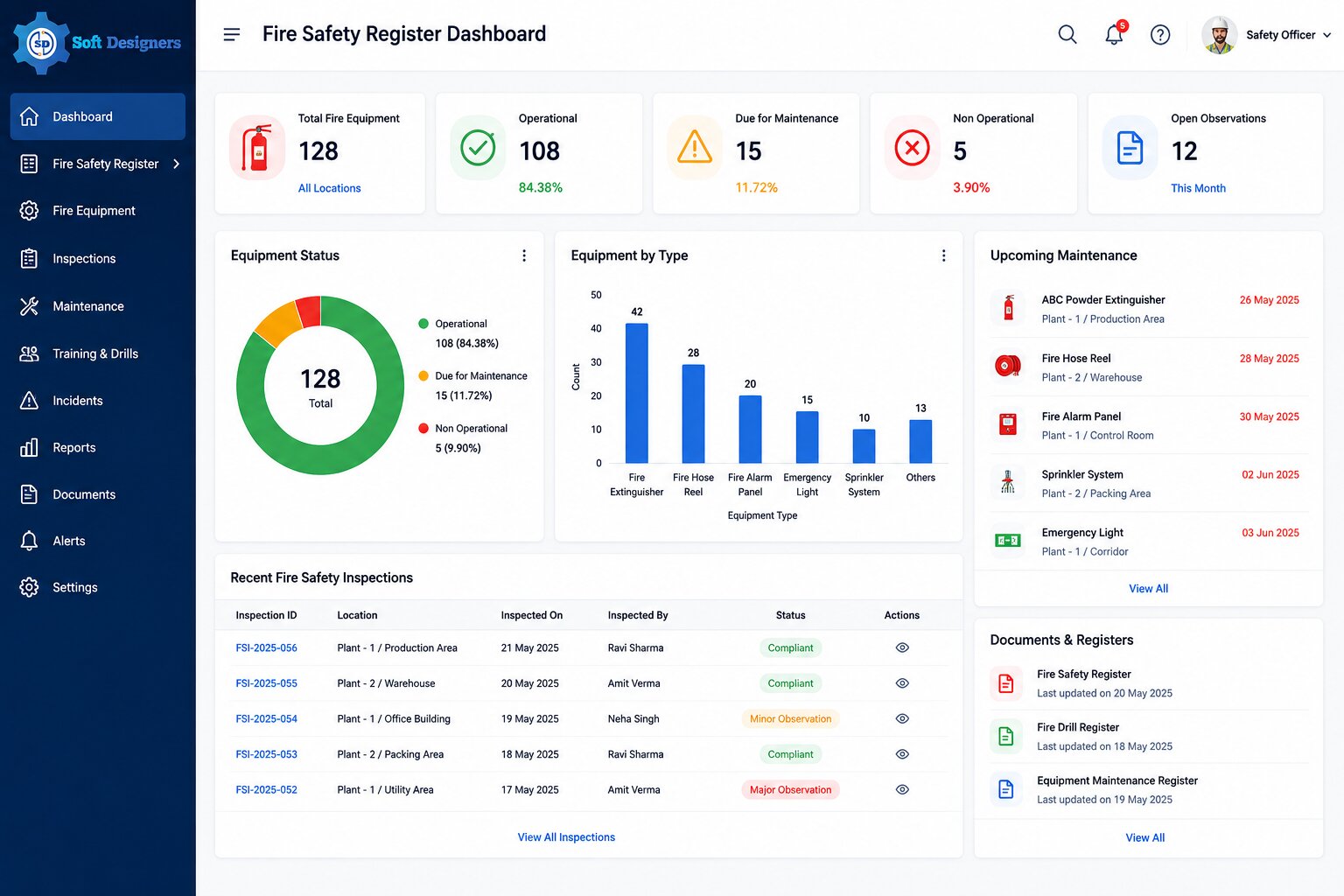
As more manufacturing plants adopt EHS management software, the Fire Safety Register is increasingly managed as a centralized, cloud-based module rather than a physical logbook. Safety managers and authorized personnel can log in from a desktop or mobile device to view real-time equipment status, upcoming inspection due dates, and historical maintenance records for any zone in the facility. Shift supervisors and technicians can update inspection findings directly from the shop floor using mobile devices, checking off items on a digital fire safety inspection checklist, with entries automatically time-stamped and attributed to the user for accountability. Role-based access controls ensure that only authorized staff can modify records, while auditors or management can be granted read-only access to review compliance status without disrupting daily operations. This digital accessibility, often bundled within broader EHS compliance software, not only speeds up day-to-day fire safety management but also ensures the register is always current, searchable, and instantly available whenever it’s needed, whether for a routine check, an internal review, or an external audit.
Why a Digital Fire Safety Register Is Better Than a Manual One
Manual fire safety registers, typically maintained as paper logbooks or spreadsheets, come with inherent limitations that become more pronounced in a fast-paced manufacturing environment. Entries can be misplaced, illegible, or inconsistently filled out across shifts, and there’s no built-in way to flag an overdue inspection until someone manually reviews the records. A digital Fire Safety Register, delivered through modern EHS management software, removes these gaps by automating inspection reminders, instantly flagging overdue or non-compliant equipment, and maintaining a single, tamper-resistant source of truth accessible to authorized users at any time. It also eliminates the risk of lost or damaged paperwork, since records are stored securely in the cloud rather than a binder that can be misfiled or destroyed. For safety managers, this translates into faster audits, quicker identification of equipment issues, stronger fire safety compliance, and better visibility across a facility with multiple zones and shifts, advantages that a manual system simply cannot match at scale.
Conclusion
For safety managers in manufacturing, a Fire Safety Register is a frontline defense against one of the industry’s most serious operational risks. By systematically tracking equipment, enforcing inspection schedules, catching failures early, and maintaining compliance documentation, it gives EHS teams the visibility and control needed to run a safe, audit-ready facility. Features like scheduled registers and configurable formats, especially when delivered through dedicated EHS management software, make it practical to manage complex, multi-zone plants with varying equipment and risk levels.
In an industry where machinery, electrical systems, chemicals, and hot work are part of daily operations, maintaining an accurate, up-to-date Fire Safety Register isn’t just a best practice; it’s a critical component of fire safety compliance, fire risk management, protecting workers, safeguarding assets, and keeping production running without interruption.