
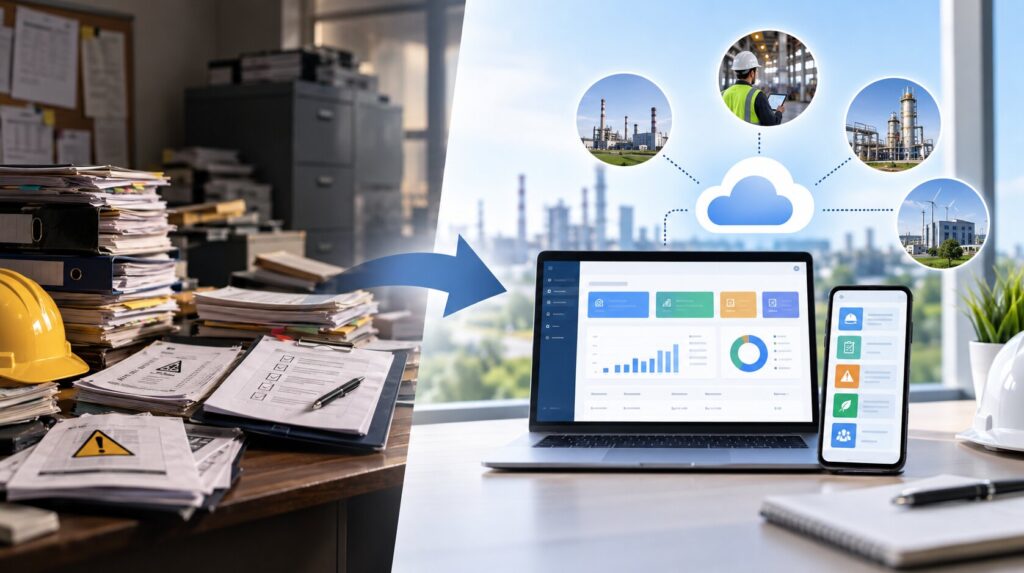
Environmental, health, and safety teams have historically run on paper forms, shared spreadsheets, and email chains. That approach worked when a single facility had a handful of permits to track and a few incidents to log each month. It breaks down the moment an organization grows to multiple sites, multiple shifts, and multiple regulatory frameworks. Digital EHS is the response to that breakdown: a cloud-based approach to managing safety, compliance, and risk that replaces disconnected paperwork with a single, real-time system of record.
This article explains what digital EHS actually means, why cloud-based delivery has become the default for safety software, and what to look for when evaluating a platform for your organization.
What Is Digital EHS?
Digital EHS refers to the use of software, rather than paper records and manual spreadsheets, to manage environmental, health, and safety processes across an organization. Instead of storing permits, inspection checklists, incident reports, and training records in filing cabinets or local files, a digital EHS system centralizes all of that data in one platform that every authorized user can access.
At its core, digital EHS covers the same activities safety teams have always handled, including permit to work, lockout tagout, incident reporting, risk assessment, audits, and training. What changes is how the work gets done. Forms become structured digital records. Approvals move through configurable workflows instead of physical signatures. Data that used to sit in a drawer becomes searchable, reportable, and available for trend analysis the moment it is entered.
Most digital EHS platforms today are delivered as cloud-based software, which is why the two terms are frequently used together. Cloud delivery is what makes a digital EHS system accessible from any site, on any device, without an organization having to run its own servers.
Why Companies Are Moving From Paper and Spreadsheets to Digital EHS
Paper-based and spreadsheet-based safety management carries hidden costs that only become obvious at scale. A single-site operation might manage with binders and Excel trackers, but a manufacturing group running multiple facilities across different states or countries runs into the same set of problems repeatedly.
- Data stays siloed at each location. A safety manager at head office cannot see incident trends, open corrective actions, or overdue inspections across sites without chasing down reports from each facility individually.
- Records are hard to retrieve during an audit. When a regulator or auditor asks for evidence of a specific inspection or permit from eighteen months ago, locating the correct paper file or spreadsheet version consumes hours that should be spent on the audit itself.
- Manual data entry introduces errors. Transcribing a paper checklist into a spreadsheet, or consolidating multiple site spreadsheets into one report, creates opportunities for transposed numbers, missed entries, and outdated versions circulating at the same time.
- There is no early warning system. Spreadsheets do not send alerts. A permit that is about to expire, a training certification that has lapsed, or a corrective action that has gone unaddressed for weeks stays invisible until someone happens to check.
- Scaling the safety program means scaling the paperwork. Every new facility, contractor group, or shift adds another set of physical records to maintain, file, and eventually retrieve.
Digital EHS addresses each of these problems directly by moving the data into one system that updates in real time and is visible to every authorized user, regardless of location.
Key Features of Cloud-Based Digital EHS Software
While specific modules vary between vendors, most digital EHS platforms share a common set of capabilities that distinguish them from paper-based processes.
- Centralized data access. All permits, inspections, incidents, audits, and training records live in one database, so any authorized user can pull up current and historical records without contacting another department.
- Cloud accessibility. Because the software runs on the vendor’s infrastructure and is accessed through a browser or mobile app, field teams, contractors, and site supervisors can log observations or complete checklists from wherever the work is happening.
- Configurable workflows. Permit approvals, corrective action assignments, and audit sign-offs follow rules the organization defines, so records move automatically to the right person instead of relying on someone remembering to forward a form.
- Automated notifications. The system flags expiring permits, overdue inspections, and unresolved corrective actions before they become compliance gaps, rather than after an auditor finds them.
- Real-time dashboards and reporting. Leadership can view incident trends, audit completion rates, and open action items across every site from a single dashboard, without waiting for someone to compile a manual report.
- Data security and backup. Cloud vendors handle encryption, access controls, and automated backups as part of the subscription, removing the burden of maintaining that infrastructure internally.
- Subscription-based deployment. Organizations pay a recurring fee tied to usage rather than a large upfront licensing and hardware cost, which lowers the barrier to adoption and lets the software scale with the organization.
Digital EHS vs. Traditional Paper-Based Safety Management
The practical difference between the two approaches becomes clearest when placed side by side.
| Factor | Paper and Spreadsheets | Digital EHS Software |
|---|---|---|
| Data visibility | Limited to one site or one file at a time | Centralized and accessible across all sites |
| Audit preparation | Manual file retrieval, often incomplete | Records retrievable in minutes with full history |
| Error rate | High, due to manual transcription | Reduced through structured digital forms |
| Alerts for expiring items | None; relies on manual tracking | Automated notifications before deadlines |
| Scalability | Adding sites multiplies paperwork | New sites and users added within the same platform |
| Upfront cost | Low software cost, high hidden labor cost | Subscription-based, predictable operating cost |
| Reporting | Manually compiled, time-consuming | Real-time dashboards and exportable reports |
Business Benefits of Digital EHS Software
Beyond replacing paper, a digital EHS system changes how the safety function operates day to day.
- Faster response to incidents and hazards. Field teams can log a near miss or hazard observation immediately from a mobile device, which means corrective action can start the same day instead of after the next scheduled meeting.
- Stronger regulatory compliance. Digital records with timestamps, approval trails, and automated retention make it straightforward to demonstrate compliance during an inspection or audit.
- Better visibility for leadership. Executives and EHS managers get a consolidated view of safety performance across the organization, which supports decisions about where to invest in training, equipment, or process changes.
- Lower total cost of ownership. Eliminating server hardware, IT maintenance, and physical storage, combined with a predictable subscription fee, generally costs less over time than maintaining manual systems at scale.
- Improved worker engagement. A simple mobile interface makes it easier for frontline workers to report observations and complete checklists, which increases participation compared to paper forms that often get set aside.
- Data-driven risk management. With historical data centralized, EHS teams can identify recurring hazards, high-risk locations, or process gaps that would be difficult to spot when records are scattered across individual sites.
Regulatory Alignment
Digital EHS platforms are typically built to support the documentation and traceability requirements set out in major safety and environmental standards, including OSHA recordkeeping rules and international management system standards such as ISO 45001 and ISO 14001.
| Standard | What It Requires | How Digital EHS Supports It |
|---|---|---|
| OSHA recordkeeping (29 CFR 1904) | Timely, accurate logging of workplace injuries and illnesses | Structured incident forms with timestamps and audit trails |
| ISO 45001 | Documented occupational health and safety management system | Centralized records for risk assessments, audits, and corrective actions |
| ISO 14001 | Documented environmental management processes | Centralized tracking of environmental permits and monitoring data |
Maintaining this level of documentation manually is possible, but it requires significant administrative effort to keep records current and retrievable. A digital system builds the documentation trail into the daily workflow, rather than treating it as a separate task.
Which Industries Benefit Most From Digital EHS
Digital EHS software delivers the most value in industries where safety programs span multiple facilities, involve contractor workforces, or operate under heavy regulatory scrutiny. This includes manufacturing, oil and gas, chemical processing, construction, shipbuilding, cement, mining, and pharmaceuticals, among others. In each of these sectors, the combination of distributed operations and strict compliance obligations is exactly what makes a centralized digital system more effective than site-by-site paper tracking.
How to Choose the Right Digital EHS Software
Not every platform fits every organization. A few criteria are worth evaluating before committing to a vendor.
- Module coverage. Confirm the platform covers the specific processes your organization needs, such as permit to work, lockout/tagout, incident management, or audits, rather than only a subset.
- Ease of use for frontline workers. A system that is difficult to use in the field will see low adoption regardless of how capable it is on paper, so mobile usability matters as much as backend functionality.
- Configurability. Workflows, forms, and approval chains should be adjustable to match how your organization actually operates, rather than forcing a fixed process onto every site.
- Integration capability. The platform should be able to connect with existing systems such as HR, maintenance, or ERP software to avoid duplicate data entry.
- Vendor support and implementation. Look for a vendor that provides hands-on onboarding and ongoing support, since the rollout across multiple sites is where most digital EHS initiatives succeed or stall.
- Trial access. A genuine free trial period allows your team to test the software against real workflows before making a long-term commitment.
Final Thoughts
Digital EHS is no longer a forward-looking concept for large enterprises alone. As regulatory requirements grow more detailed and operations spread across more sites and contractor groups, paper-based tracking becomes a liability rather than a simple inconvenience. A cloud-based digital EHS platform gives safety teams the centralized visibility, automated alerts, and audit-ready records that manual systems cannot provide at scale, while keeping the cost of adoption predictable through a subscription model.
Soft Designers helps organizations across manufacturing, oil and gas, construction, and other regulated industries move from paper-based safety management to a fully digital EHS system built around their existing workflows. Explore Soft Designers’ EHS Software or request a demo to see how a digital EHS platform fits your operation.
Cloud-Based EHS Software FAQ
Cloud-based EHS software is a digital platform that allows organizations to manage environmental, health, and safety processes online. It centralizes data, enables real-time monitoring, and provides access from any internet-connected device.
Companies switch to digital EHS software to eliminate manual paperwork, reduce data entry errors, and improve efficiency. Digital systems automate workflows, increase visibility across sites, and help organizations manage risk and compliance proactively rather than reactively.
Cloud-based EHS systems offer real-time data access, scalability across multiple sites, improved collaboration between teams, automated reporting, and stronger data security than manual, file-based systems.
Yes. Cloud-based EHS software can be accessed from mobile devices, tablets, or desktops from any location, allowing teams to report incidents, complete audits, and monitor safety performance in real time, including from remote sites.
It improves workplace safety by enabling real-time incident and hazard reporting, structured risk assessments, and immediate visibility into open corrective actions. Teams can act on issues as they arise instead of discovering them during a periodic review.
Yes. Cloud-based EHS platforms are built to scale, supporting additional sites, users, and processes without the infrastructure investment a growing organization would otherwise need to make in-house.