
For decades, workplace safety teams have leaned on supervisors, spot checks, and after-the-fact incident reports to confirm that workers are wearing the personal protective equipment their jobs require. That approach has a built-in blind spot: it catches non-compliance once someone has already been exposed to risk. An AI-powered PPE detection system closes that gap. It watches every zone continuously and flags missing gear the moment it appears on camera, instead of waiting for the next scheduled walk-through. This article covers what these systems are, how they work, where they sit within existing regulatory frameworks, and what organizations should weigh before adopting one.
What Is an AI-Powered PPE Detection System
An AI-powered PPE detection system is a computer vision solution that continuously analyzes live camera feeds to confirm whether workers in a monitored area are wearing the protective equipment required for that zone. Rather than depending on a supervisor’s line of sight or a periodic audit, the system evaluates every frame in near real time and generates an alert the moment it identifies a compliance gap.
The system typically verifies three broad categories of equipment. Safety helmets are checked in zones where head protection is mandatory, with the model distinguishing a bare head from one covered by a compliant helmet, and in more advanced deployments, confirming that the chin strap is fastened. Safety vests are checked for presence and, in some configurations, for color coding that indicates a worker’s role or authorization level within a site. In processing, welding, or chemical handling environments, detection extends further to safety aprons, face shields, gloves, and other equipment specific to the task being performed.
How PPE Detection Technology Works
Understanding how an AI-powered PPE detection system functions in practice helps safety managers set realistic expectations for deployment and performance. The workflow generally follows five stages.
The process begins with monitoring: cameras positioned across designated zones capture continuous video of workers as they move through the facility, with coverage typically concentrated in high-risk areas such as confined spaces, elevated work platforms, and machinery zones where PPE requirements are strictest. From there, the system moves into detection, where the AI model processes each frame to identify people and cross-reference them against the PPE requirements configured for that specific zone, drawing on detection models trained on large datasets of PPE imagery so they can recognize equipment across different body types, angles, and partial occlusions.
When the system identifies a worker without required equipment, it moves to the alert stage, generating a notification in real time that is typically routed to a supervisor’s dashboard, a mobile notification, or an on-site display, depending on how the deployment is configured. If that alert is not acknowledged or the non-compliance persists beyond a defined window, the system escalates the notification, often to a higher tier of management or a centralized safety operations team, so that gaps do not sit unresolved. Finally, in the analysis stage, the system logs every detection event, building a dataset that safety teams can later mine for patterns across zones, shifts, and time periods.
Camera compatibility is a practical factor that determines how easily an organization can deploy this technology across an existing site. Most modern platforms work with RTSP streams (An RTSP (Real-Time Streaming Protocol) stream is a network control protocol designed to manage real-time live audio and video feeds from devices like IP security cameras) and standard IP cameras, so many facilities can extend PPE detection to their current camera infrastructure without a full hardware replacement. Multi-camera support lets a single system monitor dozens or hundreds of feeds simultaneously, while centralized and remote management gives safety leadership visibility across multiple facilities from one dashboard, a real advantage for organizations with operations spread across regions or countries.
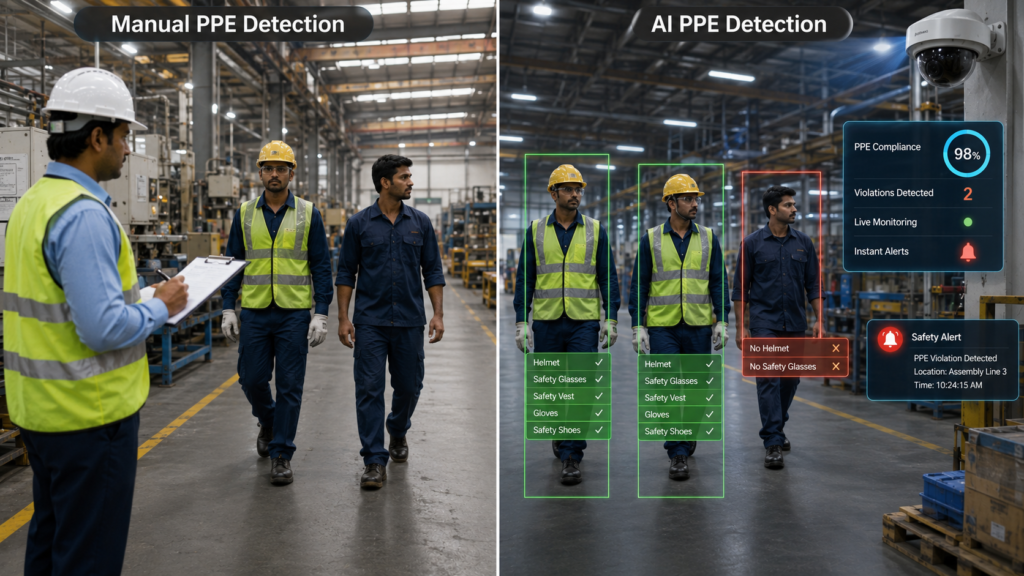
Manual PPE Checks vs. AI-Powered Detection
The table below outlines how manual compliance checks compare against an AI-powered PPE detection system across the dimensions that matter most to safety leaders.
| Parameter | Manual PPE Checks | AI-Powered PPE Detection |
|---|---|---|
| Coverage | Limited to scheduled walk-throughs or spot audits, so a zone may go unchecked for hours between rounds, leaving gaps in visibility during that window. | Continuous monitoring across every connected zone at once, so no area depends on a supervisor physically being present to catch a compliance gap. (A compliance gap is the difference between an organization's current business practices and the rules it must follow.) |
| Response time | Typically minutes to hours after non-compliance occurs, since the issue is only caught whenever the next scheduled check happens to take place. | Near real-time alerting as the system detects the gap, letting corrective action begin almost immediately. |
| Consistency | Varies by individual supervisor attentiveness, fatigue, and shift. The same PPE gap might get caught on one round and missed on the next. | Applies the same detection criteria uniformly across every zone and shift, removing variability that depends on which person happens to be checking. |
| Documentation | Relies on manual logs that are often incomplete, inconsistently filled out, or recorded well after the observation actually took place. | Generates automatic, timestamped digital records of every detection event, creating a reliable audit trail without added administrative work. |
| Scalability | Requires hiring or reassigning additional personnel to cover each new zone, which makes expansion to new areas or sites costly and slow. | Scales across additional zones and sites simply by adding camera feeds to the platform, without a proportional increase in supervisory headcount. |
| Trend data | Sparse and difficult to aggregate, since paper or spreadsheet-based logs rarely capture enough structured detail to support meaningful analysis. | Produces a rich, structured dataset that supports heatmaps, hot-spot identification, and trend analysis across zones, shifts, and time periods. |
| Labor dependency | High, since consistent coverage depends entirely on the availability and diligence of supervisory staff on any given day. | Reduced substantially, though human review of alerts and judgment on escalations remains an essential part of the workflow. |
This comparison is not an argument that human oversight becomes unnecessary. Supervisors still make judgment calls, manage escalations, and interpret ambiguous situations that a model may flag incorrectly. What changes is the volume of routine, continuous checking that no longer depends entirely on a person physically walking the floor.
Regulatory and Compliance Context for AI-Powered PPE Detection
Any organization evaluating an AI-powered PPE detection system needs to understand where it fits within existing regulatory obligations, since the technology supports compliance but does not redefine it. The table below outlines the key frameworks at play and how detection technology supports each one.
| Framework / Requirement | What It Covers | How AI-Powered PPE Detection Supports It |
|---|---|---|
| OSHA PPE Standards (29 CFR 1910.132) | Requires employers to assess workplace hazards and to provide, maintain, and enforce the use of appropriate personal protective equipment. The compliance obligation sits squarely with the employer. | Functions as a monitoring and enforcement tool that helps organizations demonstrate they are actively verifying PPE adherence in real time. It supports the standard's enforcement requirement but does not replace the hazard assessment and PPE program the standard itself requires. |
| ISO 45001 Risk-Control Hierarchy | Places PPE at the bottom tier of controls, below elimination, substitution, engineering controls, and administrative controls. PPE is treated as a last line of defense, not a primary safeguard. | Reinforces adherence (Reinforcing adherence means strengthening a person's habit of following a medical or treatment plan) at that last line of defense by catching gaps continuously but should not be treated as a substitute for investing in higher-order controls that reduce hazards at their source. |
| Privacy-First Design (GDPR and similar frameworks) | Governs how organizations, particularly those operating in the EU or with EU-based workers, may collect, process, and retain video and biometric data captured from employees. | Responsible deployments build in face blurring or anonymization. (Data anonymization is the process of removing or changing personal details like names and addresses so that no one can link the data back to a real person) at the point of processing, define clear data retention periods, apply secure data handling practices, and communicate openly with workers about what is monitored and why. |
Taken together, these frameworks make clear that an AI-powered PPE detection system is a compliance support tool, not a compliance strategy on its own. It works best when layered on top of a hazard assessment process, a hierarchy-of-controls approach, and a data protection policy that already reflects an organization’s regulatory obligations.
Benefits of an AI-Powered PPE Detection System
The operational case for adopting this technology extends well beyond simple compliance checking.
- Reduced workplace accidents: continuous verification catches PPE gaps before they contribute to an injury. The system flags a missing helmet or vest the moment it appears on camera, so supervisors can step in while the worker is still in a low-risk moment, well before a near miss or injury report would have surfaced the problem.
- Elimination of manual monitoring: safety staff are freed from constant, repetitive visual checks and can redirect that time toward higher-value work such as root cause analysis, safety coaching, and program improvement. This also reduces the risk that fatigue or competing priorities cause a supervisor to miss a compliance gap during a busy shift.
- Faster corrective action through escalation: automated escalation gets unresolved compliance gaps to the right person quickly, without waiting for the next shift handover or scheduled report. A gap that might once have sat unaddressed for hours instead reaches a decision-maker within minutes, cutting down the time a worker remains exposed.
- Proactive safety management: because the system generates data continuously, safety teams shift from reacting to incidents that have already happened to identifying risk patterns before they result in harm. This changes the posture of the safety function from investigating what went wrong to intervening before something goes wrong at all.
- Scalability across facilities: a cloud-connected, centrally managed detection system can extend to new sites or zones by adding camera feeds, without a proportional increase in supervisory headcount. This makes it practical for organizations to standardize PPE enforcement across multiple facilities, including sites in different regions, without building a separate monitoring team at each one.
- Leading indicators: the detection data itself works as a leading indicator, giving safety leadership a forward-looking measure of PPE compliance to sit alongside lagging indicators such as recordable injuries. Tracking compliance rates over time gives management an early signal of where risk is building before that risk ever shows up in an incident statistic.
- Identifying hot spots: aggregated detection data reveals which zones generate the highest volume of non-compliance events, so safety teams can target interventions where they matter most instead of spreading resources evenly across a site. A zone with consistent repeat violations can be flagged for additional signage, retraining, or engineering controls, on top of monitoring.
- Heatmaps: visual heatmaps built from camera data show where employees spend the most time and where movement concentrates, helping safety and operations teams understand traffic patterns alongside compliance data. Overlaying compliance events on top of movement data can reveal non-compliance clusters (non-compliance clusters refer to grouped or concentrated patterns where rules, treatments, or regulatory standards are repeatedly ignored or unfulfilled) around specific pathways, entry points, or workstations.
- Trend analysis: historical detection data supports trend analysis across shifts, seasons, and zones, giving safety committees evidence for where policy changes or additional training would have the greatest impact. Recurring patterns, such as higher non-compliance on night shifts or during particular seasons, become visible in a way that manual spot checks rarely surface.
- Real alarms with speakers: some deployments pair detection (Deployment pair detection usually refers to Inline Pair Mode used in cybersecurity to deploy Intrusion Detection and Prevention Systems (IDS/IPS)) with audible alerts at the point of non-compliance, prompting immediate correction on the spot instead of only through a dashboard notification. This proves especially useful in high-noise or high-traffic areas, where a worker might not otherwise notice a missed piece of equipment until someone points it out directly.
- Interlocking with doors: in higher-risk zones, detection systems can be integrated with door or turnstile access controls (A turnstile access control system is a physical security gate that regulates pedestrian entry one person at a time using tripod turnstiles, swing barriers, or flap barriers integrated with electronic authentications). so that entry is physically restricted until required PPE is confirmed. This converts PPE enforcement from an after-the-fact correction into a hard control that prevents entry into a hazardous area altogether.
- Alert notifications: configurable notifications through mobile apps, email, or on-site displays ensure the right people are informed immediately, based on zone, shift, or role. Routing rules can be tailored so that a floor supervisor receives an immediate mobile alert while a site-wide summary reaches management on a scheduled basis.
Note: real-time camera detection is the technical backbone that makes the benefits above possible. Running continuous object detection across multiple simultaneous camera feeds requires meaningful GPU (a graphics processing unit (GPU) is a specialized electronic chip designed to accelerate digital image processing, computer graphics, and parallel mathematical calculations) compute, which is why many deployments rely on hardware from providers such as Nvidia to handle the inference (an educated guess or conclusion you form using clues, evidence, and what you already know) workload at the speed live monitoring requires.
Challenges and Limitations of AI-Powered PPE Detection System
No detection technology is without trade-offs, and organizations considering an AI-powered PPE detection system should evaluate these honestly before deployment.
- False positives: models can misclassify PPE, particularly with unusual gear combinations, partial occlusion (Partial occlusion occurs when an object or sensor’s field of view is obstructed, yielding incomplete data), or equipment that visually resembles compliant items without meeting the required standard. Ongoing model tuning helps, but false positives are unlikely to reach zero, and safety teams should plan for a human review step in the alert workflow.
- Camera placement and lighting constraints: detection accuracy depends heavily on camera angle, distance, and lighting conditions. Poorly lit zones, glare, or obstructed sightlines (Obstructed sightlines occur when physical barriers block a clear view of an area) can all reduce detection reliability, so camera placement needs to be treated as a genuine engineering exercise up front.
- Workforce privacy concerns: continuous video monitoring of employees can raise legitimate concerns about surveillance, even when the stated purpose is safety. Organizations need clear policies, worker communication, and privacy-protective technical design to maintain trust alongside compliance.
- Recursive learning and model retraining: detection models degrade over time as PPE styles change, new equipment types are introduced, or camera hardware is replaced. Sustained accuracy calls for models to be retrained on a regular schedule with fresh footage and updated PPE examples, not deployed once and left alone, and organizations should budget for that as an ongoing cost rather than a one-time expense.
How Softdesigners Approaches AI-Powered PPE Detection
Softdesigners builds its AI-powered PPE detection capability as part of a connected EHS ecosystem, not a standalone camera feed.
- Integration with incident management, near-miss reporting, and CAPA: detection events do not sit in isolation. A confirmed non-compliance can be linked directly to incident records, near-miss logs, or a corrective and preventive action workflow, giving safety teams a closed loop from detection to resolution instead of a disconnected alert that needs manual follow-up in a separate system.
- Zone- and camera-level configurability: different areas of a facility carry different PPE requirements, and the platform allows administrators to configure detection rules at the individual zone or camera level, so a warehouse aisle and an adjacent welding bay (an adjacent welding bay refers to a designated welding work area located immediately next to or sharing a border with another workspace) can each enforce the equipment relevant to their specific hazards.
- Escalation matrix: the platform moves beyond a flat notification structure with a configurable escalation matrix (an escalation matrix is a clear step-by-step guide that shows who to contact when a problem cannot be fixed right away), routing alerts based on severity, zone, and how long a compliance gap has gone unaddressed so unresolved issues reach the appropriate level of management automatically.
Conclusion
An AI-powered PPE detection system gives safety teams continuous, real-time visibility into PPE compliance that manual checks were never able to provide consistently. Instead of depending on scheduled walk-throughs and the attentiveness of whoever happens to be on shift, the technology watches every connected zone at once and surfaces gaps the moment they occur, turning PPE enforcement from a periodic check into an ongoing safeguard.
The technology fits within existing regulatory frameworks like OSHA’s 29 CFR 1910.132 and ISO 45001’s hierarchy of controls; it does not replace them. It supports the enforcement and monitoring obligations those frameworks already require, but it is no substitute for the underlying hazard assessment, higher-order controls, or the PPE program itself. Its greatest value comes from pairing detection data with structured escalation and corrective action, not from the camera feed alone. A detection that never reaches the right person, or never triggers a documented follow-up, delivers little more than the manual process it was meant to improve.
Organizations evaluating this technology should weigh the genuine benefits in accident reduction, labor efficiency, and trend visibility against real constraints around false positives, camera placement, and privacy. None of those constraints argue against adopting the technology outright; they argue for planning deployment carefully, budgeting for ongoing model maintenance, and building clear worker communication into the rollout from the start. The organizations that get the most value from an AI-powered PPE detection system select a platform built to integrate with the broader EHS management system, linking detection directly to incident records, near-miss reporting, and CAPA workflows, instead of running it as an isolated monitoring tool.