
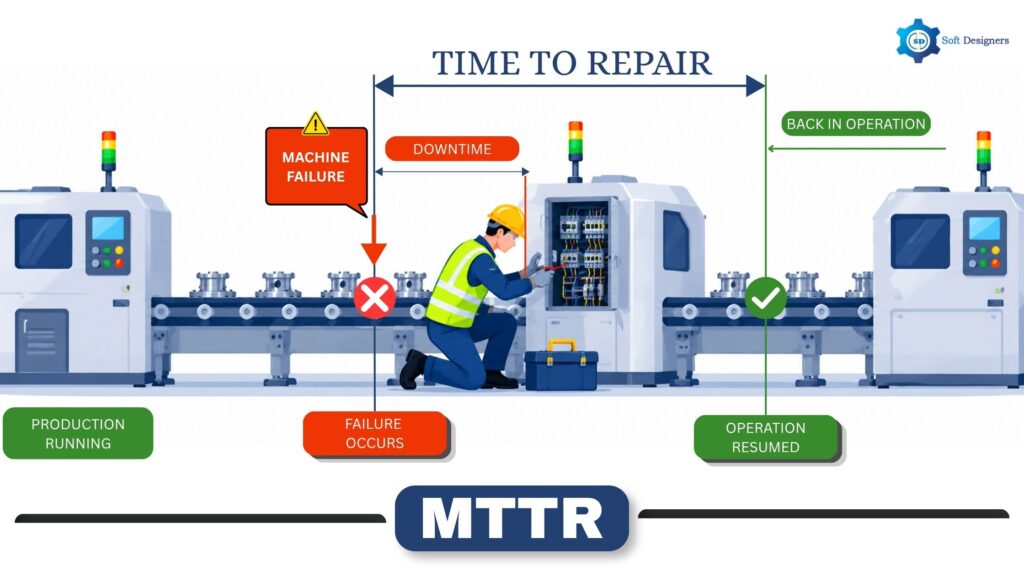
Every manufacturing unit faces equipment breakdowns, and MTTR, short for Mean Time to Repair, measures how long it takes to restore failed machinery, which decides how much output is lost. A stopped press, a tripped drive, or a failed conveyor sensor delays more than one operation. Downstream stations wait for material, schedules slip, and supervisors spend hours rearranging work instead of managing production.
MTTR represents the average time required to repair equipment after a failure has occurred. Instead of judging repair performance from the memory of a few difficult breakdowns, it converts repair records into one comparable figure for a machine, a line, or a plant.
Monitoring average repair duration matters because breakdown frequency alone does not reveal how disruptive failures are. Two machines may fail equally often, yet one returns to service quickly while the other stays idle for long stretches. MTTR in manufacturing exposes that difference and gives maintenance managers a factual basis for reviewing spare parts, technician skills, repair procedures, and communication practices. It also shows how much equipment downtime is caused by slow repairs rather than by the failures themselves. Production Monitoring Software shows when and where machines stop, while MTTR explains how long recovery takes.
What Is MTTR (Mean Time to Repair)?
MTTR stands for Mean Time to Repair. In simple technical terms, it is the average duration required to repair a failed machine and return it to its intended operating condition. The word mean indicates an arithmetic average, calculated across a set of repair events rather than a single failure.
A single repair says little. One breakdown may be solved in minutes because a technician replaced a loose connector, while another may take a full shift because a gearbox had to be opened. Averaging repair durations across multiple failures smooths out these extremes and shows the typical equipment repair time for a given machine over a defined period.
The boundaries of repair time must be defined clearly. Repair time begins when maintenance work on the failure starts or, in some plants, when the breakdown is reported. It ends when the machine is repaired and ready to resume production. Either convention is acceptable as long as it is applied consistently, because mixed conventions make comparisons meaningless.
A further distinction separates actual repair time from waiting time. Hands-on diagnosis and correction is the true repair effort. Time spent waiting for a technician to arrive, for a spare part to be issued, or for a permit to be approved is waiting time, and it reflects maintenance response time and logistics rather than technical effort. Some plants include this delay in repair duration, while others track it separately. An Andon System that records when an issue is raised, acknowledged, and closed makes the split between waiting time and repair time visible. The choice matters because a long MTTR driven by waiting points to communication and stores problems, whereas one driven by hands-on work points to skills, equipment design, or procedures.
Used properly, MTTR provides measurable visibility into repair performance. It turns the impression that a machine takes a long time to fix into a number that can be tracked, compared between machines, and reviewed after improvement actions.
How to Calculate MTTR in Manufacturing
The MTTR calculation relies on a straightforward formula:
MTTR = Total Repair Time ÷ Number of Repairs
Total repair time is the sum of the repair durations of every breakdown recorded on the machine during the chosen period. Number of repairs is the count of breakdowns repaired in that same period. Both values must come from the same machine and the same reporting window for the MTTR formula to give a meaningful result.
Consider a machine with four recorded breakdowns:
| Breakdown | Repair Time (hours) |
|---|---|
| Breakdown 1 | 2 |
| Breakdown 2 | 3 |
| Breakdown 3 | 1 |
| Breakdown 4 | 2 |
| Total repair time | 8 |
| Number of repairs | 4 |
| MTTR (8 ÷ 4) | 2 hours |
Total repair time is 8 hours, so MTTR = 8 ÷ 4 = 2 hours. The machine required an average of two hours to complete repairs across the four recorded breakdowns.
The accuracy of the result depends entirely on the accuracy of the records. If start and completion times are estimated at the end of a shift, rounded loosely, or left blank, the average misrepresents real repair performance. Reliable MTTR tracking therefore begins with disciplined capture of timestamps when repairs start and finish, along with a consistent rule for what the interval includes. A formula applied to unreliable data produces a precise-looking number of little practical value. Andon Software that records issue response times and closure details can supply these timestamps, which reduces reliance on shift-end estimates.
Why Is MTTR Important in Manufacturing?
MTTR gives maintenance and production leadership a common reference for discussing repair performance. Its value lies in the decisions it supports.
- Understanding average repair duration: A plant that knows how long repairs typically take on each machine can set realistic expectations during breakdowns instead of relying on assumptions.
- Evaluating maintenance team performance: Trends in repair duration show whether diagnosis and correction are improving or slipping. Interpreting maintenance performance still requires context, since a rise may reflect a more complex failure mix rather than weaker execution.
- Identifying machines with longer repair times: Comparing MTTR across machines highlights equipment that consistently takes long to restore, often because of design complexity, poor access, or missing spares.
- Understanding operational impact: Each additional hour of repair extends stoppages and pushes delays into downstream processes. MTTR links maintenance activity with production loss.
- Supporting production planning: Planners can build realistic buffers and recovery plans for critical machines when typical repair durations are known.
- Finding improvement opportunities: A high MTTR directs attention to specific causes such as delayed fault identification, parts shortages, or unclear procedures.
- Establishing equipment-specific targets: Machines differ in complexity, so targets should be set machine by machine, based on historical records and repair requirements.
MTTR does not describe total equipment availability on its own. It speaks only to repair duration and must be read alongside other performance information. OEE Monitoring, which reports availability, performance, and quality, supplies that wider view.
What Factors Affect MTTR in Manufacturing?
Repair duration is shaped by a combination of technical, logistical, and organisational factors.
- Fault identification: Locating the actual failure often takes the largest share of machine breakdown repair. Clear symptoms and systematic troubleshooting shorten it, while intermittent faults lengthen it.
- Availability of spare parts: A repair stalls when a component must be fetched from a distant store or ordered from a supplier. Stocked critical spares remove that delay.
- Technical expertise: Experienced technicians recognise failure patterns quickly, whereas limited skills on specialised equipment extend diagnosis and cause rework.
- Equipment complexity: Machines with integrated hydraulics, drives, and controls take longer to repair than simple mechanical assemblies, so comparisons must respect this difference.
- Repair procedures: Documented standard steps reduce variation between technicians. Absent procedures lead to improvisation and inconsistent durations.
- Access to repair information: Manuals, drawings, and past repair history within easy reach save time. Searching for documents during a breakdown adds avoidable delay.
- Error diagnostics: Machine alarms and fault codes point technicians toward the likely cause. Poor or ambiguous diagnostics force manual inspection.
- Vendor support: Equipment from external suppliers may need specialist assistance. Responsive vendor support shortens complex repairs, while slow support prolongs them.
- Service level agreements (SLAs): Contracts that define response and resolution times for vendor service determine how quickly outside help arrives. Clear and enforced SLAs reduce uncertainty, while weak terms allow open-ended delays.
These factors rarely act alone, so a rising MTTR is best investigated factor by factor. Predictive Maintenance Software can help anticipate failures, but it does not alter the repair time that MTTR measures.
How to Improve and Reduce MTTR in Manufacturing
Understanding how to reduce MTTR begins with the stages between the moment a machine stops and the moment production resumes. Sustained MTTR improvement usually comes from the following measures.
- Faster fault identification and systematic troubleshooting: Structured diagnostic steps, supported by fault codes and past case history, shorten the search for the cause.
- Critical spare parts: Stocking critical spares near high-risk machines removes procurement delays.
- Technician training: Regular skill development on specific equipment reduces diagnostic errors and rework.
- Standardised repair procedures: Written steps keep repairs aligned with the proven method rather than individual habit.
- Better communication: A breakdown reported late or to the wrong person adds waiting time before any repair begins.
- Review of recurring failures: Repeated failures on one machine reveal root causes that, once corrected, remove whole categories of repair events.
- Digital breakdown reporting and escalation: Structured breakdown reporting replaces verbal calls and paper slips.
This is where Andon Software becomes relevant. Soft Designers’ Andon Software allows operators to raise a machine issue from a tablet, smart workstation, or connected equipment. Tower lights and notifications through the mobile app, SMS, or WhatsApp inform responsible personnel, who acknowledge the issue and close it after corrective action.
Issues unresolved beyond configured thresholds escalate automatically to the next management level. Dashboards show active issues, while historical records of categories, response times, corrective actions, and closure details support MTTR review. The AI Solution Advisor draws on past issue and resolution information to help maintenance teams find relevant corrective actions.
An Andon System supports breakdown communication and repair coordination. It does not repair equipment, and it cannot guarantee a lower MTTR, because results still depend on spares, skills, and procedures behind the alerts.
Predictive Maintenance Software is different from MTTR. Predictive maintenance uses equipment condition information and historical failure patterns to anticipate potential failures, whereas MTTR measures average repair duration after failures occur.
Production Monitoring Software and OEE Monitoring complement MTTR analysis without calculating MTTR. Production visibility highlights which machines stop often, directing repair reviews toward the right equipment. OEE Monitoring reports equipment performance information, such as availability, performance, and quality, which adds context to repair-duration findings.
How to Monitor and Track MTTR in Manufacturing?
Effective MTTR monitoring depends on a disciplined, repeatable process.
- Record repair start and completion times for every breakdown when it occurs.
- Collect repair information separately for each machine.
- Calculate MTTR from consistent records and a fixed reporting period.
- Maintain historical MTTR information to allow comparison across months and shifts.
- Review trends and watch for steadily increasing repair durations.
- Use digital maintenance tools or Andon Software so that records are captured at the source rather than recalled at shift end.
Targets complete the process. Each machine should receive its own MTTR target, based on its complexity, repair requirements, and history. No universal figure applies to every machine, since a simple conveyor and a multi-axis machining centre differ widely. Actual MTTR is then compared against the acceptable repair-time threshold for that equipment, and any rise beyond the target should trigger an investigation into causes such as parts shortages, delayed response, or a new failure mode.
Dashboards and historical reports make this review practical. Dashboards show current open issues and their status, while historical reports reveal patterns across weeks and months. Together they help maintenance managers move from reacting to individual breakdowns toward managing repair performance as a continuing discipline. Production Monitoring Software can flag machines with frequent stoppages so that their repair records receive priority review.
Common Mistakes to Avoid When Measuring MTTR
Several recurring errors weaken MTTR figures.
- Inaccurate times: Estimated or rounded start and completion times distort totals.
- Incomplete records: Missing entries silently raise or lower the average.
- Incorrect repair counts: Treating one prolonged breakdown as several events, or the reverse, changes the divisor.
- Combined machines: Pooling records from dissimilar machines hides problem equipment.
- Ignored reporting periods: Comparing periods of unequal length or operating hours leads to wrong conclusions.
- Manual dependence: Spreadsheets and paper records invite transcription errors, lost sheets, and delayed entries.
- Ignored trends: Measuring without investigating rising MTTR makes the exercise pointless.
- Ignoring Short-Duration Breakdowns: Ignoring short-duration breakdowns, such as 10–15-minute stoppages, can lead to inaccurate MTTR calculations.
Digital breakdown reporting addresses many of these problems. Andon Software records each issue with its category, responsible personnel, response times, corrective actions, and closure details in one organised place, and the same workflow applies to every machine and shift. Consistent records produce MTTR figures that can be trusted and compared. Because each event carries a closure record, gaps in data become visible quickly, and reviews can concentrate on the causes of long repairs instead of on reconciling conflicting sheets.
Conclusion
MTTR gives manufacturers a measurable view of how long equipment stays out of service once a failure occurs. The figure is only as reliable as the repair records behind it, so accurate start and completion times matter. Fault identification, spare parts, skills, procedures, information access, and vendor support all influence repair duration. Practical improvement comes from systematic troubleshooting, trained technicians, standard procedures, and strong communication.
Digital Andon systems add breakdown visibility and repair coordination, helping plants record issues consistently and review MTTR with confidence. Manufacturers that treat MTTR as a regular management measure, supported by reliable records, are better placed to shorten repairs and protect production schedules.
Improve equipment reliability and streamline maintenance operations with Soft Designers’ smart manufacturing software solutions.