
Production downtime is one of the most persistent challenges on any manufacturing floor. A stopped machine, a stalled line, or a delayed process interruption does not just cost the minutes it is visibly down. It also costs the time spent noticing the problem, finding the right person, and getting that person to the affected station. Andon Software addresses this exact gap by giving production teams a faster, more structured way to identify and respond to shop floor problems.
Downtime rarely comes from a single dramatic event. More often, it accumulates from a combination of causes, including:
- Machine breakdowns
- Minor process interruptions
- Material shortages
- Stops caused by quality problems
- Delayed maintenance response
In many plants, the sequence looks familiar: an operator notices an issue, walks over to find a supervisor, the supervisor tries to reach maintenance, and maintenance personnel then locate the affected machine before troubleshooting even begins. Each handoff adds waiting time that has nothing to do with fixing the problem.
This is where the real opportunity lies. Faster issue visibility and a faster response, not just faster repairs, are what meaningfully reduce avoidable production downtime.
How Andon Software Speeds Up Identification and Reporting of Production Issues
| Aspect | Manual Reporting | Andon Software |
|---|---|---|
| Issue Reporting | Operator searches for a supervisor, makes a call, or reports verbally | Operator raises the issue directly from the workstation or device |
| Communication Speed | Reporting can be delayed | Issues can be communicated immediately |
| Information Captured | Details may be incomplete or inconsistent | Machine, station, line, issue type, and time can be recorded |
| Issue Visibility | Depends on verbal communication and individual awareness | Provides real-time visibility of reported issues |
| Response | Action begins after the responsible person becomes aware | Alerts can reach the relevant team for faster action |
| Issue Tracking | Records may be difficult to maintain and review | Issues are digitally recorded for tracking and analysis |
| Downtime Impact | Reporting delays can extend machine idle time | Faster reporting can help reduce avoidable downtime |
How Andon Software Enables Real-Time Alerts and Faster Response
Reporting an issue is only the first half of the equation. The information also needs to reach the right personnel without delay. This is where real-time alerts play their role, pushing notifications to supervisors, maintenance personnel, and other responsible teams as soon as an issue is raised.
In practice, the sequence becomes tighter:
- An issue occurs
- The issue is recognized and logged
- The responsible team becomes aware through an alert
- The team responds
Instead of depending on someone remembering to make a phone call or walk across the floor, the system carries that responsibility. Active issues also remain visible until they are formally addressed, so a report cannot simply be forgotten in the noise of a busy shift.
This shift away from manual communication matters more than it might first appear. A supervisor may be responsible for several lines at once, and a maintenance technician may already be occupied elsewhere when a new issue arises. Relying on someone to notice a missed call or walk past the right station at the right moment introduces variability that has nothing to do with the actual complexity of the repair. Real-time alerts remove much of that variability by making sure the notification reaches the responsible person directly, through the channel most likely to be seen immediately, whether that is a workstation screen, a mobile device, or a tower light visible from across the floor.
Consistency is also part of the value here. A verbal handoff can be delayed, misheard, or deprioritized depending on how busy a shift is running. A digital alert does not depend on memory or timing; it stays active until it is acted upon.
Every one of these steps connects back to a single outcome: reducing the amount of time a machine or production line sits idle while waiting for someone to respond.
How Andon Software Improves Shopfloor Visibility
A central part of this workflow is the shopfloor dashboard, which functions less like a simple screen and more like an operational command center for the plant. From this dashboard, manufacturing teams can see:
- Production issues that are still unresolved
- Machines or stations that currently need attention
- Current issue status: pending, in progress, or resolved
This is one of the areas where Andon Software provides a genuine operational advantage. Instead of supervisors and maintenance personnel relying entirely on verbal updates or walking the floor to locate a problem, the dashboard consolidates that information into one place. The result follows a clear chain: faster awareness leads to faster response, which leads to a shorter production interruption.
For a plant manager overseeing several lines, this consolidated view changes how the shift is managed. Rather than checking in with each supervisor individually or waiting for a phone call about a stoppage, a single view of the plant shows exactly where attention is needed at any given moment. This is particularly useful during shift changes, when awareness of open issues can otherwise be lost in a handover that relies purely on verbal briefing. A dashboard that already shows pending and in-progress issues carries that information forward automatically.
The same visibility also supports better decision-making about where to allocate maintenance personnel during a shift. If several stations show active issues at once, a supervisor can prioritize based on severity and production impact rather than responding purely in the order calls come in.
KPI visibility fits naturally into this same view, since tracking issue frequency, response time, resolution time, and recurring downtime trends in one dashboard helps manufacturing teams understand patterns without maintaining separate manual records.
How Andon Software Automatically Escalates Unresolved Issues
Even a well-designed alert can fail to shorten downtime if nobody responds to it in time. This is a familiar frustration on busy shifts, where an assigned technician may be occupied elsewhere and an issue simply sits unattended.
Automatic escalation exists to close this gap. When maintenance receives an alert but no action follows within a configured window, the system escalates the issue to the next level of responsibility. In practice, this looks like:
- The operator reports the issue
- Maintenance receives the alert
- No response follows
- The alert is escalated
- Higher-level personnel become aware and take action
Escalation reduces the chance of an issue being forgotten, encourages faster intervention, and prevents what should have been a short stoppage from turning into a prolonged interruption. Without this safeguard, a single missed notification can quietly extend downtime well beyond what the original problem actually required.
How Andon Software Speeds Up Problem Resolution and Learning From Repeated Issues
Once maintenance personnel are alerted, centralized issue visibility gives them useful context before they even reach the affected machine, including:
- Which station/machine is involved
- What type of issue was reported
- Its current response status
- When it was reported
- How long the issue has remained open
This same visibility extends naturally into repeated issue history. When a particular machine or station experiences a recurring problem, historical records can show how a similar issue was previously handled. Maintenance teams reviewing this history can see:
- The earlier issue
- The corrective action taken
- The solution that was applied at the time
In many plants, this kind of institutional knowledge exists only in the memory of a few experienced technicians. When that person is on leave or moves to a different shift, the knowledge often leaves with them, and the next person facing the same issue has to work through the same troubleshooting steps from scratch. A recorded history of previous issues and corrective actions keeps that knowledge available to the entire maintenance team, regardless of who is on shift.
This does not guarantee the same fix will work again. However, it gives teams useful troubleshooting context instead of starting from zero every time. Even confirming that a previously tried solution did not fully resolve the issue is valuable, since it narrows down what still needs investigation rather than repeating an approach already ruled out. The logic follows through clearly: previous solution visibility leads to faster troubleshooting, faster resolution, and less repeated downtime.
Using Pareto Analysis to Prevent Repeated Downtime
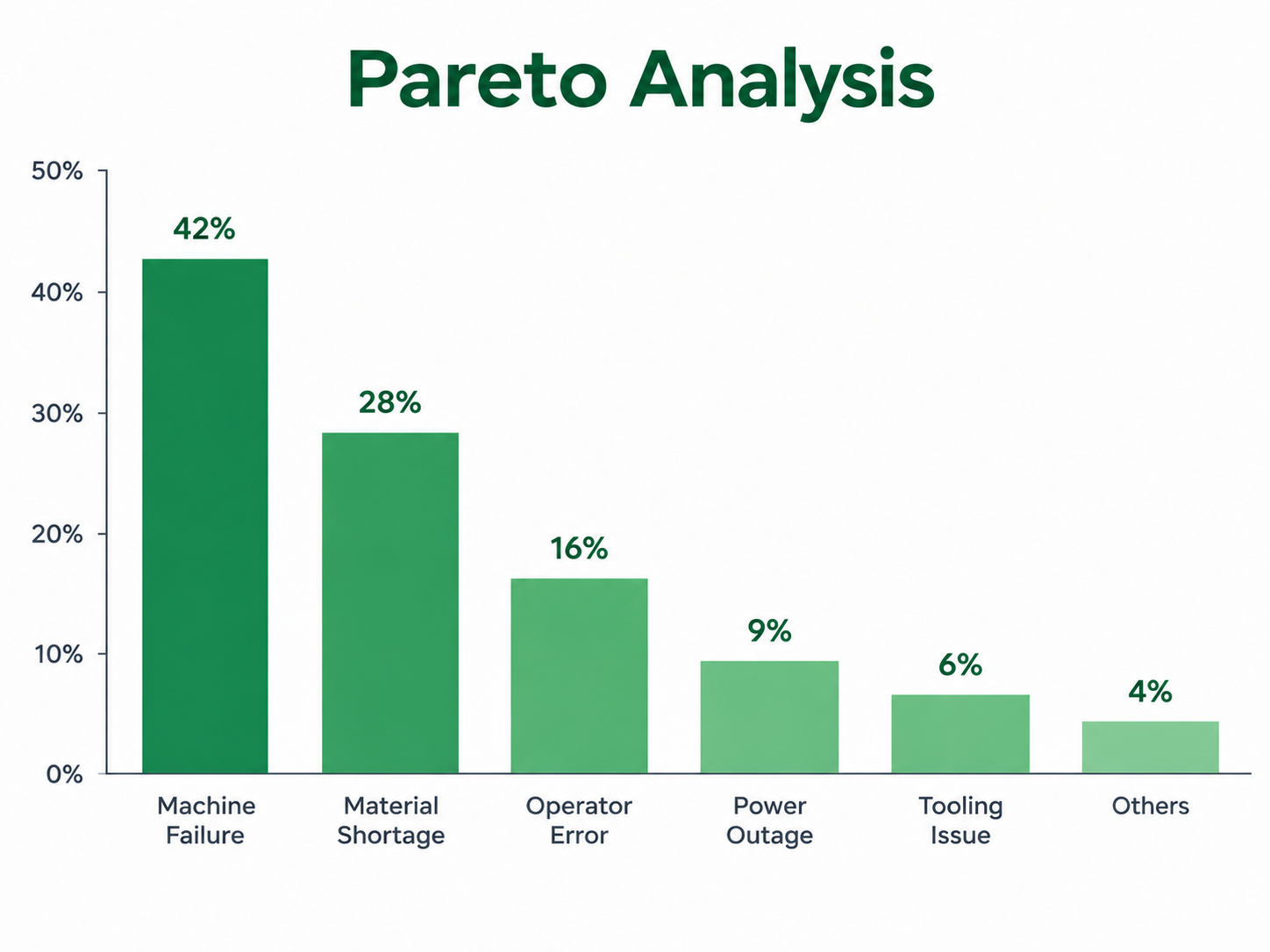
Historical issue records also make it possible to identify the top three recurring production issues within a specific plant. These will not be identical across every manufacturing unit; the actual top three should come from that manufacturer’s own recorded issue data rather than a generic assumption.
This is where Pareto analysis becomes practical. Issue data feeds into the identification of top recurring issues, Pareto analysis highlights which of those issues have the highest impact on downtime, and that prioritization guides where corrective action is focused. As a result, resources go toward the problems contributing most significantly to production downtime rather than being spread evenly across every issue regardless of impact.
This kind of prioritization matters because maintenance resources are limited. Treating every reported issue with equal priority tends to spread effort too thin. A plant that reviews its recorded issue data regularly can see which problems keep resurfacing and direct corrective action, spare parts planning, or equipment redesign toward those causes.
Common examples might include:
- Machine breakdowns
- Material constraints
- Process-related stoppages
These are illustrative rather than universal. What matters is that the analysis is based on actual recorded data from the plant floor, not assumptions carried over from a different facility or a different production line. The underlying goal remains constant: reducing recurring downtime by focusing on what actually drives it.
Andon system tracks key equipment KPIs such as Mean Time to Repair (MTTR), which measures how quickly reported issues are repaired, and Mean Time Between Failures (MTBF), which indicates how long equipment operates between failures. Together, these KPIs help teams monitor response efficiency and machine reliability.
Real Manufacturing Scenario: Reducing Machine Downtime
Consider a representative, though hypothetical, scenario involving a production line during an active shift.
Without Andon Software, the sequence unfolds as follows:
- A machine stops unexpectedly
- The operator notices the stoppage and searches for a supervisor or a maintenance contact
- The supervisor becomes aware only after being located
- Maintenance is then contacted, often by phone
- Maintenance personnel must locate the correct machine before troubleshooting can begin
Each of these steps adds avoidable waiting time on top of the actual repair.
With Andon Software, the same machine issue occurs, but the response looks different:
- The operator reports the issue immediately from the workstation
- A real-time alert reaches the responsible personnel without delay
- The shopfloor dashboard shows exactly which machine requires attention
- If no one responds within the configured window, automatic escalation ensures the issue reaches higher-level personnel
- Troubleshooting begins sooner, and resolution time is recorded automatically
If the same issue recurs on a later shift, a different maintenance technician can pull up previous records and past solutions before starting from scratch, which shortens the diagnostic phase. The event also becomes part of the plant’s ongoing recurring-issue and Pareto analysis, contributing to a clearer picture of which problems are worth prioritizing for permanent corrective action rather than repeated short-term fixes.
The machine failure itself may still occur in both versions of this scenario. What changes is the unnecessary delay in response, which a digital workflow is designed to remove.
Conclusion: From Faster Response to Lower Production Downtime
Production downtime cannot always be eliminated entirely; equipment will still fail and processes will still occasionally interrupt output. What can be reduced, however, is the unnecessary delay in identifying, reporting, responding to, and resolving these problems.
The path from faster response to lower downtime runs through immediate reporting, real-time alerts, shopfloor visibility, faster response, automatic escalation, quicker resolution, previous solution visibility, recurring issue analysis, and Pareto-based prioritization, with all of them leading toward lower production downtime.
Andon Software delivers value not because it displays an alert on a screen, but because it helps manufacturing teams respond faster and learn from recurring problems over time. Keeping machines and production lines running for more of the available production time remains one of the most direct ways manufacturing operations protect output and efficiency.