
Every year, workers are killed or seriously hurt not because a task was unusual, but because a routine task went ahead without clear control over the hazards around it. The importance of permit to work at high-risk job sites lies in closing that gap. A permit to work (PTW) is a formal, written authorization that allows a specific job to start only after the hazards are identified, the controls are in place, and a competent person has approved the work. This article explains where injuries occur, which activities demand a permit, how to work safely under one, and how to build a PTW system that holds up in daily operations.
Most Injuries Happen During High-Risk Jobs in These Industries
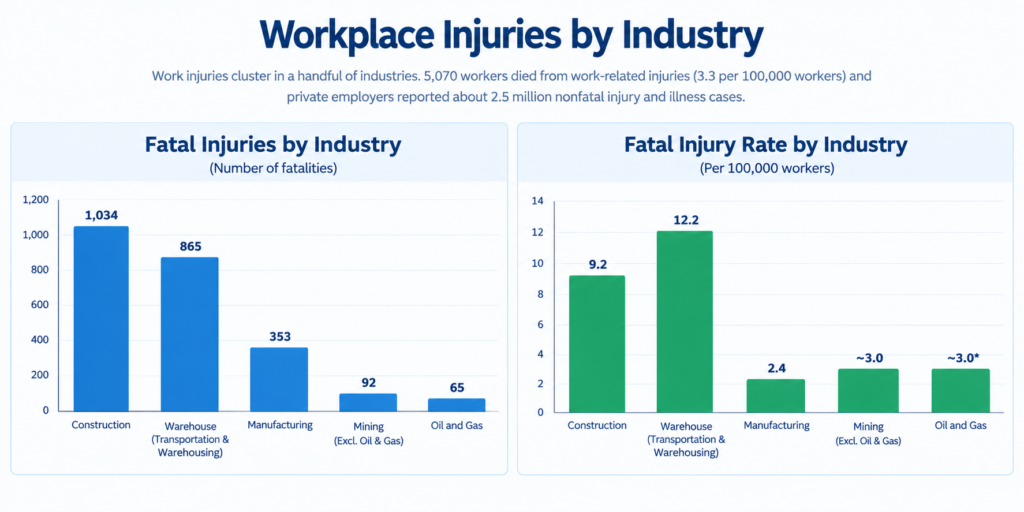
Work injuries cluster in a handful of industries and a handful of tasks. In 2024, 5,070 workers died from work-related injuries, a rate of 3.3 deaths per 100,000 full-time workers, and private employers reported about 2.5 million nonfatal injury and illness cases. The injuries behind those numbers have familiar causes: hazards were not identified before the job, energy sources stayed live, and several crews worked in the same area without coordination. A permit to work exists to answer those questions before the task starts.
Construction
Construction recorded 1,034 fatal injuries in 2024, a rate of 9.2 per 100,000 workers, which is about one in every five work deaths in the country.
- How Injury Happens: Falls, slips, and trips caused 389 of those deaths, or roughly 38%. Transportation incidents accounted for 244 deaths, exposure to harmful substances and environments (including electrocution) for 187, and contact with objects and equipment for 161.
- Why It Happens: Inadequate hazard identification, weak fall protection, changing site conditions, poor contractor coordination, and gaps in EHS supervision are major contributing factors. Inconsistent risk assessments, toolbox talks, PPE checks, and critical-control verification can leave hazards unmanaged, while poor housekeeping and improper permit or isolation practices can further increase incident exposure.
Warehouse
The transportation and warehousing sector recorded 865 fatal injuries in 2024, a rate of 12.2 per 100,000 workers. It also reported about 261,500 nonfatal cases, at a rate of 4.4 per 100 workers, the highest among the large sectors.
- How Injury Happens: Forklifts strike or pin pedestrians, loads fall from racking, and workers strain themselves lifting and moving stock by hand.
- Why It Happens: Vehicles and pedestrians share lanes, racking is overloaded, and non-routine work such as maintenance or elevated picking continues while normal operations run around it.
Mining
Mining, quarrying, and oil and gas extraction together recorded 92 fatal injuries in 2024. Of these, 24 occurred in mining outside oil and gas, 39 were transportation incidents, 27 were contact incidents such as being struck by or caught in equipment, and 7 involved explosions and fires.
- How Injury Happens: Haul truck and vehicle collisions, ground falls, machinery entanglement, and exposure to toxic or oxygen-deficient air cause the most serious harm.
- Why It Happens: Ground and ventilation conditions shift constantly, work takes place in remote and confined locations, and heavy equipment moves in tight areas with limited visibility.
Manufacturing
Manufacturing recorded 353 fatal injuries in 2024, a rate of 2.4 per 100,000 workers, and about 326,400 nonfatal injuries in 2023.
- How Injury Happens: Contact incidents such as being caught in or struck by machinery caused 104 deaths. Exposure to harmful substances caused 69, transportation incidents 65, and falls 52.
- Why It Happens: Inadequate machine guarding, incomplete lockout/tagout, poor electrical isolation, and gaps in EHS supervision are major contributing factors. Weak procedures, inadequate verification of isolation, and unsafe machine restart practices can expose workers to unexpected movement, hazardous energy, electrical contact, and other equipment-related hazards.
Oil and Gas
Oil and gas work accounted for 65 fatal injuries in 2024: 5 in extraction, 47 in support activities for oil and gas operations, and 13 in drilling of oil and gas wells. The pattern shows that most of the danger sits with contractors performing support tasks.
- How Injury Happens: Within the wider mining and extraction group, transportation incidents and contact with equipment cause most deaths, while fires, explosions, and hydrogen sulfide exposure produce the most severe events.
- Why It Happens: Flammable and toxic materials are handled under pressure, and simultaneous operations put drilling, maintenance, and production crews in the same area. Small lapses in isolation, gas testing, or hot work control can escalate quickly.
Across all five industries, the same failure repeats: work starts before hazards are checked and controls are confirmed. That gap is exactly what a permit system closes, and it is the clearest reason for the importance of permit to work at high-risk sites.
High-Risk Activities That Require a Permit to Work
A permit is not needed for every task. It is reserved for work where a single error can kill quickly or endanger people outside the work team. Six activities appear on almost every high-risk list.
- Hot Work: Welding, cutting, grinding, and brazing produce sparks and heat that can ignite flammable vapors or combustibles. NFPA data links thousands of fires each year to hot work.
- Confined Space Entry: Tanks, vessels, pits, and silos can hold toxic gas, lack oxygen, or trap a worker. A significant share of confined space deaths involves would-be rescuers who enter without protection.
- Work at Height: Roofs, scaffolds, and elevated platforms expose workers to falls. The permit confirms fall protection, anchor points, and a rescue plan before anyone climbs.
- Electrical Work: Work on or near energized systems risks shock, arc flash, and burns. The permit verifies isolation, testing for absence of voltage, and the competence of the person doing the job.
- Lifting and Crane Operations: Suspended loads can crush people or topple equipment. The permit checks load calculations, ground conditions, rigging conditions, and exclusion zones.
- Radiography and Radiation Work: Industrial radiography uses ionizing radiation to inspect welds and vessels. The permit controls barricading, exposure limits, source handling, and notice to neighboring crews.
Ways to Work Safely at High-Risk Sites
The importance of permit to work at high-risk job sites becomes concrete in the controls it enforces. Each control below is a step that a well-run permit system requires before, during, or after the job.
- Fire Watch: A trained fire watcher stays at the location after hot work ends, commonly for at least 30 minutes, to catch smoldering material before it flares up. For example, a welder cutting a pipe near a cable tray can leave slag inside insulation that ignites long after the crew has left. The fire watcher checks adjacent areas and the floor below, and the permit is closed only when nothing is found.
- Regular Gas Monitoring: A calibrated detector must test oxygen, flammable gas, and toxic gases before entry and at set intervals during the task. In a storage tank, for example, readings are taken at the top, middle, and bottom because gases settle at different levels. Continuous monitoring with an alarm matters because atmospheres can change once sludge is disturbed.
- Training for Work at Height: Only workers holding valid training or certification should be permitted to work at height. Take a worker assigned to a roof repair: the permit issuer checks the certificate, confirms the harness has been inspected, and verifies that the person knows the rescue procedure.
- Hazard Identification and Risk Assessment: The team identifies hazards and assesses risks before work begins. Before cleaning a chemical tank, for instance, they review toxic residue, ventilation, slip hazards, and rescue access, and then rate each risk. The resulting controls are written onto the permit so they cannot be skipped.
- Permit Authorization and Approval: Permits must be reviewed and approved by authorized personnel. For example, the issuer walks to the job location, confirms conditions match the paperwork, and obtains the area owner’s countersignature. This prevents a contractor supervisor from approving their own crew’s work.
- Energy Isolation and LOTO: Hazardous energy sources are isolated and verified before work starts. Before a technician enters a conveyor housing, each person applies a personal lock and tag, and the team tries to start the machine to prove that no energy remains.
- Permit Validity and Time Limits: Every permit defines a start time, an expiry, and a maximum working duration. A hot work permit valid for one shift is a common example. If the job runs longer, a new permit is issued because gas readings, weather, and nearby activities may have changed.
- Permit Suspension and Revalidation: Permits are suspended when conditions change and revalidated before work resumes. If sudden rain makes a roof slippery, or a gas alarm sounds, work stops immediately. The area is retested and the permit is reauthorized only when it is safe again.
- AI Monitoring Round the Clock: Cameras with AI analytics can watch work areas at all hours and flag missing helmets or harnesses, entry into barricaded zones, or a load passing over workers. These alerts capture near misses that would otherwise go unreported and let supervisors respond in real time.
Trend Analysis: Measuring the Importance of Permit to Work at High-Risk Sites
When permits are recorded digitally, each one can be linked to the injuries, near misses, and suspensions that occurred under it. That link turns permit data into an injury trend report. The figures below come from an illustrative site that issues about 4,800 permits a year and records 40 injuries in the same period.
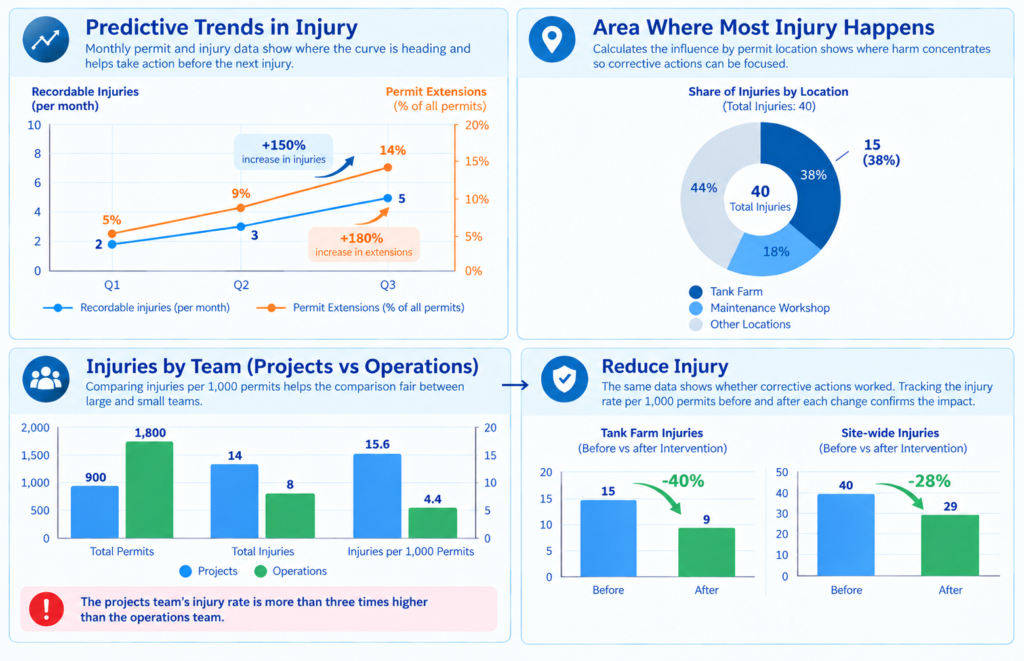
- Predictive Trends in Injury: Monthly permit and injury data show where the curve is heading. If recordable injuries rise from 2 a month in the first quarter to 5 a month in the third, an increase of 150%, while permit extensions grow from 5% to 14% of all permits, the two lines are moving together. That points to rushed work running past its approved limits. A simple rule, such as triggering a supervisor review when extensions stay above 10% for two consecutive months, lets the site act before the next injury. Leading signals such as rising suspensions and repeated gas alarms tend to move weeks before injuries do, which is what makes the trend predictive.
- Area Where Most Injury Happens: Grouping injuries by permit location shows where harm concentrates. In this example, the tank farm accounts for 24% of permits (1,150 of 4,800) but 38% of injuries (15 of 40). The maintenance workshop, with 30% of permits, records only 18% of injuries. A gap like this shows that the tank farm needs targeted action, such as better ventilation, revised entry procedures, or additional gas monitoring, and not site-wide reminders.
- Department in Which Most Injury Happens: Comparing injuries per 1,000 permits keeps the comparison fair between large and small teams. Suppose the project team records 14 injuries across 900 permits (15.6 per 1,000), while the operations team records 8 across 1,800 (4.4 per 1,000). The project team’s rate is more than three times higher, and its late closures and frequent extensions suggest weak planning and handover. Sharing these rates in monthly reviews puts the coaching effort where it will matter most.
- Reduce Injury: The same data shows whether corrective actions worked. After the tank farm introduced continuous gas monitoring and retrained its permit issuers, injuries there fell from 15 to 9 the following year, a reduction of 40%, and site-wide injuries dropped from 40 to 29, or about 28%. Tracking the injury rate per 1,000 permits before and after each change confirms which measures deserve continued investment.
Best Practices for Implementing Permit to Work at High-Risk Sites
Implementation succeeds when it is treated as an operational change, not a paperwork exercise. It begins with planning: map every high-risk activity, define the permit types, and assign clear roles for requesters, issuers, performers, and area owners. Involve frontline workers early, because they know where the current process breaks down.
Next comes implementing the software. A digital PTW platform enforces the sequence of steps, blocks incomplete approvals, links isolation records, and keeps a searchable history. Configure workflows to match each permit type instead of forcing one template on every job.
Once the system is in place, run it as a one-month trial to check that it works in high-risk jobs. Use it on live tasks such as hot work, confined space entry, and lifting. During the month, audit a sample of permits, compare paperwork to what is actually happening in the field, and collect feedback from users.
Finally, act on what the trial shows. Apply the lessons across all industry areas and sites, update procedures, retrain teams, and extend the system to new locations, so improvement is continuous and not limited to one pilot.
Conclusion
High-risk work will always carry danger, but injuries and deaths are not an unavoidable cost. Falls, fires, toxic atmospheres, and unexpected energy release are predictable, and a disciplined permit system controls them. The importance of a permit to work at high-risk job sites comes down to three things: hazards are examined before work begins, responsibility is clearly assigned, and every step is recorded. Organizations that pair a strong PTW process with digital tools, regular monitoring, and trend analysis gain both safer sites and better evidence to keep improving them.