
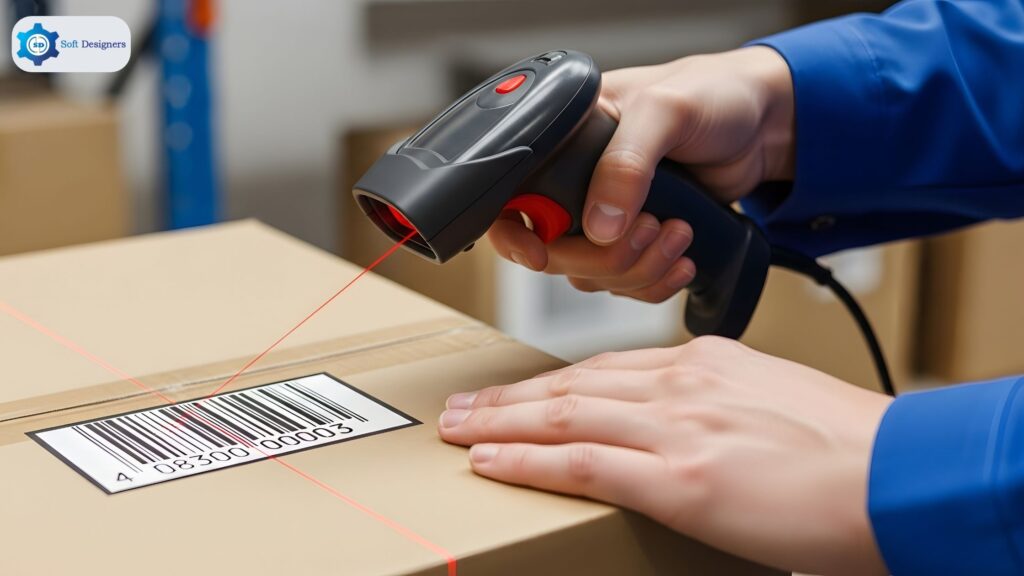
Traceability Software gives manufacturers a dependable record of how each product was made. A part number by itself doesn’t provide enough information. Plant teams also need to know where the material came from, how the product moved through production, and what the inspections showed.
Without that record, one customer complaint can start days of searching through spreadsheets, paper travellers and disconnected systems. Reliable manufacturing traceability reduces that search to minutes. It also narrows corrective action to the products that are actually affected.
The following sections trace the production process, starting with product identification and progressing to advanced analysis. Each section lists the key features and the shop-floor problem they address.
Features of Traceability Software
1. Product Identification and Digital Tracking
Every traceability record starts with identity. The methods below work together to establish what an item is and where it has been.
Barcode and QR code scanning: The most common method, because labels are inexpensive and scanners are easy to deploy at stations. It needs a clear view of the label.
- RFID: Adds contactless identification. Tags cost more, but they read without alignment, which suits fixtures or returnable containers moving through a cell.
- Serial number tracking: Identifies a single unit. Configurable rules prevent duplicate or mistyped identifiers and link each unit to its work order from the first operation.
- Batch tracking: Identifies a group of items that share a material source or production run, using batch or lot numbers.
- Label printing: Labels printed at a station, or at the end of the line, carry the identifier forward to packaging and dispatch. As a result, later scans match the original record.
- Real-time product tracking: Each scan records which item reached which station, and when. Supervisors see where material sits without walking the floor, and engineers can rebuild a product’s route later.
- Example: A bracket receives its serial number at the first station. Scans at drilling, welding and inspection add timestamps to the same record. If the bracket fails in service, the route is already documented.
2. End-to-End Traceability and Product Genealogy
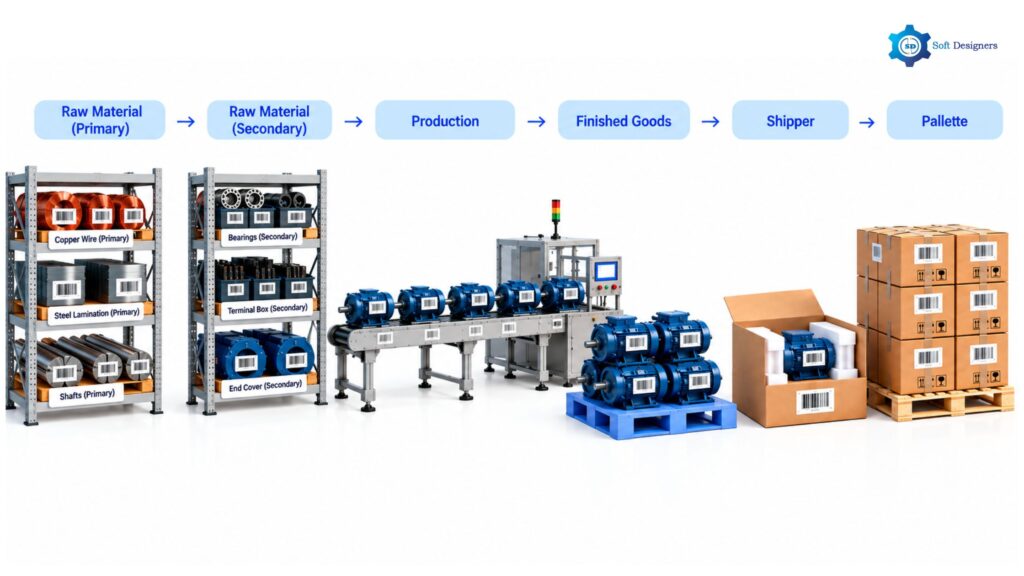
End-to-end traceability connects incoming material to the finished product and its packaging. Product genealogy creates a clear framework for linking every stage of a product’s lifecycle.
Parent-child relationships: Materials feed components, components form subassemblies, subassemblies form finished units, and finished units go into boxes, cartons and pallets.
- Forward and backward traceability: Backward tracing starts with a finished product and lists the materials, components, stations and operators behind it. Forward tracing starts with a material or component and lists every product that consumed it.
- Supplier lot tracking: Capturing supplier lot numbers at receiving extends both directions beyond the plant boundary.
- Man, machine and material (3M) traceability: Links each unit to the operator who worked on it, the machine and station that processed it, and the material it consumed. Together, these three records turn a simple product history into a complete production record.
- Multi-level genealogy: An identification code at every level keeps the chain unbroken. When a pallet holds a unit under investigation, the pallet identifier shows which other units shipped with it.
- Example: An assembly plant builds pump controllers. Incoming inspection finds out-of-tolerance readings on one capacitor lot. Forward tracing lists every controller built with that lot, including units already packed on two pallets. A backward trace on a returned controller confirms the same lot. As a result, quarantine covers only the affected serial numbers instead of a full week of output.
3. Production, Operator and Machine Traceability
A product record is incomplete without the people and equipment involved. The features below connect each unit to its order, station, operator and equipment.
Work order tracking: Ties each unit to a customer order, a planned quantity and a produced quantity.
- Station tracking: Shows where each operation took place.
- Operator and machine identification: Shows who performed each operation, and on which equipment.
- Process parameters: Torque values, temperatures or measured dimensions show how an operation was performed, where the system captures them from connected equipment.
- Production sequence validation: Checks that steps occur in the defined order.
- Process interlocking: Blocks a transaction when a mandatory condition is missing. A station can refuse a unit that skipped its leak test, or reject an operator who lacks the required qualification. The error stops at the station instead of becoming scrap or a hidden defect.
Soft Designers builds this man, machine and material approach into its traceability solution. The system tracks operators, stations and materials against each work order, with planned, produced and balanced quantities visible in real time. It validates operator skill before an operation begins, and it applies process interlocking where required conditions are not met.
4. Quality Inspection and Compliance Records
Quality data becomes far more useful when it is attached to the product it describes.
- Inspection history: Inspection and test results linked to a serial or batch number form a complete record for each unit.
- Defect and non-conformance records: Show what failed, where it failed, and which production stage preceded it.
- Automated inspection: Machine vision systems can write pass or fail results directly against the serial number, which removes transcription errors and delays.
- Digital audit trail: Timestamps and user activity record who changed a record, when the change occurred, and what the earlier value was.
- Traceable production changes: Help investigators separate a genuine process problem from a data entry correction.
- Example: A recurring weld defect can be filtered by station, shift and material lot until the common factor appears. During an audit, the same records provide evidence without a manual search.
However, records do not guarantee compliance on their own. Their value depends on correct configuration, data integrity controls and the requirements that apply to the product and industry.
5. Automated Data Capture, System Integration and Alerts
Manual entry causes many traceability gaps. Operators skip fields, mistype numbers or record data hours later. Connected systems remove much of that risk.
Automated data capture: Barcode scanners, RFID readers, PLC connections, sensors and vision systems feed events directly into the record. Industrial printers and operator terminals complete the loop at the station.
- ERP and MES integration: Work orders and material information flow down from ERP, while produced quantities and completion status flow back. Because each event arrives with its transaction, data attaches to the correct work order without re-keying.
- Andon and digital work instruction links: A downtime event or a skipped checklist step can be read alongside the product record.
- Configurable alerts: Flag a missing scan, a failed inspection or a unit that reached a station out of sequence. These alerts follow fixed rules set by the plant. They report that a defined condition occurred, but they do not interpret patterns.
6. AI-Powered Traceability Software and Intelligent Analysis
Rule-based checks answer known questions. AI-assisted analysis looks for patterns that no one wrote a rule for. The capabilities below describe what AI can add to traceability data in general. They are not confirmed features of any specific product unless the vendor documents them.
- AI-powered anomaly detection: Identifies unusual cycle times, recurring rework patterns, and irregular scan sequences.
- Root cause investigation: Compares defect records across batches, components and production stages.
- Document extraction: Reads supported documents, such as supplier certificates, and captures their data.
- Product relationship analysis: Suggests which units may share an affected material or process.
- Predictive alerts: Estimate risk when suitable data and validated models exist.
- Example: A rule may only flag a failed leak test. AI-assisted analysis might notice that failures cluster on units built from one seal batch and processed at one press station on night shifts. That finding gives investigators a starting hypothesis within hours.
- Limits: AI output needs verification. Models depend on data quality, and correlation does not prove cause. Quality engineers still confirm each finding through inspection, testing and process review before acting on it.
7. Traceability Dashboards, Reports and Product History
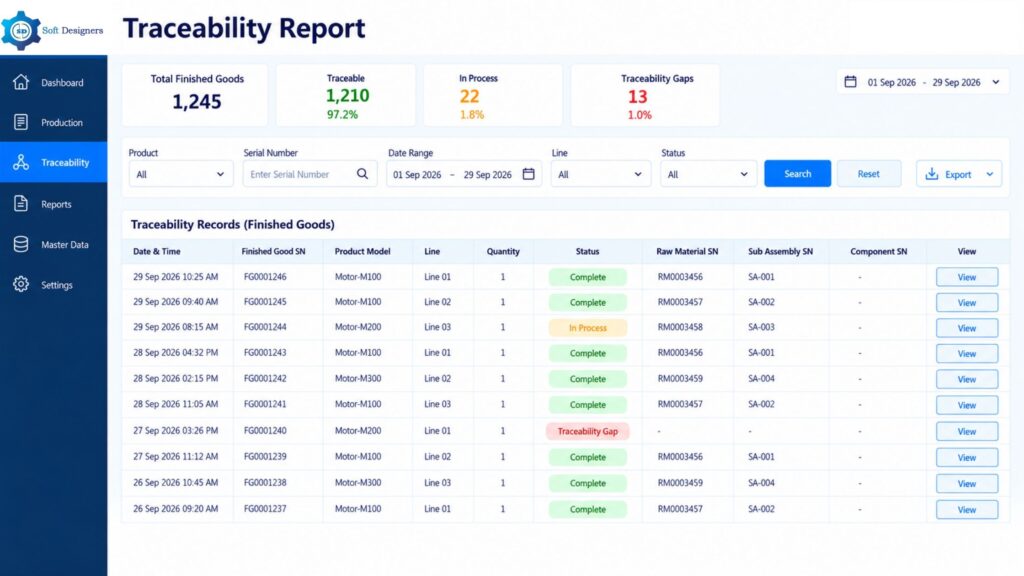
- Product History Retrieval: Retrieve a product’s complete manufacturing history using a serial number, batch number or work order. Review associated materials, production stages, machine and operator details, inspection results, and packaging or dispatch records where captured.
- Traceability Dashboards: View relevant production and traceability information in a centralised dashboard to understand product movement, batch status and the progress of manufacturing orders. This helps teams identify missing records and locate products or batches requiring further investigation.
- Forward and Backward Traceability Reports: Generate reports to trace a finished product back to its raw materials and components, or identify finished products linked to a particular material batch. These reports help narrow the scope of quality investigations and support targeted recalls.
- Digital Traceability Records: Maintain searchable digital records of materials, production activities and quality checks. These records help quality teams retrieve supporting information for internal reviews, supplier coordination and audits.
- Production and Quality Insights: Review available production and inspection records to investigate defects, trace affected batches and understand where issues occurred during manufacturing. Linking relevant records to products or work orders helps teams identify the source of problems more efficiently.
Together, these tools support several tasks:
- Defect investigations: Move from a failed unit to its process history.
- Batch reviews: Confirm records are complete before release.
- Recall assessments: List affected serial numbers and shipments.
- Traceability audits: Provide evidence on request.
Conclusion
Effective traceability relies on features that work together seamlessly as one connected system. Identification creates the record. Genealogy connects materials to products. Production tracking adds people, machines and sequence control. Quality records supply the evidence. Automation and reporting keep data accurate and retrievable, while advanced capabilities expose gaps early. A weakness in any link leaves part of a product’s history unanswered.
Manufacturers evaluating Traceability Software should test one real scenario before selecting a system. Start from a single serial number and retrieve its full history. A system that answers quickly and completely is ready for the shop floor.
Explore Soft Designers’ manufacturing traceability software to see how it works in practice, or book a demo with the team to learn more.