
Personal protective equipment compliance depends on timely verification that workers are wearing the required PPE before exposure to a hazard occurs. Traditionally, this verification has relied on supervisors, safety officers, or camera operators observing workers during floor rounds or through surveillance monitors. While manual observation can identify visible PPE issues, its coverage depends on where and when a person is looking.
AI PPE Software introduces a different approach by using visual analysis of connected camera feeds to identify configured PPE conditions and generate digital monitoring events or alerts where supported. This changes not only how PPE violations are detected, but also how observations are recorded, reviewed, and tracked across different areas.
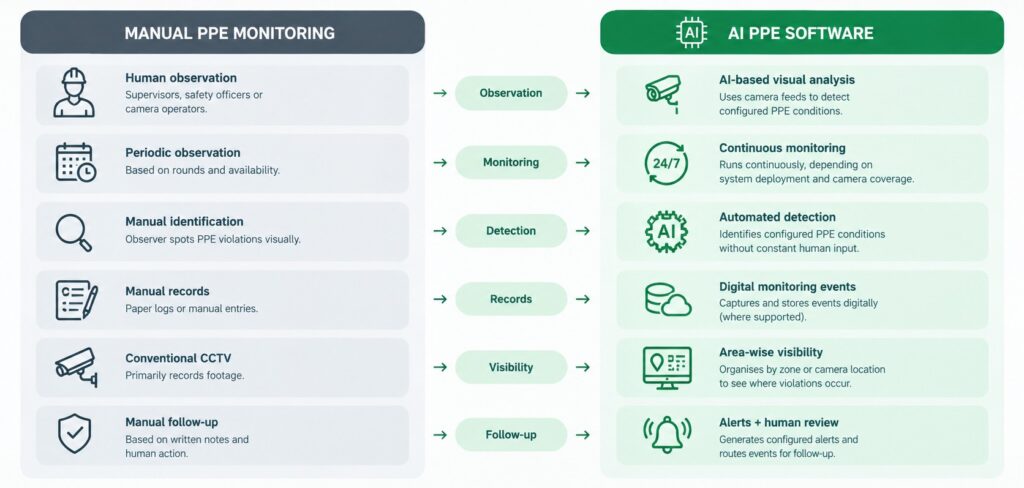
The shift from manual monitoring to AI-based detection therefore involves more than replacing a person’s observation with software. It affects the way PPE compliance is observed, detected, documented, alerted, organized by area, reviewed for recurring patterns, and followed up. This article examines AI PPE Software vs Manual PPE Monitoring across these specific areas, focusing only on what changes in PPE monitoring itself. For a deeper explanation of AI-based PPE detection and its implementation, refer to the article on Implementing AI for Effective PPE Detection.
How Manual PPE Monitoring Works
Monitoring Through Human Observation
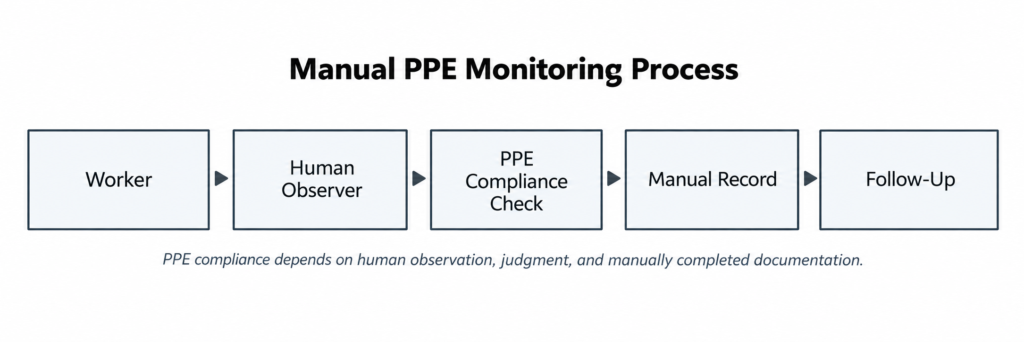
Manual PPE monitoring relies on safety officers, supervisors, or observers to check workers for PPE compliance. They assess required equipment based on what they can see during inspections or camera monitoring. The process depends on human availability, attention, and field of view.
Monitoring at Specific Times
Manual PPE monitoring usually occurs during scheduled safety rounds, inspections, or floor walks rather than continuously. Observation frequency depends on the availability and attention of the person conducting the checks. Any gap in observation means PPE compliance is not actively monitored during that period.
Identifying PPE Non-Compliance
Manual PPE violation identification depends on what an observer can see and how they interpret it at that moment. Borderline cases may be judged differently by different observers based on their experience. This makes manual detection dependent on individual judgment and consistency.
Recording What Was Observed
Manual PPE observations are usually recorded through checklists, forms, notes, or digital entries. Record quality depends on what the observer notices and documents during the check. Busy or rushed inspections can result in less detailed records.
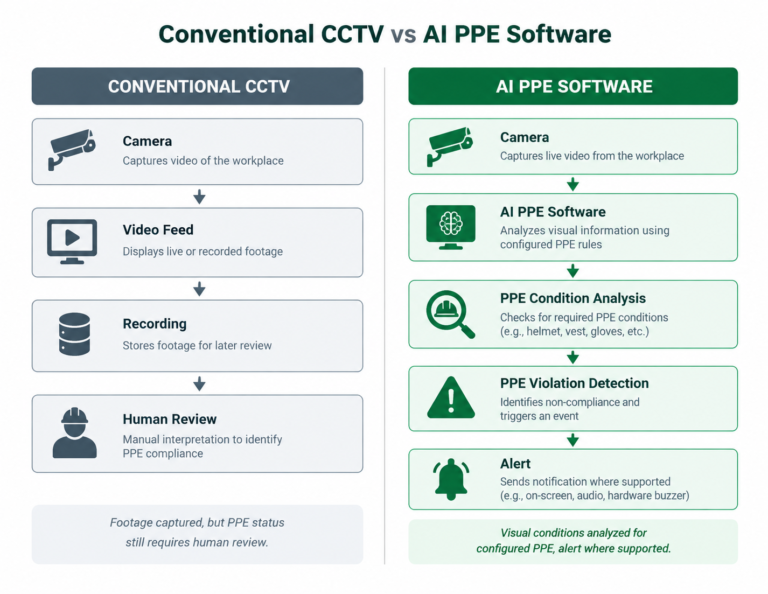
A Camera Can See, But It Cannot Automatically Detect PPE
Conventional CCTV captures, displays, and records footage but does not identify PPE compliance on its own. A person must review the footage and determine whether workers are wearing the required PPE. Cameras improve visibility, but PPE detection still depends on active human monitoring.
Operator Training, Time and Cost
Manual PPE monitoring requires trained personnel who understand PPE requirements, identify violations, and document findings. It also requires time for safety rounds, observation reporting, and follow-up. Larger facilities may need multiple trained observers to maintain coverage across areas and shifts.
How AI PPE Software Changes Manual PPE Monitoring
From Human Observation to AI-Based Visual Monitoring
AI PPE Software shifts the point of observation from a person’s eyes to visual analysis performed on camera input. Rather than a supervisor walking past a work area, a connected camera view is analyzed for configured PPE conditions, such as the presence or absence of a helmet or safety vest within the frame. This is a direct parallel to human observation on purpose, both are trying to determine PPE status, but the mechanism differs.
Visual analysis software does not get tired or distracted the way a person monitoring for an extended period might, though it is not free of limitation either; detection accuracy depends on camera placement, lighting, image quality, and how the system has been configured for a given area. It is not presented here as infallible, only as a different method of performing the same underlying task, and one that is generally better suited to areas with steady camera coverage than to zones where visibility is inconsistent or frequently obstructed.
From Periodic Monitoring to Continuous Monitoring
Manual monitoring occurs when a person is actively observing, which is inherently periodic. AI PPE monitoring changes the frequency question because connected camera views can, depending on deployment and configuration, be analyzed continuously rather than only during scheduled rounds. This does not mean every deployment runs around the clock; camera coverage, network availability, and system setup all influence how continuous the monitoring actually is in practice. The meaningful shift is that observation is no longer tied to a single person’s shift pattern or attention span in the same way.
From Manual Identification to Automated Detection
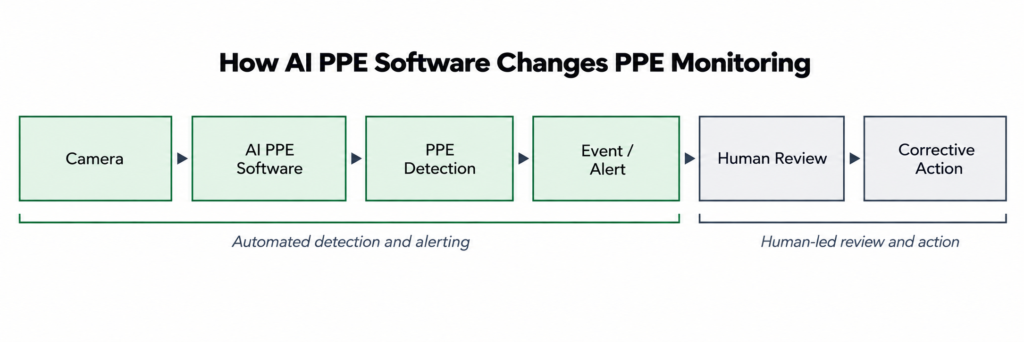
The manual sequence runs as follows: a person observes a worker, interprets what they see, identifies whether a violation exists, and records it. The AI-supported sequence runs differently: a camera captures visual information, the software analyzes that information, a configured PPE condition is detected, and an event or alert is generated where supported. Human review still has a role in this second sequence, particularly for confirming context and deciding what action to take, but the initial detection step no longer depends on a person watching in real time.
Area-Wise PPE Monitoring
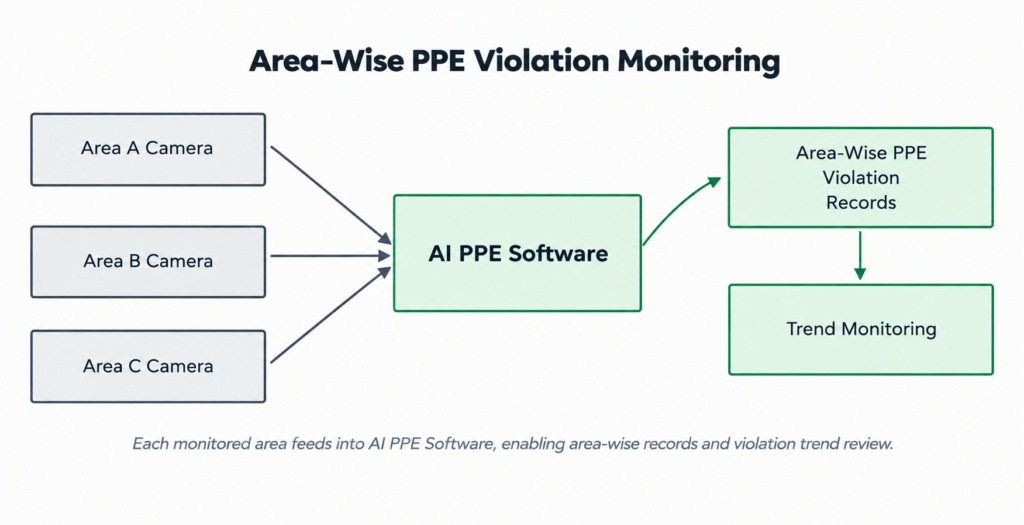
Camera-based AI PPE monitoring can organize detection by production area, work zone, camera location, or designated workplace section. This allows safety teams to see PPE compliance broken down by specific parts of the facility rather than as a single undifferentiated observation. A manual round covers whatever area the observer happens to walk through; area-wise digital monitoring, by contrast, can maintain separate visibility for each covered zone at the same time, which is a structural difference in how coverage is organized rather than simply a difference in speed.
Alerts and Hardware Buzzers
Detected PPE violations can generate alerts through various channels depending on how a system has been set up. Where supported, this can include audio alarms, hardware buzzers on the shop floor, other warning devices, or digital notifications sent to a supervisor’s device. Hardware integration of this kind is not automatic or universal; it depends on the specific configuration chosen for a given facility. The underlying purpose across these options remains the same: converting a detected condition into a signal that a responsible person can act on.
PPE Violation Trends and Which Area Has More Violations
Digital PPE monitoring events accumulate into a historical record that manual observation logs rarely achieve at the same scale, since they depend on individual entries made during specific rounds. This record can support trend analysis, and one of the most practical questions it can help answer is which area has more PPE violations than others. By reviewing area-wise event counts over time, safety teams can identify locations with recurring compliance issues, spot patterns that would be difficult to notice from isolated manual observations, and direct closer attention toward zones that show repeated activity.
This does not resolve the underlying compliance problem by itself; it simply makes the pattern more visible than a series of separate paper records would. A safety team reviewing weekly or monthly event summaries, for instance, can compare one work zone against another on a consistent basis, which is difficult to do reliably when the underlying data comes from rounds conducted at different times by different observers using slightly different judgment.
Action Tracking Integration
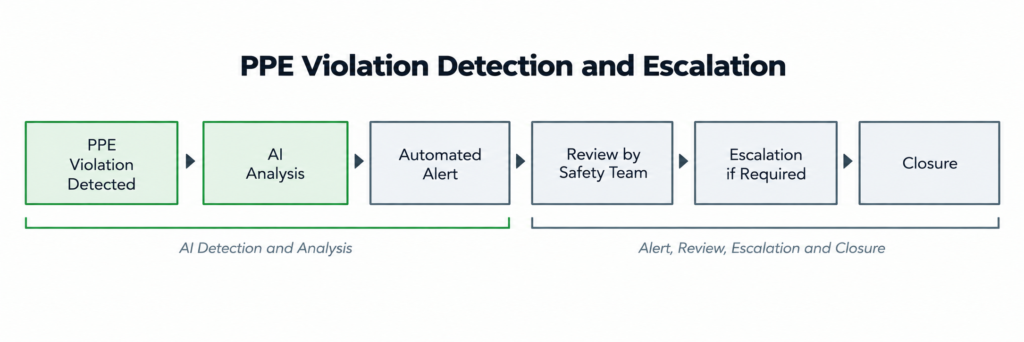
A detected PPE violation can, depending on software integration, connect into a broader action tracking workflow: violation detected, alert or event generated, responsible person reviews the event, corrective action assigned, and action tracked through to closure. This conceptual flow mirrors what a diligent manual process would also aim for, but the digital event provides a consistent starting point that does not depend on someone remembering to raise it manually.
Escalation Workflow
PPE monitoring software can also support a configurable escalation path: violation detected, initial alert issued, supervisor notified, and escalation triggered if the matter remains unresolved. It is worth being precise about what this automates and what it does not. The software can identify a condition and communicate it along a defined path; deciding what the appropriate corrective action is, and actually carrying it out, remains the responsibility of the personnel involved at each stage. Framing this clearly matters for how a facility sets expectations internally, since treating an escalation notification as equivalent to a closed corrective action would understate the human review still required at each step.
Evidence Photo and Video
Where supported, an AI PPE Software deployment may capture or associate an evidence image, an event snapshot, or a short video clip with a detected violation. This differs from manual observation, which typically relies on a written record describing what was seen. Visual evidence, where available, gives reviewers a way to independently confirm what triggered an alert rather than depending solely on a written description after the fact. Not every system stores video evidence automatically, and whether this capability exists depends on the specific configuration in place.
AI PPE Software vs Manual PPE Monitoring: Key Differences
| Monitoring Aspect | Manual PPE Monitoring | AI PPE Software |
|---|---|---|
| Initial observation | Human observer | AI-based visual analysis |
| Monitoring method | Direct observation | Camera-based monitoring |
| Monitoring frequency | During observation periods | Can operate continuously |
| PPE detection | Human identifies compliance | Software detects configured PPE conditions |
| Non-compliance identification | Observer notices issue | System flags detected condition |
| Records | Manually documented | Digitally captured where supported |
| Monitoring coverage | Depends on observer activity | Depends on connected camera views |
| Alerts | Human communication | Configurable alerts where supported |
| Area visibility | Dependent on monitoring activity | Camera/area-based digital visibility |
| Trend analysis | Requires manual compilation | Digital events can support trend analysis |
| Evidence | Manual observation record | Image/video evidence where supported |
| Follow-up | Human-led | Human review and follow-up of detected events |
Understanding What Really Changes With AI PPE Software
Conclusion
The comparison between manual PPE monitoring and AI PPE Software comes down to a change in mechanism rather than a change in objective. Both approaches exist to confirm whether workers are wearing required protective equipment, but they arrive at that confirmation differently. Manual monitoring depends on a person’s direct observation, available during specific rounds or shifts, recorded by hand or through manual entry, and communicated through direct human contact.
Soft Designers AI PPE Software depends on visual analysis of connected camera views, which can operate continuously depending on configuration, generate digital events and alerts where supported, and organize findings by area to support trend review, including identifying which zones show more frequent violations.
Evidence capture, action tracking, and escalation can extend from these detected events, though the extent of that integration varies by system and setup. None of this removes the role of supervisors, safety officers, or EHS personnel; detected events still require human review, judgment, and corrective action. The practical difference for a manufacturing unit lies in how observation, detection, recording, and follow-up are structured, not in whether people remain responsible for the outcome.