NEXT-GEN EHS ECOSYSTEM

Health & Safety Management System for Safer Workplaces

Digitize your safety processes with AI-driven insights. Streamline compliance, mitigate risks, and foster a proactive safety culture across your enterprise.
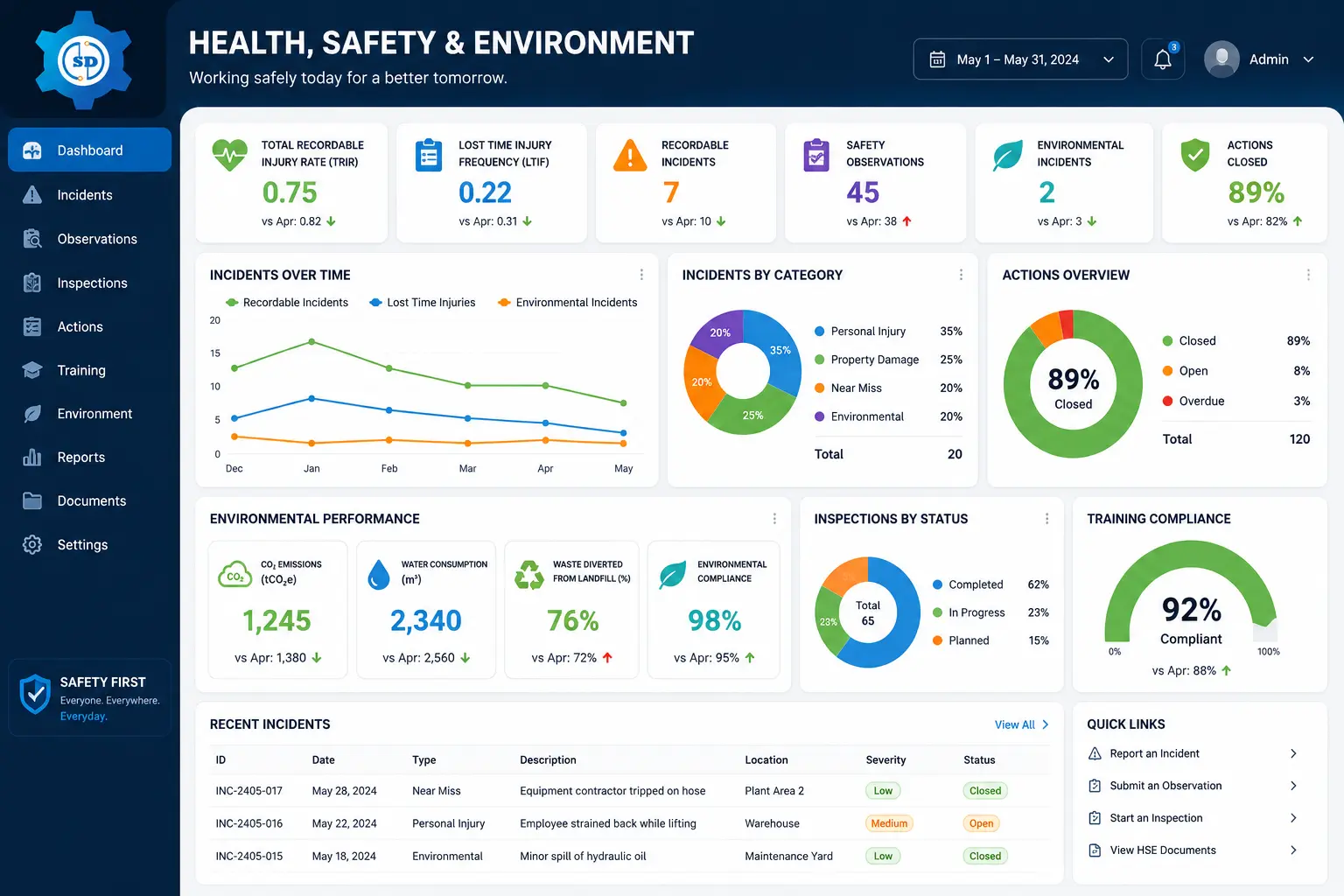
Health & Safety Dashboard

Zero Incidents

Last 120 Days

Health & Safety Management

What is Health & Safety Management?

A Health and Safety Management System (HSMS) is a structured approach to identifying workplace hazards, reducing risks, ensuring compliance, and continuously improving employee safety and organizational performance.

Risk Identification

Identify, assess, and mitigate workplace hazards before incidents occur.

Compliance & Governance

Ensure compliance with OSHA, ISO 45001, and industry-specific safety regulations.

Hazard Control

Track corrective actions, monitor safety performance, and continuously improve workplace safety.

Comprehensive Safety Governance

Digitizing key safety responsibilities into integrated, actionable modules.

Incident Investigation

Root cause analysis (RCA) and comprehensive reporting.

Industrial Hygiene

Monitoring chemical, physical, and biological exposures.

Safety Inspections

Scheduled and ad-hoc checklists with mobile support.

Safety Training

Manage certification, LMS, and induction programs.

Emergency Response

Drill management and emergency coordination.

Contractor Safety

Pre-qualification and onsite safety compliance.

Environmental Compliance

Waste tracking and air emission monitoring.

Audit Management

Internal and external compliance audit cycles.

Behavior Based Safety

Observing and rewarding safe workplace behaviors.

MSDS Management

Centralized digital safety data sheet repository.

Transitioning from Manual to Digital Excellence

Manual safety systems lead to fragmented data, delayed responses, and compliance gaps. Soft Designers EHS centralizes operations to provide total visibility.

The Manual Challenge

  • Spreadsheet silos & paperwork delays
  • Reactive instead of proactive response
  • Difficult to audit & maintain compliance

The Digital Benefit

  • Real-time data sync across departments
  • Predictive risk modeling with AI
  • Single source of truth for all audits

Digital Transformation Diagram

Comprehensive HSE Modules

Permit To Work
Learn More →
LOTO System
Learn More →
Risk Assessment
Learn More →
Inspection Management
Learn More →
Audit Management
Learn More →
Change Management
Learn More →
Near Miss Reporting
Learn More →
Incident Reporting
Learn More →
HSE Metrics
40%
Reduction in Incidents
10x
Faster Audit Readiness
100%
Regulatory Compliance
25%
Insurance Premium Savings
65%
Operational Efficiency
0
Data Redundancy

Industries We Serve

The Lifecycle of Safety Excellence

1
Identify
Spot hazards through observations.
2
Assess
Evaluate risk level and impact.
3
Implement
Establish safety controls.
4
Monitor
Continuous surveillance of sites.
5
Correct
Fix non-conformities via CAPA.
6
Improve
Optimize for safety growth.

Why Choose Soft Designers?

We aren't just another software vendor; we are your strategic safety partner. Our platform is built on 15 years of industrial EHS expertise.

AI-Driven Insights

Predictive analytics to prevent incidents before they happen.

Cloud Scalability

Secure, reliable infrastructure that grows with your organization.

IoT Integration

Connect wearable safety devices and machinery sensors.

Expert Support

Dedicated safety consultants for implementation and training.

A Future-Proof Investment

While legacy software struggles with modern compliance, Soft Designers adapts at the speed of regulation.

Future-Proof Investment

Transform Workplace Safety Today

Join the thousands of safety professionals who trust Soft Designers EHS to protect their workforce and ensure operational excellence.

Frequently Asked Questions (FAQs)

A Health and Safety Management System (HSMS) is a structured framework that helps organizations identify workplace hazards, manage risks, ensure regulatory compliance, and improve employee safety through standardized processes, policies, and procedures.

Common HSMS features include incident reporting, risk assessment, audits and inspections, permit-to-work management, corrective and preventive actions (CAPA), safety observations, training management, compliance tracking, and real-time safety dashboards.

An HSMS improves workplace safety by proactively identifying hazards, implementing control measures, tracking incidents, monitoring corrective actions, and promoting a strong safety culture across the organization.

Industries such as manufacturing, construction, oil and gas, chemicals, pharmaceuticals, mining, utilities, logistics, and healthcare can significantly benefit from implementing an HSMS to manage operational risks and maintain compliance.

Yes. An HSMS helps organizations comply with local and international safety regulations by maintaining accurate records, automating compliance processes, conducting audits, and ensuring timely corrective actions.

Digital Health and Safety Management Software centralizes safety data, automates workflows, provides real-time visibility into safety performance, reduces paperwork, improves reporting accuracy, and enables faster decision-making for safer operations.