1. Introduction
Industrial facilities operate in a state of continuous modification. Equipment is upgraded, chemical suppliers are substituted, process parameters are adjusted, and procedures are revised to reflect new regulatory requirements or operational lessons. Each of these modifications, regardless of how routine it appears, can introduce new hazards when it is not formally evaluated before implementation. This is the context in which management of change software has become a critical tool for EHS professionals and operations leaders across high-risk industries.
Management of change software addresses the structural limitations of manual MOC processes by providing a centralized platform that captures every change request, routes it through risk assessment and approval stages, and generates an auditable record that supports both internal accountability and regulatory compliance.
2. What Is Management of Change (MOC)?
Management of change is a formal discipline used to evaluate, approve, and document modifications to equipment, processes, materials, procedures, or organizational structure before those modifications take effect. The objective is to ensure no change is implemented without a prior assessment of its potential impact on safety, compliance, product quality, and operational integrity.
A key distinction in MOC practice is the difference between a genuine change and a replacement in kind. Replacing a pump with an identical unit is a replacement in kind and falls outside MOC scope. Replacing it with a unit that operates at a different pressure rating or requires a procedure update qualifies as a change requiring formal review. MOC applies across process modifications, equipment changes, procedure revisions, material substitutions, and organizational changes that affect safety-critical functions.
Why Management of Change Software?
Organizations managing MOC through paper forms and email correspondence encounter predictable structural failures. Reviews are completed inconsistently across departments. High-risk changes move forward without full cross-functional input. Mitigation actions identified during risk assessments are recorded but never confirmed complete. When a regulatory inspector requests the MOC record for a specific modification, assembling the evidence from scattered files takes days rather than minutes.
Dedicated MOC software resolves these gaps. It enforces the same procedural standard across every site regardless of local staffing. It routes low-risk changes through an expedited path while applying more rigorous review to high-risk modifications. It gives EHS leadership a live view of every open change request, its current stage, and any overdue items. And it produces records that are complete by design, time-stamped, and retrievable on demand during regulatory inspection. The cost of implementing the platform is fixed and predictable. The cost of a single serious incident traced to an unreviewed change is not
4. Types of Change MOC Covers
Management of change is often associated narrowly with equipment modifications, but its scope is broader. A mature MOC program accounts for several categories of change, summarized below.
| Type of Change | Description | Example |
|---|---|---|
| 1. Process Change | Changes to operating procedures, production methods, or process parameters. | Increasing reactor temperature, changing production workflow. |
| 2. Equipment or Technology Change | Changes to machinery, tools, software, automation, or control systems. | Installing a new conveyor, upgrading PLC software, replacing a pressure vessel. |
| 3. Material Change | Introducing or replacing raw materials, chemicals, fuels, or lubricants. | Switching to a different solvent or cleaning chemical. |
| 4. Organizational or Personnel Change | Changes in staffing, roles, responsibilities, contractors, or organizational structure. | Hiring a new contractor, changing shift patterns, restructuring the maintenance team. |
| 5. Facility or Infrastructure Change | Physical modifications to buildings, layouts, utilities, or site infrastructure. | Expanding a warehouse, relocating production equipment, adding a new storage area. |
| 6. Temporary Change | A short-term modification with a defined end date, requiring tracking to ensure it is reversed or reviewed for permanence. | Installing a temporary bypass line during a repair, running a process at reduced capacity while a part is on order. |
| 7. Permanent Change | A lasting modification requiring full documentation updates, retraining, and long-term verification. | Redesigning a process step, permanently replacing equipment with an upgraded model. |
5. The MOC Process: Step-by-Step Workflow
5.1 The MOC Documentation Cycle
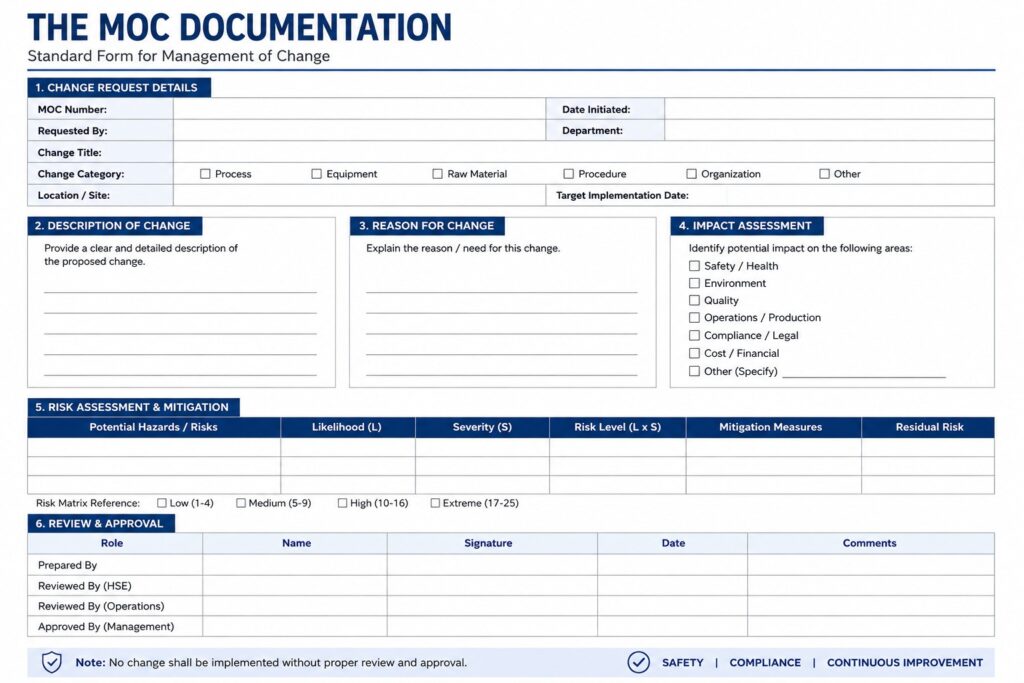
A well-run management of change process follows a documentation cycle that builds a complete, defensible record from the moment a change is proposed to the moment it’s closed out.
Current Process Documentation. Before evaluating a change, the existing state must be captured accurately: the current procedure, equipment configuration, or organizational arrangement. Without this baseline, it’s impossible to assess what will actually be different.
Problem Statement. Every change should be traceable to a clearly defined issue. What isn’t working, what risk needs to be reduced, or what improvement is being sought? A vague or missing problem statement is often a sign that a change hasn’t been thought through.
Proposed Change. This section details exactly what is being changed and how, describing the specific technical, procedural, or organizational modification being requested.
Benefits Assessment. Reviewers need to understand the value the change delivers, both to the company (efficiency, cost savings, risk reduction) and to the customer or end user, where relevant.
Impact Assessment. This is where the operational, safety, and process implications of the change are evaluated. What else does this change touch? Which systems, procedures, or teams are affected downstream?
Financial Investment. Cost implications are documented and routed for budget approval, ensuring the change is financially as well as operationally sound.
Risk Assessment. A structured evaluation identifies the risks introduced by the change and the controls needed to manage them. This is one of the most critical elements of management of change, since it’s where hazards that weren’t obvious at first glance get surfaced.
Two-Team Review. Most mature MOC processes split review responsibility between two groups:
- The Implementation Team, which executes the technical or operational rollout and understands the practical realities of the change.
- The Committee Team, which reviews, approves, and provides independent oversight, acting as a check against the implementation team’s inherent bias toward moving forward.
Action Tracking. The committee assigns actions the implementation team must complete before or during rollout, such as additional risk mitigation, training, or documentation updates. The implementation team is responsible for tracking and closing those actions, and the committee verifies closure before final approval.
Change Implementation. Once actions are closed and approvals secured, the change is executed according to the approved plan.
MOC Certificate. The process concludes with a formal sign-off document, issued only once every required stakeholder has approved the change. This certificate becomes the permanent record that the change was properly evaluated and authorized.
5.2 The End-to-End MOC Approval Workflow
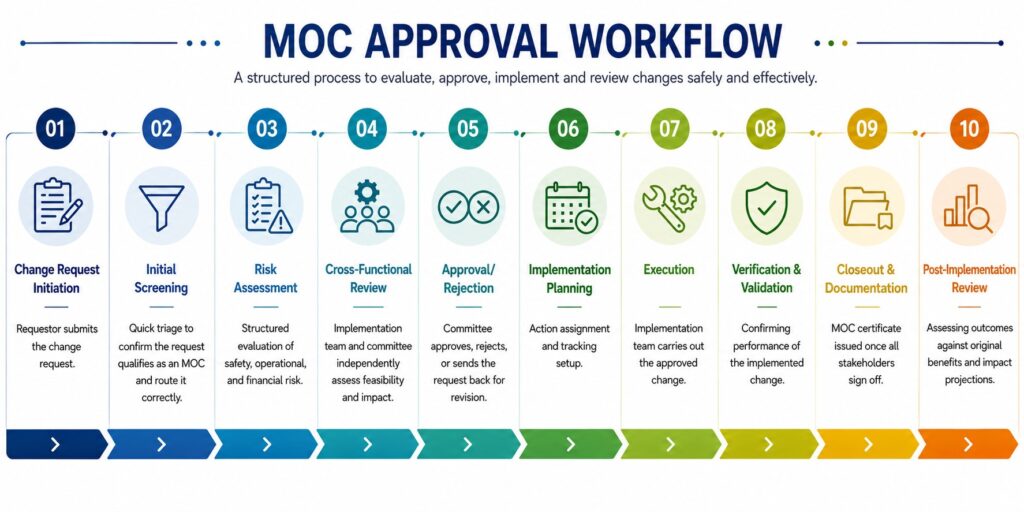
Zooming out from the documentation cycle, the full management of change workflow typically runs through these stages:
- Change Request Initiation. The requestor, often an engineer, operator, or manager, submits a formal change request describing what they want to change and why.
- Initial Screening. A quick triage step confirms whether the request actually qualifies as an MOC (as opposed to routine maintenance or an operational decision that doesn’t require formal review) and routes it to the correct review track.
- Risk Assessment. The proposed change undergoes a structured evaluation of safety, operational, and financial risk, often using tools like hazard identification matrices or what-if analysis.
- Cross-Functional Review. The implementation team and the review committee independently assess feasibility and impact, bringing different perspectives, one operational and one oversight-focused, to the same proposal.
- Approval/Rejection. The committee approves the change, rejects it, or sends it back for revision with specific feedback on what needs to change before it can proceed.
- Implementation Planning. Once approved, actions are assigned and a tracking structure is set up to ensure nothing falls through the cracks during execution.
- Execution. The implementation team carries out the approved change according to plan.
- Verification & Validation. After implementation, the team confirms the change performs as intended and hasn’t introduced unexpected issues.
- Closeout & Documentation. The MOC certificate is issued once every stakeholder has signed off, formally closing the request.
- Post-Implementation Review. Some time after the change is live, outcomes are assessed against the original benefits and impact projections: did the change deliver what it promised, and were there any unanticipated consequences?
Pre-Startup Safety Review
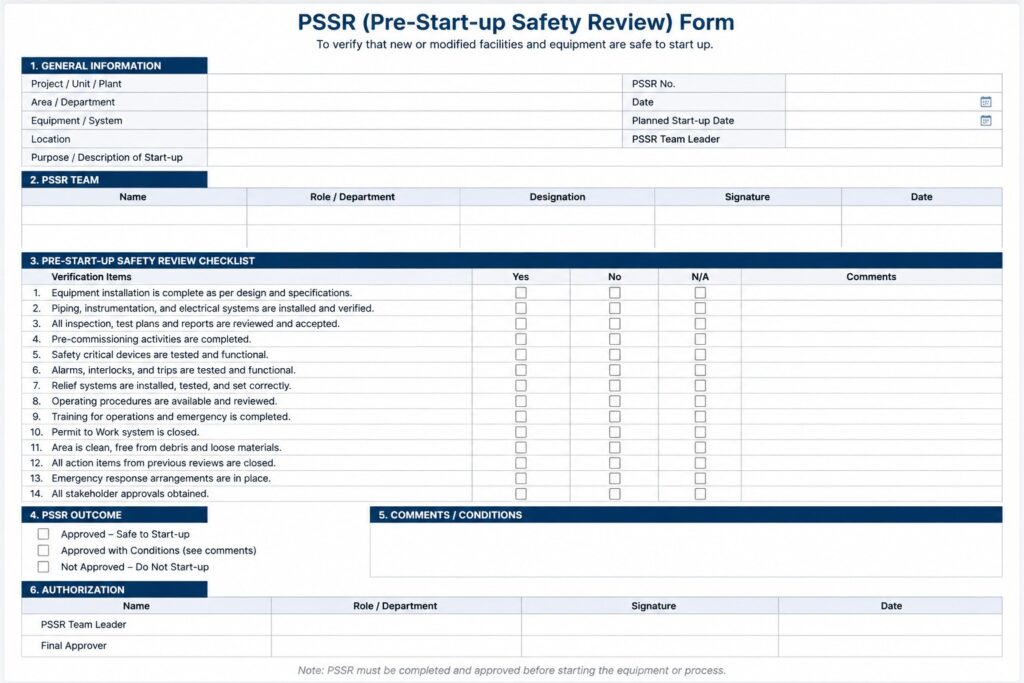
When a change involves new or significantly modified equipment, a pre-startup safety review confirms that the physical installation matches the approved design, safety systems are functional, procedures have been updated, and affected personnel are trained before the equipment enters service. Under OSHA’s Process Safety Management standard, this review is a specific regulatory requirement for covered processes.
MOC software embeds the pre-startup safety review as a formal workflow stage with a structured checklist and sign-off requirements assigned to qualified personnel. The platform holds the change at this stage until every checklist item is resolved and documented, establishing a defined hold point before startup. When the PSSR is embedded in the same record as the change request, risk assessment, and approval history, every piece of associated documentation is accessible in one location during regulatory inspection.
Regulatory and Standards Framework
Regulatory expectations around change control span multiple frameworks. The table below outlines key requirements and how management of change software supports compliance.
| Regulation | Key MOC Requirements | How MOC Software Supports Compliance |
|---|---|---|
| OSHA 29 CFR 1910.119 (Process Safety Management) | A written MOC procedure is required for all non-replacement-in-kind changes. Affected employees and contractors must be trained before startup. MOC records must be retained and available for regulatory inspection. | Enforces a documented workflow for every covered change. Captures training completion within the closeout stage. Maintains a permanent, time-stamped record per change. |
| ISO 45001 (OHS Management Systems) | OHS implications of new processes or activities must be assessed before implementation. Risks from planned changes must be managed. Documented information must demonstrate consistent application of change controls. | Integrates structured risk assessment into every change request. Routes changes to OHS reviewers based on configured workflow. Generates audit-ready records for ISO certification reviews. |
| EU Directive 2012/18/EU (Seveso III) | Safety management systems must include procedures for controlling modifications to installations and processes. Competent authorities must be notified of modifications with major accident implications. Change documentation must be retained as part of the facility safety report. | Captures and evaluates every modification before implementation. Escalates high-risk changes for authority notification. Produces documentation that satisfies competent authority inspection requirements. |
How Digital MOC Software Solves These Challenges
Paper-based and spreadsheet-driven management of change processes are prone to delays, lost documentation, and inconsistent application. Digital MOC platforms address these gaps directly.
Notification. Automated alerts notify stakeholders the moment a change request needs their input, approval, or action, removing the dependency on someone remembering to follow up manually.
Reporting. Centralized reporting consolidates every MOC record into a searchable, auditable repository, making it dramatically easier to prepare for regulatory audits or internal reviews.
Initial and Final Review Tracking. Digital capture of both the initial screening and final closeout review ensures that no change slips through without the required checkpoints and creates a clean audit trail from request to certificate.
Dashboard. Real-time dashboards give safety managers and leadership visibility into the status of every open management of change request across the organization, showing which changes are stuck, which are overdue, and where bottlenecks are forming.
Digital tools don’t replace the judgment required to evaluate risk, but they remove the administrative friction that causes so many MOC programs to break down in practice.
Common Challenges in Adopting MOC
Despite its clear value, management of change is still not universally adopted, and even where it is, implementation often falls short.
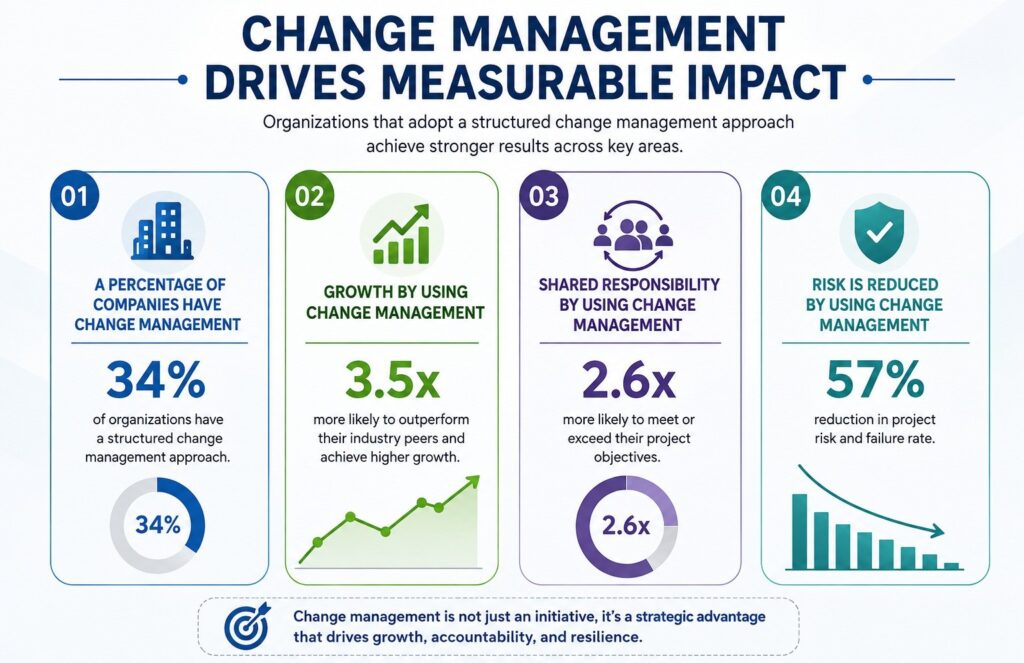
Not every industrial organization uses formal MOC software. Many facilities still rely on email, paper forms, or verbal approvals to authorize changes. MOC exists as a policy, but practice on the floor stays inconsistent.
The perception that MOC slows things down. Formal change control is often seen as time-consuming and resource-heavy. A poorly designed process can genuinely be slow, but that’s an argument for a better process, not for skipping it.
Shortcuts that trade a short delay for a long-term problem. Teams push minor or “temporary” changes through informally, intending to document them later. That documentation rarely happens, and an unreviewed modification stays in place indefinitely. The time saved upfront is almost always smaller than the cost of that gap surfacing during an audit or incident.
Note: Paper-based MOC is a weak substitute for digital tracking. Requests get lost between departments, approvals sit unanswered, and status is hard to track. A review that should take days can stretch into weeks. For MOC to actually function rather than exist only on paper, digital tracking is essential.
Case Study: What Happens When MOC Is Skipped
To illustrate the stakes, consider a representative scenario drawn from patterns seen across the chemical processing industry.
A mid-sized specialty chemical plant needed to replace a corroded feed pump. The replacement unit carried a slightly higher pressure rating than the original, but the maintenance team classified it as a replacement in kind to avoid the delay of a full MOC review. No risk assessment was performed and no procedure update was issued.
Weeks later, an operator ran the line at a flow rate that had been safe under the old pump’s limits but pushed the new pump into a pressure zone the downstream piping wasn’t rated for. A fitting failure released process fluid and triggered an emergency shutdown. No one was seriously injured, but the incident caused a multi-day production stoppage, an internal investigation, and a report to the site’s regulatory body.
The investigation traced the root cause back to the pump swap: the higher pressure rating changed the system’s operating envelope, which should have triggered a full MOC review and a piping compatibility check before installation.
Afterward, the facility implemented a digital MOC platform with mandatory screening for every equipment substitution. Within the first year, the system flagged several similar “like-for-like” replacements that turned out to involve meaningful specification changes, catching each one before installation. The cost of those extra reviews was measured in hours. The cost of the one review that had been skipped was measured in lost production days and regulatory scrutiny.
Conclusion
Management of change is one of the most effective tools an organization has for preventing the kind of incidents that come from small, unreviewed modifications quietly accumulating risk over time. From technical and equipment changes to shifts in personnel and organizational structure, MOC provides a structured way to ask the right questions, such as what’s changing, what could go wrong, and who needs to approve it, before a change is locked in.
Done well, management of change isn’t a bottleneck; it’s a safeguard that protects people, assets, and compliance standing while preserving institutional knowledge for the future. Organizations that haven’t yet formalized their MOC process, or that are still relying on manual, paper-based tracking, should treat this as a priority. The cost of building a strong management of change program is consistently lower than the cost of the incident it prevents.