
Introduction
Lockout tagout remains one of the most critical procedures in industrial safety, and getting it right increasingly depends on selecting the best lockout tagout software to support it. Manual lockout tagout processes, built on paper logs and physical tags, are increasingly unable to keep pace with the complexity of multi-site operations, contractor access, and regulatory scrutiny. Choosing the best lockout tagout software is therefore not simply a technology decision. It is a decision that directly shapes how well an organization identifies hazardous energy, authorizes work, and prevents incidents before they occur.
This guide walks through what lockout tagout software does, the workflow it should support, the compliance standards it must align with, and the questions worth asking before selecting a vendor so that safety, operations, and procurement teams can make an informed decision together.
What Is Lockout Tagout Software?
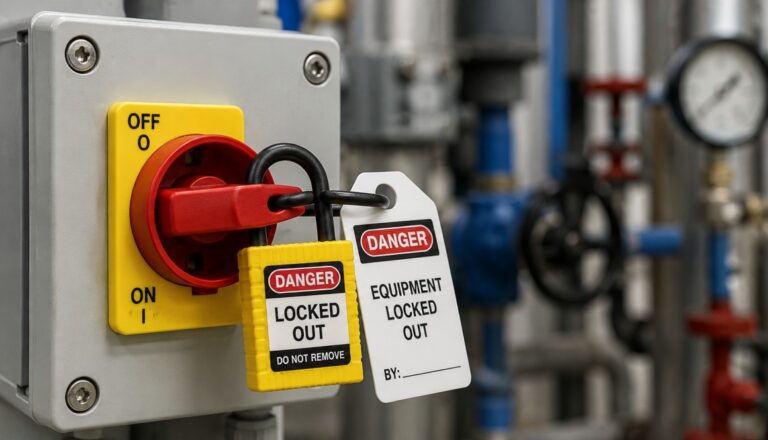
Lockout tagout software is a digital platform that manages the identification, isolation, and control of hazardous energy sources during equipment maintenance, servicing, or repair. It replaces manual permit books and physical tag registers with structured digital workflows that record every isolation point, every authorization, and every verification step. Rather than relying on a supervisor’s memory or a paper trail that can be misplaced, the software creates a single source of truth for who isolated what equipment, when, and under what authority. This traceability is what allows lockout tagout to function as a dependable component of a plant’s overall safety program rather than an isolated procedural checklist.
Why Organizations Are Moving to Digital LOTO Management
Organizations across manufacturing, oil and gas, and utilities are shifting away from paper-based lockout tagout because manual processes cannot scale with modern operational demands. A facility running multiple shifts, several contractors, and dozens of concurrent maintenance jobs cannot rely on physical tags alone to confirm that every energy source has been isolated correctly. Digital LOTO management gives safety teams real-time visibility into active isolations, overdue permits, and equipment still awaiting reinstatement. When lockout tagout data flows directly into a unified digital safety platform, leaders gain a consolidated view of risk exposure rather than fragmented records scattered across departments. This consolidation is often the deciding factor that pushes organizations to invest in the best lockout tagout software rather than continuing with spreadsheet-based tracking.
How to Apply LOTO: Safe Switch-On and Switch-Off Procedures
DGMS-Recommended Shutdown and Restart Sequence for Safe Isolation
The Directorate General of Mines Safety lays out a defined sequence for safely de-energizing and restoring equipment in its circular on Lockout and Tagout energy control procedures. The steps below reflect that sequence, from initial energy identification through to final restart.
- Identify the Energy Source: Before any shutdown begins, workers must pinpoint the type and level of energy powering the equipment, recognize the hazards it presents, and understand the correct approach to bringing it under control.
- Bring the Equipment to a Stop: Using the manufacturer-specified operating controls, the equipment is powered down in a way that reaches a safe state without exposing anyone to risk during the shutdown.
- Disconnect All Energy Sources: Every isolating device is engaged so the equipment is fully cut off from both its primary and backup power supplies. Partial measures, such as pulling fuses instead of performing a complete disconnection, are not acceptable.
- Neutralize Stored Energy: A thorough check confirms that all components have stopped moving, discharge rods or grounding wires are fitted where needed, built-up pressure is released, and any spring-loaded or gravity-affected parts are secured against unexpected motion.
- Confirm Isolation Is Complete: With the work area cleared, the main disconnect switch is checked to ensure it cannot shift to ON, a test meter verifies the power supply is fully de-energized, and all start controls are tried to reconfirm isolation before equipment controls are powered off.
- Apply Personal Locks and Tags: Each worker secures their own uniquely keyed lock and a completed identification tag to the disconnect point, so anyone in the vicinity can immediately see the equipment’s status and who is responsible.
- Restore Equipment Safely: Once the job is complete and the permit is closed out, each worker retrieves their own lock. The final lock, belonging to the person supervising the isolation, can only be removed by that individual, an accountability that cannot be transferred, before the equipment is brought back online.
Types of Energy Sources Controlled Using Lockout Tagout Software
Lockout tagout procedures must account for every form of hazardous energy present at an isolation point, not just the most obvious one. The best lockout tagout software allows each energy type below to be logged against specific equipment so that isolation instructions are unambiguous for every technician who performs the procedure.
- Electrical Energy: The most commonly recognized source, present in motors, control panels, wiring, and other powered components that require isolation at breakers or disconnect switches.
- Mechanical Energy: Stored in moving parts, springs, flywheels, and other components that can release kinetic force even after equipment is powered down.
- Hydraulic Energy: Present in pressurized fluid power systems used in presses, lifts, and other heavy machinery, requiring isolation of pressure lines and reservoirs.
- Pneumatic Energy: Found in compressed air lines and cylinders that can retain pressure long after the main air supply has been shut off.
- Thermal Energy: Heat or cold generated by process equipment, piping, or steam systems, capable of causing burns even when the equipment is not actively running.
- Chemical Energy: Present in reactive or hazardous process fluids that require isolation through valve lockouts and other dedicated devices.
- Gravitational Energy: Present wherever suspended loads or elevated components exist, frequently overlooked, and must be addressed through blocking or securing devices.
Where a single machine involves several energy types simultaneously, such as a hydraulic press with an electrical control panel, the software should require every associated isolation point to be closed before the permit can be marked complete, preventing a partial isolation from being mistaken for a full one.
Core Workflow of Lockout Tagout Software
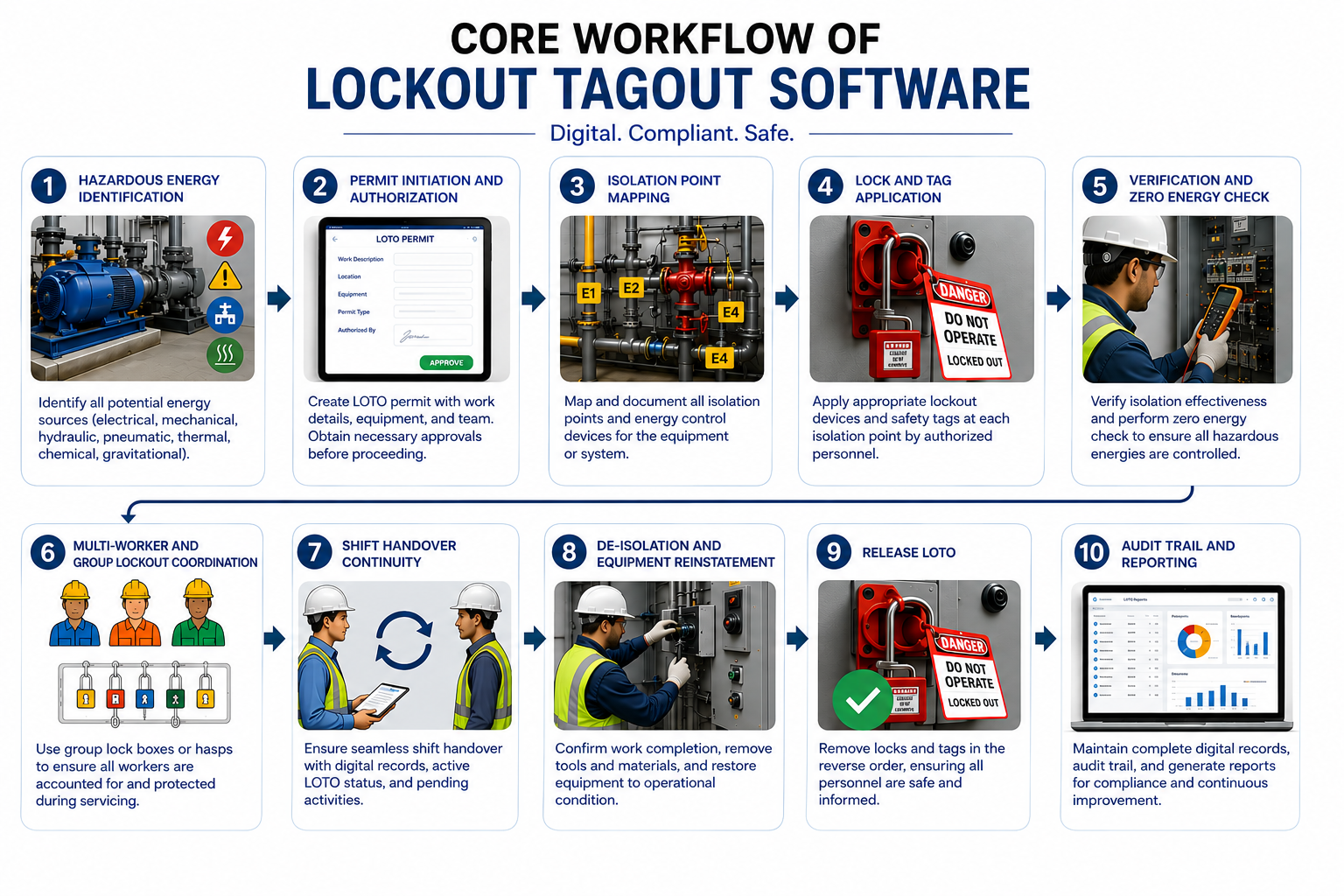
- Hazardous Energy Identification: The system maintains a documented inventory of every energy source associated with a piece of equipment, so technicians know exactly what must be isolated before work starts.
- Permit Initiation and Authorization: A digital permit is raised for the specific job, routed to the appropriate authorized personnel for approval before any isolation activity begins.
- Isolation Point Mapping: Each isolation point is mapped to its corresponding energy source and physical location, reducing the risk of missed or incorrectly identified points.
- Lock and Tag Application: Technicians record the application of physical locks and tags directly against the digital permit, creating a real-time link between the physical and digital record.
- Verification and Zero Energy Check: The platform prompts a formal verification step, requiring confirmation that all isolation points have reached a zero-energy state before work proceeds.
- Multi-Worker and Group Lockout Coordination: Group lockout boxes and multi-worker permits are managed digitally, ensuring that no single lock is removed until every authorized worker has signed off, even when workers are drawn from different teams or contractor organizations working on the same job.
- Shift Handover Continuity: Active isolations are automatically carried forward across shift changes, so incoming teams see exactly which equipment remains locked and why.
- De-isolation and Equipment Reinstatement: Before de-isolation, the system checks that all personnel, tools, and guards have been accounted for and confirms readiness for restart.
- Release LOTO: Locks are released only by the technician who applied them or through a documented authorized removal process, with the action time-stamped for the record.
- Audit Trail and Reporting: Every action, from initiation to release, is logged automatically, producing a complete audit trail available for internal review or regulatory inspection.
Regulatory Compliance Standards for Lockout Tagout Software
Lockout tagout software should be built to support compliance across the regulatory frameworks most commonly referenced by industrial safety teams. The table below summarizes the key standards and their relevance to LOTO management.
| Standard | Focus Area | Relevance to LOTO Software |
|---|---|---|
| OSHA 29 CFR 1910.147 | The Control of Hazardous Energy | Establishes the core US requirement for energy control procedures, authorized employee training, and periodic inspections |
| OSHA 29 CFR 1910.333 | Electrical Safety-Related Work Practices | Governs safe work practices around electrical hazards, reinforcing isolation requirements for electrical energy sources |
| EU Directive 2009/104/EC | Use of Work Equipment Directive | Sets minimum safety requirements for work equipment across EU member states, including isolation before maintenance |
| HSE (UK) PUWER 1998 | Provision and Use of Work Equipment Regulations | Requires UK employers to ensure equipment is safe to use and properly maintained, including isolation controls |
| HSE HSG253 | Safe Isolation of Plant and Equipment | Provides detailed UK guidance on isolation practices for a wide range of plant and equipment types |
| ISO 45001:2018, Clause 8.1.2 | Hazard Identification and Risk Assessment | Requires organizations to identify hazards such as uncontrolled energy release as part of operational planning |
| ISO 45001:2018, Clause 6.1.3 | Determination of Legal Requirements | Requires organizations to track applicable legal and regulatory obligations relevant to hazardous energy control |
Digital Lockout in LOTO: Smart and Secure Energy Isolation
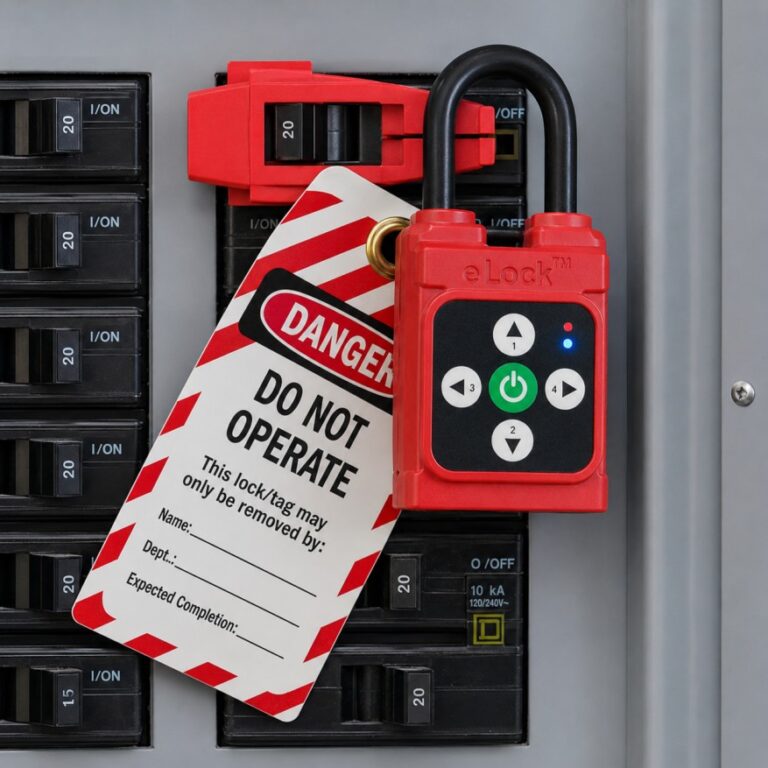
Digital lockout technology works much like traditional lockout tagout, with one key difference: the physical padlock is replaced by a smart, electronically connected device such as a smart padlock, an RFID-tagged isolation point, or a sensor-based lock that confirms energy status automatically. The rest of the procedure stays the same; workers still identify the energy source, isolate it, and verify a zero-energy state before starting work. The difference is that instead of relying purely on a technician’s visual check, the digital lock itself detects whether the isolation point has actually reached zero energy and records that confirmation directly in the system. This closes a common gap where a lock is applied but the underlying isolation device hasn’t fully engaged, and it reduces the amount of manual judgment needed at the verification stage. For organizations working in high-hazard environments, this creates an added layer of assurance without changing the core isolation process, and it leaves behind a defensible, time-stamped record that isolation was confirmed electronically rather than assumed, which proves valuable during any post-incident review or regulatory audit.
Key Benefits of Digital Lockout Tagout Software
The advantages of moving lockout tagout onto a digital platform extend well beyond convenience, touching safety outcomes, regulatory posture, and operational efficiency at the same time.
- Reduced Human Error: Structured digital workflows prevent steps from being skipped or performed out of sequence, which is a common cause of lockout tagout incidents.
- Improved Visibility: Safety managers can see every active isolation across a facility or multiple sites from a single dashboard rather than relying on physical walkthroughs.
- Faster Incident Investigation: A complete digital audit trail allows investigators to reconstruct the exact sequence of events following any incident or near miss.
- Stronger Regulatory Readiness: Automated documentation ensures records are available and complete whenever regulators request evidence of compliance.
- Better Contractor Oversight: Digital permits make it easier to confirm that contractors have received the correct site-specific isolation training before starting work.
- Reduced Downtime: Faster permit processing and clearer isolation instructions shorten the time between shutdown and safe work start.
Key Features to Look for in the Best Lockout Tagout Software
- Digital Permit Management: The platform should support end-to-end permit creation, approval routing, and closure, replacing paper-based permit books entirely.
- Mobile Accessibility: Field technicians need the ability to initiate, verify, and close isolations directly from a mobile device at the equipment location.
- Equipment and Energy Source Database: A centralized, searchable database of equipment and their associated energy sources ensures consistency across every isolation performed.
- Real-Time Dashboard Visibility: Safety leaders should be able to view active isolations, overdue permits, and equipment status across every site in real time.
- Automated Compliance Reporting: The system should generate audit-ready reports aligned with OSHA, HSE, and ISO 45001 documentation requirements without manual compilation.
- Integration Capability: Lockout tagout software should integrate with existing permit-to-work, maintenance management, and incident reporting systems to avoid duplicate data entry. Organizations already operating a broader digital safety platform should confirm that lockout tagout data feeds directly into that system, rather than sitting as a standalone module disconnected from the rest of the safety program.
Key Features to Look for in a LOTO Safety Lockout Device
- Durability and Material Strength: Devices must withstand harsh industrial environments, including exposure to chemicals, moisture, and temperature extremes, without degrading.
- Universal or Application-Specific Fit: The device should either fit a wide range of equipment types or be purpose-built for a specific isolation point, depending on facility needs.
- Tamper-Resistant Design: A quality lockout device should resist unauthorized removal or bypass, protecting the integrity of the isolation.
- Clear Identification and Labeling: Devices should allow for legible, durable labeling that identifies the responsible technician and the date of application.
- Multi-Lock Capacity: Group lockout scenarios require devices, such as hasps or group boxes, that accommodate multiple padlocks from different workers simultaneously.
- Color Coding for Hazard Recognition: Standardized color schemes help technicians quickly identify lock ownership or hazard type at a glance, which is particularly useful during group lockout scenarios involving multiple trades on the same equipment.
- Ease of Application: Devices should be simple to apply and remove correctly under normal working conditions, reducing the temptation to bypass proper procedure.
Types of LOTO Safety Lockout Devices and Their Applications
- Circuit Breaker Lockouts: Fit over circuit breaker switches to prevent them from being turned back on during electrical isolation work.
- Valve Lockout Devices: Secure ball valves, gate valves, and other valve types in the closed position to control hydraulic, pneumatic, or chemical energy.
- Plug Lockout Devices: Cover electrical plugs to prevent equipment from being reconnected to a power source during maintenance.
- Cable Lockouts: Provide a flexible option for isolating equipment with irregular shapes or multiple access points using a single cable and lock.
- Group Lockout Boxes: Allow multiple workers involved in the same job to apply individual locks, ensuring equipment cannot be restarted until every worker has cleared the area.
- Pneumatic and Hydraulic Lockouts: Block valves or fittings in compressed air and fluid power systems to prevent accidental pressurization.
- Padlocks and Hasps: Serve as the foundational hardware for nearly every lockout application, often used alongside more specialized devices.
Challenges in Lockout Tagout and How Digital Solutions Address Them
Even well-designed lockout tagout programs run into practical challenges on the plant floor. Modern LOTO software increasingly builds in specific safeguards to close these gaps.
- IoT Sensor-Based Control Panels: A common challenge is confirming that an isolation point has genuinely reached a zero-energy state rather than relying on a technician’s manual check alone. IoT-enabled sensors fitted to control panels and isolation points can continuously monitor energy status and feed that data directly into the control panel, giving supervisors a live, verified view of every isolation across the facility rather than a periodic manual sweep.
- Pre-Approval Workflows: Unauthorized or rushed isolations are a recurring risk, especially when multiple jobs are competing for the same equipment. Requiring pre-approval before a lockout permit can be issued ensures a supervisor or safety officer reviews and signs off on the job scope, energy sources, and required isolation points before any physical work begins, preventing isolations from being started informally.
- Notification Alerts to Higher Authorities: When a lockout is overdue, a lock is removed without proper sign-off, or an isolation point shows unexpected activity, automated alerts sent to senior safety personnel or plant management ensure the issue is escalated immediately rather than surfacing later during a routine audit or, worse, after an incident.
- CCTV Camera Integration: Visual verification adds another layer of assurance, particularly for high-risk or high-consequence equipment. Linking CCTV coverage to isolation points allows safety teams to visually confirm that a lock has been physically applied and remains in place and provides recorded evidence that supports incident investigations or regulatory audits.
Together, these capabilities move lockout tagout from a process that depends heavily on individual diligence toward one that is continuously monitored, escalated automatically when something goes wrong, and independently verifiable, closing many of the gaps that manual or partially digital LOTO programs still face.
Questions to Ask Before Selecting a LOTO Software Vendor
Does the platform support multi-site and multi-language deployment?
Organizations operating across regions need a system that can standardize procedures while accommodating local language and regulatory differences.
Can it handle group lockout scenarios and contractor access?
The platform should manage complex multi-worker permits as easily as single-technician isolations, with clear contractor onboarding controls.
How configurable are approval hierarchies and escalation rules?
Different sites and job types often require different levels of authorization, so the system should adapt to existing organizational structures.
What audit and reporting formats does it generate out of the box?
Vendors should be able to demonstrate report templates aligned with OSHA, HSE, and ISO 45001 requirements without custom development. It is also worth asking how the vendor supports data migration from existing paper or spreadsheet records, since a smooth transition period often determines how quickly a site achieves full adoption.
Conclusion
Selecting the best lockout tagout software is ultimately about strengthening an organization’s entire approach to hazardous energy control. The best platforms do more than digitize paperwork. They enforce correct sequencing, provide real-time visibility across sites, and generate the audit trails that regulators and internal safety teams both depend on. Organizations evaluating vendors should look closely at workflow completeness, mobile usability, and integration capability while also confirming that the physical lockout devices in use meet the durability and identification standards the job demands. When the best lockout tagout software and dependable hardware work together, hazardous energy control becomes a consistent, auditable part of daily operations rather than a procedure left to individual judgment. Organizations that treat this selection process with the same rigor applied to other core safety technology investments tend to see faster adoption, fewer compliance gaps, and a measurable reduction in energy-related incidents over time.