
Industrial sites are running more work activities, managing larger contractor workforces, and operating under increasingly detailed regulatory scrutiny. In that environment, the systems designed to keep workers safe need to keep pace. The HSE permit to work process is one of the most critical of those systems, and for too many organizations, it is still running on paper, clipboards, and manual sign-off chains that were never designed for the demands of a modern site.
Automation is changing that. What was once a paperwork burden is becoming a strategic safety asset that gives managers real oversight, gives regulators a defensible audit trail, and gives workers the assurance that the controls around their work have actually been verified.
What Is an HSE Permit to Work System?
An HSE permit-to-work system is a formal control mechanism that authorizes specific individuals to carry out defined hazardous tasks under agreed conditions. It is not simply a form. It is a structured process that brings together hazard identification, risk assessment, isolation confirmation, and multi-level authorization before a single tool is picked up.
The range of work types covered is broad. Hot work near flammable atmospheres, confined space entry, electrical isolation, work at height, excavation near buried services, and lifting operations all require specific permit types with their own preconditions and sign-off requirements.
ISO 45001 establishes a permit to work as a key operational control within an occupational health and safety management system. OSHA Process Safety Management standards require written procedures for non-routine work in process facilities. Organizations that treat PTW as a box-ticking exercise quickly find themselves exposed when incidents occur and regulators look for evidence that the process was followed.
Challenges of Manual PTW Processes
The table below shows how a manual HSE permit to work process compares with a digital system across the areas that matter most to safety managers and compliance teams.
| Manual HSE Permit to Work | Digital HSE Permit to Work |
|---|---|
| Paper forms filled by hand, prone to missing fields and illegible entries | Structured digital form guides the requestor, mandatory fields enforced before submission |
| Physical sign-off required, approvals stall when supervisors are unavailable or off-site | Instant digital routing to the right approver, accessible from any device, anywhere on site |
| Risk assessment completed as a separate document, often treated as a formality | Embedded directly in the permit workflow, scored automatically, cannot be bypassed |
| No live view of active permits; supervisors rely on physical logbooks and verbal updates | Live dashboard showing all active, pending, expiring, and closed permits in real time |
| Conflicts between simultaneous work activities easy to miss with no cross-referencing capability | System flags permit conflicts and routes for SIMOPs review before approval is granted |
| Incomplete paper records make regulatory audits time-consuming and compliance gaps hard to defend | Immutable timestamped records are searchable and exportable, ready for regulatory inspection at any time |
What Is PTW Workflow Automation?
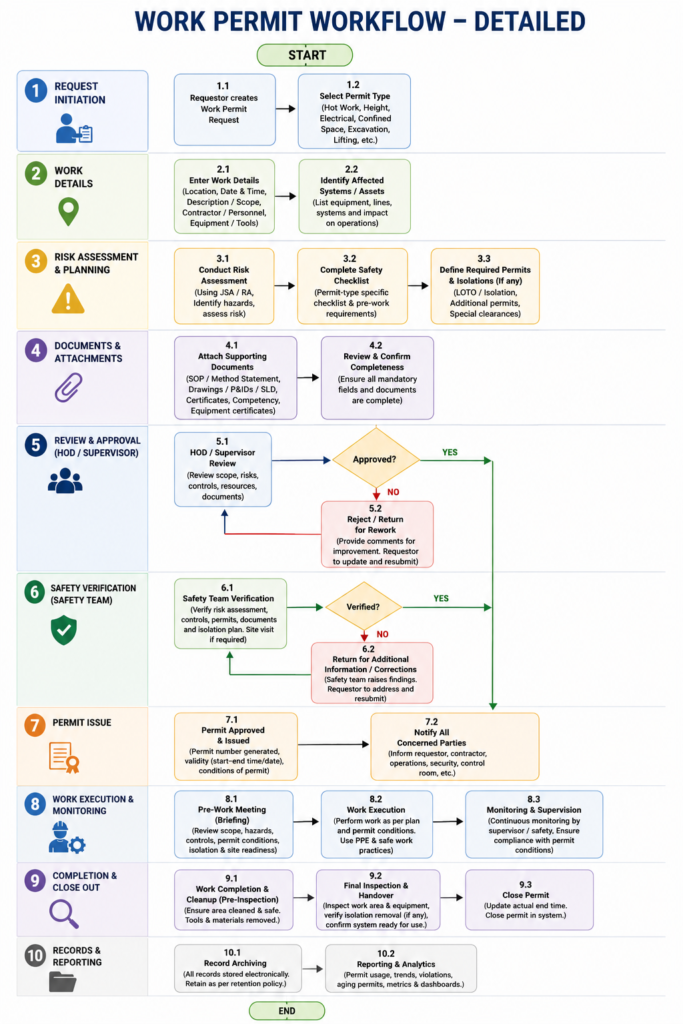
PTW workflow automation applies digital systems to manage, route, track, and record every stage of the permit-to-work lifecycle. It replaces paper forms and manual approval chains with a structured digital process that enforces each step in sequence, notifies the right people at the right time, and creates a complete, timestamped record of every action taken from request through to close-out and archiving.
Core benefits of HSE Permit to Work Workflow Automation
Streamlined Permit Workflows
A fully automated HSE permit-to-work system digitizes every stage of the permit lifecycle, from the moment a requestor raises a work order to the final archiving of records. Each stage triggers the next automatically. Requestors submit permits through a structured digital interface. Reviewers act on complete, clearly presented requests. Approvers sign off from any device, from anywhere on site. Close-out is recorded digitally with full confirmation. The result is a permit process that moves faster, loses nothing, and produces a complete record without additional administrative effort.
Real-Time Dashboards and Reports
Safety managers gain live oversight of every permit across the facility, showing which permits are active, pending approval, approaching expiry, or closed. That information is available from any device without anyone conducting a physical walkdown or calling supervisors for updates.
Customizable KPI dashboards allow safety managers to track permit cycle times, approval rates, open permit counts by work type, and compliance with renewal procedures. Weekly operational reports, monthly trend analyses, quarterly compliance reviews, and annual summaries are generated and distributed automatically, giving leadership an accurate picture of permit activity without anyone compiling data manually.
Alert and Notification System
Automated notifications keep every stakeholder informed at every stage. When a permit is submitted, the reviewer is notified immediately. When it is approved or rejected, the requestor is informed without delay. When a permit is approaching its expiry window, responsible parties receive an alert with enough time to act.
If a permit requiring approval sits without action beyond a defined threshold, the system escalates to the next authority level automatically. Safety breaches or site condition changes trigger notifications to all relevant parties in real time. The communication burden on individual supervisors is replaced by a systematic process that runs without human prompting.
Risk Assessment Integration
In a manual HSE permit to work process, risk assessments are often treated as a formality completed after the decision to proceed has already been made. Embedding digital JSA and risk assessment forms directly into the permit workflow changes that. The risk evaluation becomes a genuine precondition rather than an afterthought.
The system scores hazard levels automatically and routes high-risk permits to the appropriate senior authority. Lower-risk work moves through a faster approval path. Over time, accumulated risk data becomes a resource for trend analysis, pre-task planning, and audit preparation.
Evacuation Assistance Workflow
When an emergency occurs, the immediate questions are always the same: who is on site, where are they, and are they accounted for? A digital HSE permit-to-work system answers those questions in real time. Every active permit is linked to the individuals authorized to carry out the work, so the system generates an immediate report of who should be on-site and their last-known work location.
Digital muster and headcount processes allow assembly point marshals to confirm attendance against the permit record, identify anyone unaccounted for, and communicate with emergency response coordinators faster and more accurately than any manual headcount process allows.
LOTO Hardware Integration
For facilities managing electrical work, pressure systems, or rotating equipment, the connection between the digital PTW system and physical Lockout/Tagout hardware is a significant safety control. The system enforces permit interlocks so that a work permit cannot progress to execution until relevant isolations have been physically applied and confirmed in the digital record.
Every energy isolation point, every lock applied, and every verification step is logged automatically. Digital isolation records replace handwritten LOTO sheets and provide defensible compliance evidence for regulatory inspections.
SIMOPs Management
Simultaneous Operations (SIMOPs) occur when multiple work activities run at the same time in the same area or on interconnected systems, creating hazards that no single permit review would catch in isolation. A digital HSE permit-to-work system maps active permits against work locations and flags conflicts automatically before approval is granted. Dedicated SIMOPs workflows coordinate the scheduling of concurrent activities, define exclusion zones, and keep all linked permit statuses updated in real time so no team is working on conditions that no longer apply.
Regulatory Compliance Frameworks for HSE Permit to Work
Different regulatory bodies set their own requirements for permit-to-work systems. Understanding which frameworks apply to your operation is essential for ensuring your PTW process meets the required standard.
| Regulatory Body | Framework | Key PTW Requirement |
|---|---|---|
| OSHA | Process Safety Management (29 CFR 1910.119) | Written safe work practices for controlling hazardous work, including hot work, confined space entry, and lockout/tagout in process facilities |
| ISO | ISO 45001:2018 | Permit to work established as a required operational control for managing non-routine and high-hazard work within an occupational health and safety management system |
| HSE (UK) | Health and Safety at Work Act 1974 / Permit to Work Systems Guidance (HSG250) | Formal PTW systems required for high-risk activities; guidance specifies design, implementation, and monitoring of permit systems to control foreseeable hazards |
| EU | Directive 92/57/EEC (Temporary and Mobile Construction Sites) / ATEX Directive 1999/92/EC | PTW controls required for work in explosive atmospheres and on construction sites with multiple contractors; risk coordination obligations apply to principal contractors |
Key Features to Look for in a PTW Automation Solution
A configurable no-code or low-code workflow builder gives the safety team control over the process without technical dependency. Role-based access control should reflect the actual approval hierarchy of the organization. Mobile accessibility is essential for field workers. Integration APIs for LOTO, ERP, and CMMS systems ensure permit data flows between platforms. Automated scheduled reports, offline capability for remote sites, and a robust audit and compliance reporting module complete the essential feature set.
How to Successfully Implement PTW Workflow Automation
Step 1: Map Current PTW Processes Document every permit type, the full approval chain, and the information collected at each stage. This forms the foundation for accurate digital workflow configuration.
Step 2: Identify Pain Points and Compliance Gaps Analyze where permits stall, where audit findings appear, and which work types carry the highest residual risk. This defines priorities for configuration.
Step 3: Choose the Right Solution Evaluate platforms against the full scope of requirements. A system that cannot handle complex high-hazard work will leave the most critical processes manual.
Step 4: Configure Workflows, Roles, and Approvals Translate the mapped process into the digital system. Configure approval hierarchies, risk scoring thresholds, notification rules, and escalation paths.
Step 5: Integrate With Existing Systems Connect the PTW platform to LOTO hardware, maintenance management systems, and site access controls so permit data flows across the operational environment.
Step 6: Train Teams and Run a Parallel Pilot Run the digital system alongside the existing paper process on a defined subset of permits before full rollout. This builds confidence and surfaces configuration issues before the old system is retired.
Step 7: Monitor Dashboards and Refine Once live, use the analytics and dashboards as the primary tool for continuous improvement. Permit cycle times, approval bottlenecks, risk trends, and compliance metrics all become visible in ways that a paper-based system cannot provide.
Case Study: Priya Cement
Priya Cement’s large-scale manufacturing facility was running permits on paper, with manual approval routing that added two to four hours to every work request. Work teams stood idle, maintenance windows were missed, and concurrent permit conflicts were caught only through informal communication. Compliance records were incomplete, leaving the safety team scrambling before every audit.
After implementing a digital HSE permit-to-work system, approval routing became automatic, and approvers could sign off from their mobile devices in minutes. Automated expiry alerts eliminated lapsed permits. A live dashboard gave the safety team real-time visibility across all active permits with automatic conflict detection.
Within the first quarter, approval times dropped significantly, the permit backlog cleared, and the compliance record became complete and instantly accessible.
Conclusion
An HSE permit-to-work system has always been one of the most important controls for managing risk in non-routine industrial operations. For too long, manual processes have prevented it from fulfilling that potential.
Workflow automation changes that. It makes the HSE permit-to-work process faster, more reliable, more visible, and more defensible. It reduces the administrative burden on safety teams while increasing the quality of the controls in place. And it elevates the permit to work from a compliance checkbox into what it was always meant to be: a proactive, integrated part of a safety culture that protects workers every day.