
Introduction
EHS software for the aerospace industry has become essential as aerospace manufacturing involves high-risk operations such as CNC machining, composite manufacturing, welding, heat treatment, chemical processing, paint booths, and robotic assembly. These processes expose workers to metal dust, hazardous chemicals, high temperatures, confined spaces, and heavy machinery, making safety management increasingly complex.
Paper-based permits, spreadsheets, and manual inspections are no longer sufficient to manage these risks or meet regulatory expectations. Modern EHS software for the aerospace industry connects permits, inspections, incident reporting, contractor safety, waste management, and risk assessments into one digital platform, providing “real-time visibility, stronger compliance, and safer manufacturing operations.
Overview of EHS Challenges in Aerospace Manufacturing
- Hazardous chemical processes: involving chromic acid, solvents, and coatings require strict handling, ventilation, and PPE controls.
- Composite manufacturing and CNC machining: generated carbon fiber dust, metal dust, and machining chips that pose respiratory, fire, and explosion risks.
- High-risk maintenance activities: such as confined space entry, hot work, work at height, and Lockout Tagout (LOTO) demand rigorous safety procedures.
- Contractor management: requires verification of competency, medical fitness, certifications, and site-specific induction before work begins.
- Hazardous waste management: must ensure proper tracking, storage, transportation, and disposal of chemicals, solvents, composite waste, and metal scrap.
- Regulatory compliance and audits: require accurate, traceable records for ISO 45001, ISO 14001, AS9100, and environmental regulations, making paper-based systems difficult to manage effectively.
Manual Safety Challenges vs Digital EHS Solutions in Aerospace Manufacturing
|
Major Aerospace Manufacturing Hazard |
Potential Consequences |
Traditional Challenge |
Digital EHS Solution |
|
CNC Machining Operations |
Cuts, crush injuries, machine entanglement |
Paper inspections are often missed or delayed |
Digital inspections verify machine safety before operation |
|
Composite Manufacturing |
Chemical exposure, respiratory issues, fire risk |
Manual chemical and curing records |
SDS integration and digital inspections improve control |
|
Carbon Fiber Dust |
Respiratory hazards and dust accumulation |
Paper PPE and dust control logs |
Digital inspections and PPE monitoring |
|
Titanium & Aluminum Machining |
Fire and explosion from metal dust |
Manual housekeeping schedules |
Automated cleaning schedules and alerts |
|
Chemical Processing & Electroplating |
Chemical burns, toxic exposure |
Paper chemical records |
Digital tracking with SDS access |
|
Hot Work |
Burns, fire, explosion |
Manual permit approvals |
Digital PTW with fire watch verification |
|
Work at Height |
Falls and serious injuries |
Paper inspection records |
Digital permits linked to inspections |
|
Lockout Tagout (LOTO) |
Unexpected equipment energization |
Manual isolation checklists |
Digital LOTO verification workflow |
|
Contractor Management |
Unqualified workers |
Manual induction verification |
Safety Pass with competency validation |
|
Hazardous Waste Management |
Environmental violations |
Spreadsheet-based tracking |
Digital tracking with alerts and reports |
|
Incident & Near Miss Reporting |
Repeat incidents |
Delayed paper reporting |
Digital reporting with CAPA tracking |
|
Emergency Evacuation & Headcount |
Incomplete evacuation |
Manual roll calls |
Digital live headcount management |
Core Benefits of EHS Software for Aerospace Manufacturing
The right EHS software for aerospace industry facilities touches nearly every corner of daily operations, from who is allowed onto the floor to how hazardous waste leaves the building. The sections below break down where it makes the biggest difference.
Permit to Work with EHS Software for the Aerospace Industry
A structured Permit to Work system controls high-risk activities such as hot work, confined space entry, and work at height. The digital workflow begins with hazard identification and risk assessment, followed by multi-level approvals and energy isolation verification. Before work starts, a toolbox talk is recorded, and once the task is complete, the permit is closed after confirming the work area is safe. Every step is time-stamped, providing a complete digital audit trail for compliance and future review.
PTW Stage | Why It Matters | What Happens if Missed |
Hazard identification | Defines the specific risks of the task before work begins | Unidentified hazards go uncontrolled during execution |
Risk assessment | Determines appropriate controls and precautions | Inadequate controls increase likelihood of incidents |
Multi-level approval | Ensures accountability from supervisors and EHS staff | High-risk work could proceed without proper oversight |
Energy isolation confirmation | Confirms equipment is de-energized before work starts | Risk of electrical, mechanical, or hydraulic injury |
Toolbox talk | Ensures all workers understand task-specific hazards | Workers may proceed without understanding site-specific risks |
Permit closure | Confirms area is restored to a safe operating state | Isolations may be left in place or hazards left unresolved |
Hot Work Permit
A Hot Work Permit is required for activities such as welding, cutting, grinding, brazing, and soldering that generate heat, sparks, or open flames. In aerospace manufacturing, these tasks are often carried out near composite materials, paints, solvents, and other combustible substances, making strict authorization, fire watch, and area inspections essential before work begins.
Confined Space Entry Permit
A Confined Space Entry Permit is mandatory before entering enclosed areas such as fuel tanks, pressure vessels, ducts, pits, or aircraft structural compartments. The permit ensures atmospheric testing, ventilation, standby personnel, emergency rescue arrangements, and safe entry procedures are completed before workers enter the confined space.
Work at Height Permit
A Work at Height Permit is required for tasks performed on elevated platforms, scaffolding, aircraft wings, fuselage sections, overhead cranes, or maintenance structures. The permit verifies that fall protection equipment, anchor points, access platforms, and rescue arrangements are in place before work starts.
Electrical Work Permit
An Electrical Work Permit is required for maintenance, testing, installation, or repair of energized electrical systems, control panels, switchgear, and high-voltage equipment. It confirms proper isolation, lockout procedures, electrical testing, and authorization before electrical work is carried out.
Emergency Evacuation Permit
An Emergency Evacuation Permit helps control personnel movement during emergencies, plant shutdowns, gas leaks, fires, or other critical situations. It ensures evacuation routes are clear, headcount procedures are followed, emergency responders are informed, and only authorized personnel enter restricted areas.
General Work Permit
A General Work Permit is used for routine maintenance, inspections, servicing, and non-routine activities that do not fall under other high-risk permit categories. It ensures hazards are identified, safety precautions are implemented, and the required approvals are obtained before work begins.
Incident Management & CAPA
When something does go wrong, a hand injury during machining, a chemical splash during a plating process, or a near-collision with a forklift the response speed and quality matter. Incident management modules allow immediate reporting from a mobile device on the shop floor, triggering an investigation workflow that includes root cause analysis, often using the 5 Why method. From there, Corrective and Preventive Actions (CAPA) are assigned to specific owners with due dates, and the resolution is tracked until closure. Findings are shared across departments so similar incidents don’t recur in a different part of the plant.
Step | Why It Matters | What Happens if Missed |
Immediate reporting | Captures accurate details while the incident is fresh | Details are lost or distorted over time |
Investigation | Identifies contributing factors and process gaps | Underlying causes remain unaddressed |
Root cause analysis (5 Why) | Gets to the actual cause rather than the symptom | Surface-level fixes fail to prevent recurrence |
CAPA assignment | Ensures accountability for corrective action | Actions stall with no clear owner |
Organizational learning | Shares lessons across shifts and departments | Similar incidents recur elsewhere in the facility |
In a modern digital EHS platform, these modules rarely operate in isolation. A near miss reported on the shop floor, for instance, can automatically trigger a risk assessment review, generate a CAPA for the responsible department, schedule a follow-up inspection or audit, and notify the relevant supervisor or safety manager, all without manual handoffs between systems. Management dashboards update in real time as each step is completed. This connected workflow improves traceability, strengthens accountability, and supports continuous safety improvement across aerospace manufacturing operations, rather than leaving each function to operate as a disconnected silo.
Near Miss Reporting and CAPA in Aerospace Manufacturing
Aerospace manufacturers put real emphasis on near miss reporting because it surfaces risk before an actual injury occurs. A dropped tool near a machining cell, a slippery patch near a paint booth, or a temporary blockage of an emergency exit are all signals worth capturing. EHS software makes this reporting fast, often a few taps on a mobile app and routes each near miss into the same CAPA workflow used for incidents, so patterns can be caught and corrected before they escalate into something more serious.
Headcount Management
During an emergency evacuation, knowing exactly who on-site employees, contractors, and visitors is critical. EHS software maintains a live headcount by pulling data from access control and induction records, so that during a fire drill or an actual emergency, the safety team can confirm assembly point numbers against the expected count in minutes rather than relying on a manual roll call across a large facility.
Management of Change (MoC)
Aerospace manufacturing environments change constantly: a new CNC machine gets installed, a robotic work cell is reconfigured, a chemical supplier changes their solvent formulation, or a new composite material is introduced for a program. Each of these changes can introduce risks that weren’t present before. An MoC workflow requires that any significant change, new tooling, layout modifications, process changes, or chemical substitutions go through a structured review before implementation, capturing what changed, what the new risks might be, and what controls need to be updated.
MoC Trigger | Why It Matters | What Happens if Missed |
New CNC machine or robot installation | New equipment may introduce unfamiliar hazards | Operators may be exposed to unassessed risks |
Chemical substitution | Different chemicals may need different PPE or storage | Incompatible storage or improper handling could occur |
Composite material change | New materials may have different dust or resin properties | Existing controls may not adequately protect workers |
Process or layout modification | Changes can affect traffic flow, ventilation, or emergency egress | Safety gaps may go unnoticed until an incident occurs |
Observation Reporting
Beyond formal incidents, day-to-day safety observations, a guard left off a machine, poor housekeeping near a walkway, or a minor spill not yet cleaned matter. Mobile observation reporting lets any employee log a concern with a photo attached in seconds. AI-assisted categorization sorts these observations by type and area, helping EHS teams spot recurring issues in specific zones, such as repeated housekeeping problems near a particular machining line, and assign corrective actions accordingly.
Inspection Checklists & AI Scheduling
Routine inspections cover a wide range of equipment: CNC machines, hydraulic presses, compressors, paint booths, dust collection systems, chemical storage areas, pressure vessels, overhead cranes, and autoclaves. Digital checklists standardize what gets checked and store the results with photo evidence where relevant. AI-based scheduling can analyze inspection history and equipment usage patterns to recommend inspection frequency adjustments for instance, increasing dust collector checks during periods of heavier composite machining rather than relying on a fixed calendar that doesn’t account for actual operating conditions.
Because every check is logged digitally, the system maintains a complete inspection history for critical manufacturing assets such as CNC machines, robotic cells, autoclaves, hydraulic presses, compressors, paint booths, and heat treatment furnaces. Reviewing this history over time makes it easier to spot recurring issues on a specific machine or line, helping maintenance teams plan preventive actions before those issues escalate into equipment failures or safety incidents.
Lockout Tagout (LOTO)
LOTO discipline is especially critical in aerospace manufacturing given the range of machinery involved CNC machines, milling machines, lathes, robotic cells, hydraulic presses, heat treatment furnaces, compressors, paint booths, autoclaves, and laser cutting machines. Each of these has distinct isolation points, and a digital LOTO system maps out the specific energy sources for each equipment type, confirms that isolation devices are applied correctly, and requires sign-off before maintenance work begins. This removes reliance on memory or generic checklists for equipment with complex isolation requirements.
LOTO Step | Why It Matters | What Happens if Missed |
Equipment-specific isolation mapping | Different machines have different energy sources to isolate | Incomplete isolation leaves residual energy hazards |
Lock and tag application | Physically prevents accidental re-energization | Equipment could be started while a worker is still exposed |
Verification/zero-energy check | Confirms isolation was effective before work starts | Worker may begin task under a false assumption of safety |
Sign-off before work | Creates accountability for the isolation process | No clear record of who confirmed the equipment was safe |
Lock removal after work | Restores equipment safely to operation | Equipment may remain unnecessarily offline or unsafely restored |
Safety Data Sheet (SDS) Management
EHS software centralizes Safety Data Sheets (SDS) for chemicals used in aerospace manufacturing, such as solvents, adhesives, resins, paints, and cleaning agents. Employees can quickly access the latest SDS to understand hazards, PPE requirements, handling procedures, storage guidelines, and emergency response measures, helping improve chemical safety and regulatory compliance.
Audit Management with EHS Software for the Aerospace Industry
Internal audits, external compliance audits, and customer quality audits are a constant in aerospace manufacturing. Unlike many manufacturing industries, aerospace facilities undergo frequent external audits, internal audits, supplier audits, certification audits, and regulatory inspections because aircraft components are safety-critical and every manufacturing process must be fully traceable. From CNC machining and composite manufacturing to heat treatment, surface treatment, assembly, and final testing, complete documentation and timely corrective actions are essential to maintain compliance, certification, and customer confidence.
Digital audit management software simplifies this process by automating audit schedules, standardizing checklists, capturing digital evidence, and tracking corrective and preventive actions (CAPA) until they are verified and closed. Real-time dashboards and reports provide visibility into audit completion status, recurring findings, overdue corrective actions, and overall compliance performance, helping aerospace manufacturers remain continuously audit-ready instead of preparing only when an audit is announced.
Audit Step | Why It Matters | What Happens if Missed |
Audit Planning & Scheduling | Ensures internal, customer, supplier, and compliance audits are completed on time. | Delayed audits can create compliance gaps and affect certification or customer confidence. |
Standardized Digital Checklists | Maintains consistent inspections across machining, composite manufacturing, assembly, and testing areas. | Critical observations may be missed, leading to inconsistent audit quality and non-conformities. |
Non-Conformance & CAPA Tracking | Ensures audit findings are assigned, corrected, and verified before closure. | Repeated issues remain unresolved, increasing operational and compliance risks. |
Audit Reports & Dashboards | Provides real-time visibility into audit findings, compliance trends, and pending actions. | Limited visibility makes it difficult to monitor recurring issues and maintain continuous audit readiness. |
AI Risk Assessment
Dynamic risk scoring uses data from past incidents, inspection results, and near miss reports to continuously update the risk level associated with specific machines, processes, or areas of the plant. Rather than a static risk assessment done once a year, this gives EHS teams a living picture of where risk is currently concentrated for example, flagging a machining line with a recent uptick in near misses for closer attention.
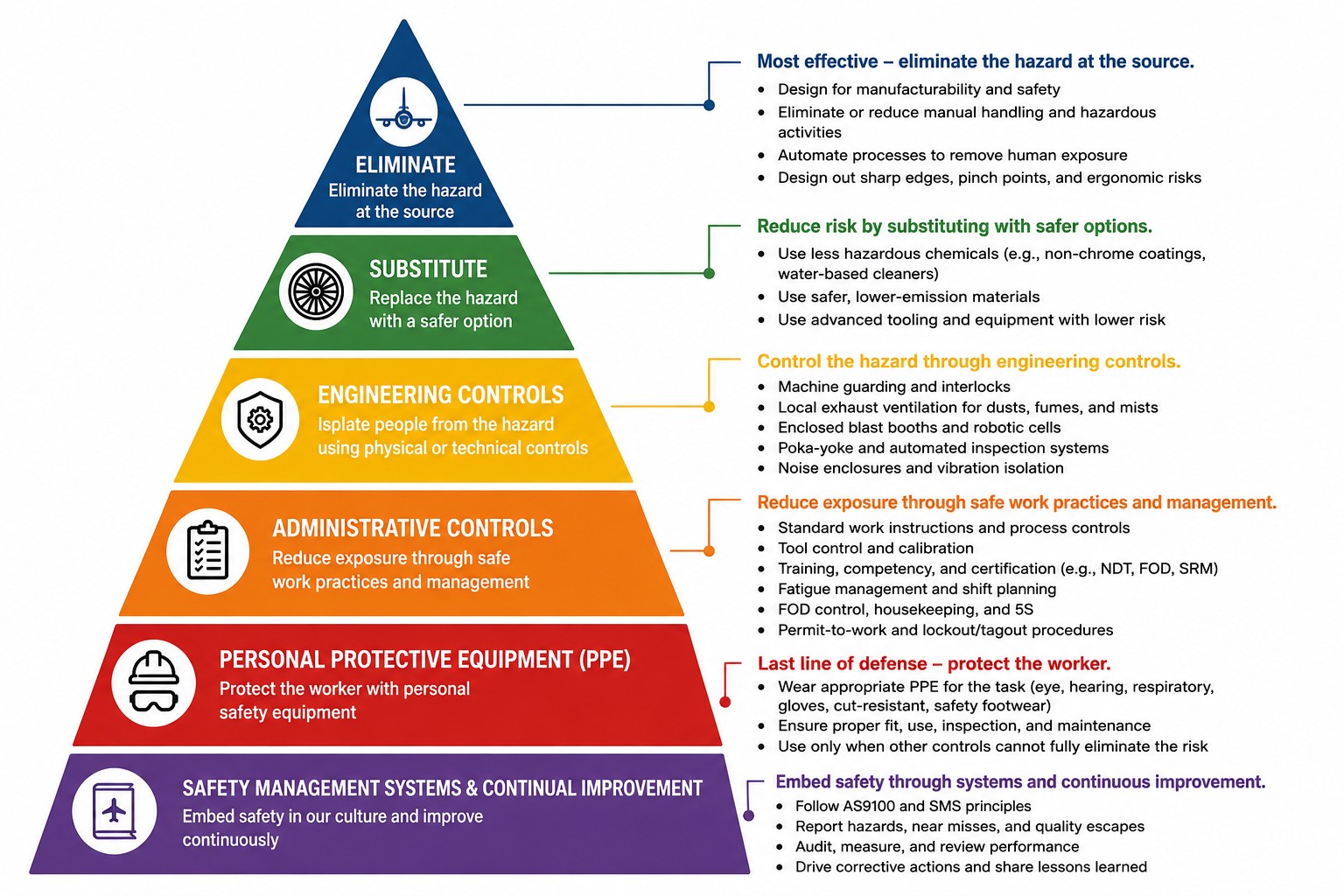
Hierarchy of Control
Accident Reporting
When an accident does occur, severity classification helps determine the appropriate level of investigation and response. From there, root cause analysis and CAPA follow the same rigorous path as incident management, with emergency contacts triggered automatically for serious cases. Investigation findings are documented thoroughly, and the resulting lessons are communicated across the organization so similar accidents are less likely to happen in another part of the facility.
|
Step |
Why It Matters |
What Happens if Missed |
|
Severity classification |
Determines the depth of investigation required |
Serious accidents may not receive adequate scrutiny |
|
Root cause analysis |
Identifies the true cause behind the accident |
Recurrence becomes more likely |
|
CAPA implementation |
Prevents similar accidents through corrective action |
Same accident type could repeat |
|
Emergency contact notification |
Ensures rapid response for serious cases |
Delayed response could worsen outcomes |
|
Learning communication |
Spreads awareness across departments and shifts |
Other teams remain unaware of the risk |
Training & Competency Management
Operators need training specific to the machines they run; a CNC operator’s training differs from that of an autoclave technician or a paint booth operator. EHS software tracks operator training, machine-specific certifications, chemical handling training, PPE training, emergency drill participation, and refresher training schedules, with automatic alerts when certifications are approaching expiry.
|
Training Element |
Why It Matters |
What Happens if Missed |
|
Machine-specific training |
Ensures operators understand the specific equipment they use |
Increased risk of operational errors or equipment damage |
|
Chemical handling training |
Prepares workers to handle hazardous substances safely |
Improper handling could lead to exposure or spills |
|
PPE training |
Ensures correct selection and use of protective equipment |
PPE may be worn incorrectly or not at all |
|
Emergency drill participation |
Builds familiarity with evacuation and response procedures |
Slower, less organized response during a real emergency |
|
Certification expiry tracking |
Keeps training records current |
Workers may operate equipment without valid certification |
Safety Pass Management
Before entering a manufacturing area, every worker’s identity, competency, and medical fitness must be verified. Safety Pass Management automates this by digitally storing site induction records, contractor details, expertise certificates, competency validations, and previous incident history while automatically alerting safety teams before certifications expire. Integrated access control prevents workers or contractors with expired or invalid credentials from entering restricted areas such as composite curing rooms or electroplating lines, eliminating a common compliance gap that often goes unnoticed until an audit or incident.
|
Mandatory Step |
Why It Matters |
What Happens if Missed |
|
Site induction completion |
Ensures workers understand facility-specific hazards before entering the floor |
Untrained personnel enter hazardous zones unaware of specific risks |
|
Contractor verification |
Confirms external workers meet the same safety standards as employees |
Unqualified contractors may be assigned to high-risk tasks |
|
Medical fitness check |
Confirms physical capability for tasks like working at height or in confined spaces |
Workers with medical restrictions could be exposed to unsuitable conditions |
|
Competency validation |
Confirms the person is trained on the specific machine or process |
Increases risk of operational errors on CNC machines, presses, or autoclaves |
|
Gate pass expiry tracking |
Keeps access limited to currently authorized personnel |
Expired or unauthorized individuals could retain floor access |
How AI is Transforming EHS Software for the Aerospace Industry
AI PPE Detection – Camera systems positioned across machining bays, composite rooms, and paint booths can identify missing PPE in real time, sending an alert to the area supervisor before an incident occurs rather than after.
AI-Powered Inspections – By analyzing historical inspection data, AI can adjust inspection frequency for equipment like dust collectors or autoclaves based on actual usage patterns and past findings, rather than a one-size-fits-all schedule.
AI Risk Assessment – Dynamic risk scoring pulls from incident, near miss, and inspection data to highlight which machines or processes currently carry elevated risk, allowing EHS teams to act before conditions worsen.
AI-Assisted Root Cause Analysis – When an incident is reported, AI compares it with similar past incidents to identify recurring patterns and likely root causes. AI-guided 5 Why questioning automatically generates relevant follow-up questions, helping investigators uncover the actual cause faster and improve the quality of corrective actions.
AI-Powered Unsafe Activity Detection – AI-enabled cameras continuously monitor aerospace manufacturing areas to detect unsafe activities such as missing PPE, unsafe machine interaction, restricted area access, and unsafe work practices. Real-time alerts, automatic evidence capture, and incident logging enable immediate corrective action, helping prevent accidents and improve workplace safety.
What to Look for in EHS Software for Aerospace Manufacturing
Selecting the right platform matters as much as adopting one. Not every EHS software for the aerospace industry platform is built the same way, so aerospace manufacturers should look for industry-specific modules that reflect the realities of machining, composite work, and chemical processing, rather than a generic industrial template. AI capabilities for PPE detection, inspection scheduling, and risk scoring add real value when they’re built around actual manufacturing workflows.
An offline mobile application matters on a shop floor where connectivity can be inconsistent near heavy machinery. ERP integration lets EHS data connect with existing production and maintenance systems rather than existing in a silo, and role-based access ensures operators, supervisors, contractors, and EHS managers each see information relevant to their role. Strong dashboards and reporting turn raw safety data into something leadership can act on.
Interactive dashboards give leadership live visibility into active permits, ongoing high-risk work, pending inspections, contractor status, overdue CAPAs, equipment inspection compliance, audit scores, incident trends, waste disposal status, and department-wise safety performance, all in one view. Management reports built on top of that data help track KPIs such as permit turnaround time, inspection completion rates, CAPA closure performance, audit findings, and overall operational safety performance, turning day-to-day safety activity into metrics leadership can actually use for decision-making.
Scalability matters for facilities adding new production lines or component types over time, and document control keeps SDS sheets, certifications, and audit records organized and current. Solid contractor management, waste management, audit management, risk assessment, and training modules round out a platform that genuinely supports day-to-day operations rather than just checking a compliance box.
Conclusion: Why EHS Software for the Aerospace Industry Matters
The difference between manual safety systems, digital EHS platforms, and AI-powered EHS software is substantial. Manual safety relies on paper forms, slow approvals, missing records, and reporting that lags behind actual conditions. Digital EHS connects workflows across departments, improves traceability, and gives safety teams real-time visibility into what’s happening on the floor. AI-powered EHS goes further still, adding predictive analytics, AI-driven inspections, dynamic risk assessment, and automated PPE detection that help teams act before problems escalate.
Aerospace manufacturing facilities operate at a level of process complexity and regulatory scrutiny that few other industries match. Titanium and composite machining, chemical processing, heat treatment, and precision assembly all carry real consequences when safety controls fail. This is why connected EHS software for aerospace industry facilities has become central to protecting the workforce, meeting compliance requirements, and maintaining the operational discipline that aerospace manufacturing excellence demands.