
Introduction:
Step inside any cement plant and the hazards are immediate. Kilns exceeding 1,400°C, vast conveyor systems, dust-filled confined spaces, and contractors who know their trade but not this specific plant. A paper permit system rarely reflects what is actually happening on the ground. EHS software for the cement industry introduces a hazard-free environment.
Cement manufacturing consistently ranks among industry’s most dangerous sectors. Extreme heat, heavy rotating machinery, work at height, live electrical systems, and complex multi-contractor shutdowns demand more than spreadsheets and clipboards. AI-powered EHS software was built precisely for this level of complexity.
The Real Safety Challenges Addressed by EHS Software in Cement Industry
Most manufacturing plants deal with one or two dominant hazard categories. Cement plants deal with nearly all of them simultaneously. Kiln maintenance alone involves confined space entry, hot work, work at height, LOTO isolation, and contractor management often within the same 48-hour shutdown window. A single procedural gap during that window can be catastrophic.
The specific hazards that define cement manufacturing risk:
- Nonstop machinery makes equipment isolation extremely difficult during maintenance activities.
- Kiln operations present constant risks of severe burns and dangerous gas buildup that are hard to detect early.
- Confined space entry checks are frequently skipped or inadequately completed under operational pressure.
- Falls from height often result from missed inspections and informal anchor point practices.
- Hot work conducted near combustible dust creates serious ignition risks without rigorous controls.
- Managing multiple contractor crews simultaneously during shutdowns creates significant coordination and compliance gaps.
Where Paper Systems Break Down
The core failure of paper-based safety management is not laziness or negligence, it is structural. Paper permits can be backdated, Checklists can be pre-filled, Near-miss books go unreported because nothing links the observation to an action. Audit findings sit in folders waiting for someone to schedule a follow-up. Contractor inductions get signed off without being properly verified.
|
Major Cement Plant Hazard |
Potential Consequences |
Traditional Challenge |
Digital EHS Solution |
|
Kiln maintenance and entry |
Fatal burns, toxic gas, explosion |
Paper permits, manual gas logs |
Digital PTW with atmospheric monitoring integration |
|
Confined space entry |
Suffocation, H2S exposure |
Manual checklists, informal standby |
Digital workflow, AI alerts, mandatory gas test fields |
|
Working at height |
Falls, fatalities |
Incomplete inspection records |
AI-scheduled inspections, mobile photo evidence |
|
Hot work near combustibles |
Fire, explosion, burn injuries |
Permits issued without an area check |
Digital PTW with area clearance workflow |
|
LOTO failures |
Unexpected energisation |
Human error, missing steps |
Digital LOTO with step-by-step verification |
|
Contractor activities |
Unauthorised work, untrained workers |
Poor visibility, paper sign-in |
Safety Pass, digital induction, competency tracking |
|
Dust-related incidents |
Respiratory disease, explosions |
Manual monitoring logs |
Digital observation reporting with escalation |
|
Emergency evacuation |
Incomplete headcount, delayed response |
Manual register, radio roll call |
Digital headcount with geofencing and real-time count |
Core Benefits of EHS Software in Cement Industry
Each of the following modules represents a distinct layer of protection,
1] Safety Pass Management
Paper-based safety passes collect signatures but rarely check if certifications are still valid, a gap that contributed to a 2022 Southeast Asian petrochemical fatality, where a worker entered a confined vessel without the required competency. Digital safety pass systems fix this by automatically blocking access if certifications have lapsed, removing the need for manual checks. Safety managers also get a live view of who is on site, which zones they are cleared for, and when certifications expire.
|
Mandatory EHS Step |
Why It Matters |
What Happens if Missed |
|
Site-specific induction completion |
The worker understands local hazards |
The worker enters the area without hazard awareness |
|
Certification and competency verification |
Confirms the worker is qualified for the task |
An unqualified person performs high-risk work |
|
Medical fitness check |
Ensures fitness for confined space or height work |
Medical incident during or after high-risk activity |
|
Gate pass issuance with expiry |
Controls authorised access |
Expired credentials go undetected |
|
Contractor company vetting |
Ensures the hiring company meets safety standards |
Substandard contractor brings unmanaged risk |
2] Permit to Work (PTW)
The permit-to-work system is arguably the single most important administrative control in a cement plant. Done properly, it creates a documented trail of authorisation, hazard identification, isolation verification, and sign-off that keeps high-risk work from proceeding until every prerequisite is genuinely satisfied.
A PTW lifecycle begins at the gate with worker verification, moves through hazard identification, risk assessment, and multi-level approval, then confirms physical isolation before work starts. A toolbox talk briefs the crew on controls, work proceeds within permit conditions, and any unexpected change triggers an immediate suspension. Once complete, the area is cleared and the permit formally closed out.
|
Mandatory EHS Step |
Why It Matters |
What Happens if Missed |
|
Hazard identification |
Surfaces hidden risks |
Known hazard goes uncontrolled |
|
Isolation verification |
Confirms energy sources are dead |
A worker contacts live electrical or mechanical energy |
|
Toolbox talk |
Ensures crew understands permit conditions |
Worker unaware of the controls they must comply with |
|
Shift handover of active permits |
Maintains continuity of control |
The incoming crew is unaware of the work in progress |
|
Permit closure and area check |
Confirms safe restoration |
Tools or workers left in a hazardous space |
2.1 Work at Height
Falls remain a leading cause of fatal injury in cement plants, with the preheater tower presenting numerous simultaneous hazards during shutdowns. In one European incident, a technician fell when an anchor point that had never been formally rated or inspected, highlighting the danger of informal practices. Digital tools address this directly by photographing every anchor point, recording rated capacity, and blocking permit progression if inspection intervals have lapsed.
2.2 Confined Space
Confined space entry is cement’s most unforgiving hazard, where a single skipped atmospheric test or absent standby attendant can prove fatal. Several South Asian fatalities traced to workers entering incompletely purged coal mill chambers share one root cause: procedural gates that could be bypassed. Digital confined space management eliminates this risk by requiring timestamped gas test results and tester identification before entry authorisation becomes available.
2.3 Hot Work Management
Hot work permits must function as genuine safety controls rather than paperwork formalities. A 2018 North African cement facility fire, linked to hot work near a bag filter with residual coal dust accumulation, resulted from a post-work fire watch being informally reduced to five minutes, allowing the fire to spread undetected. Digital EHS platforms enforce mandatory fire watch durations within the permit workflow, ensuring no step can be skipped or shortened without authorisation.
3] Incident Management and CAPA
How an organisation responds to an incident determines whether it happens again. Fast, honest reporting is the foundation of a learning safety culture, while delayed or incomplete reporting breeds repeat incidents. [Text Wrapping Break][Text Wrapping Break]A complete incident management process covers immediate reporting, scene preservation, first aid, root cause analysis using structured methodologies like 5 Whys and RCA, corrective and preventive actions, closure verification, and company-wide learning communication. For cement plants managing complex multi-system incidents, digital platforms significantly reduce investigation time while improving analytical depth.
|
Mandatory EHS Step |
Why It Matters |
What Happens if Missed |
|
Immediate reporting within minutes |
Preserves scene and witness memory |
Evidence lost; investigation compromised |
|
Root cause analysis |
Identifies systemic failures, not just symptoms |
Only surface causes addressed; incident recurs |
|
Corrective action closure verification |
Confirms the fix was actually implemented |
Action raised but never executed; hazard persists |
|
Learning communication across the organisation |
Spreads the lesson beyond the immediate site |
The same incident occurs at a different plant or area |
4] Headcount Management
During a major kiln shutdown, a cement plant can have upwards of 500 workers and contractors on site simultaneously. If an emergency evacuation is required, gas leak, fire, or structural failure, knowing exactly who is where becomes a matter of life and death. Manual registers, sign-in books, and radio-based roll calls cannot answer: who is currently inside which area, who left for lunch and has not returned, and whether three contractors who arrived at 14:00 have completed their induction, Headcount Management helps in filling this gap.
5] Management of Change (MoC)
In cement manufacturing, even minor changes can trigger serious consequences across interconnected systems. A temporary interlock bypass on a kiln drive, a fuel blend adjustment in the precalciner, or a replacement gearbox with different torque specifications can each introduce risks that were never formally assessed. Management of Change ensures every modification, whether to equipment, process parameters, safety systems, or personnel, is evaluated before implementation. This is particularly critical in cement plants where an unreviewed change in one area can quietly affect pressure dynamics, gas flow, or mechanical load in an adjacent system.
|
Mandatory EHS Step |
Why It Matters |
What Happens if Missed |
|
Hazard review before implementation |
Identifies new risks created by the change |
A hidden hazard was introduced into the operating system |
|
Approval by qualified personnel |
Ensures change is technically validated |
Engineering error creates a safety-critical failure mode |
|
Workforce communication |
Ensures operators understand the change |
Operator responds incorrectly to modified system behaviour |
|
Post-change review |
Confirms change achieved its intent safely |
Adverse consequences discovered only after an incident |
6] Observation Reporting
Safety observation reporting is one of the most overlooked tools in any EHS programme. The barrier is rarely awareness. Most workers can spot an unsafe act or condition when they see one. The real barrier is effort: paper forms, unclear ownership, and no way to know if anything was done. A digital platform removes that barrier, letting employees report from their phone in under a minute with photos and location attached, while automatically sending the observation to the right person and assigning corrective action. Built-in AI-guided 5 Whys questioning helps teams find the root cause rather than just closing out observations without real follow-through.
7] Inspection Checklists and Smart Scheduling
Inspections in paper-based systems follow one of two failure modes: they happen too infrequently for the actual risk level, or they happen on schedule but with no connection between what is found and what happens next. AI-powered inspection management addresses both. Risk-based scheduling means high-risk equipment, such as the kiln drive, bag filter systems, and coal mill isolation valves, gets inspected more frequently and with greater thoroughness. Mobile tools let field workers complete checklists on a phone and submit findings in real time.
8] Lockout Tagout (LOTO)
LOTO failures are responsible for a significant proportion of the most severe injuries in heavy manufacturing. In cement plants, unexpected re-energisation can mean crush injuries from crusher jaws, entanglement in conveyor drives, burns from kiln shells and preheater components, or electrocution from high-voltage motor control centres.
Proper Lockout Tagout requires complete identification of all energy sources (electrical, pneumatic, hydraulic, thermal, stored kinetic), a documented step-by-step isolation sequence for each specific machine, individual lock application by every worker in the isolation group, a try-out procedure confirming the machine is truly de-energised, clear tagging with worker identity and permit reference, and a documented restoration sequence.
|
Mandatory EHS Step |
Why It Matters |
What Happens if Missed |
|
Complete energy source identification |
Ensures no stored energy remains |
Residual pneumatic or hydraulic energy releases during maintenance |
|
Individual lock application by each worker |
Ensures no single person can remove all locks |
Supervisor removes the group lock while the worker is still inside the machine |
|
Try-out verification procedure |
Confirms isolation is effective |
Machine starts while worker is in contact with it |
|
Restoration sequence documentation |
Ensures safe re-energisation |
Equipment damaged or worker endangered during startup |
Equipment requiring critical LOTO attention in cement plants: raw mill drives, kiln main drive, clinker conveyor drives, coal mill grinding circuits, preheater fan drives, and all crusher and hammer mill systems. Digital LOTO management provides each machine with a scannable equipment tag that the worker receives the isolation procedure, confirms each step with a timestamped digital signature, and receives a system-issued permit only when the procedure is complete.
9] Waste Management
Cement plants deal with a wide variety of waste, from hazardous and chemical to bio-medical, non-hazardous, and recyclable, and managing all of it properly isn’t straightforward. The waste management module takes that complexity in stride by letting you configure waste types and chemicals specific to your facility, broken down by department. When disposal is due, department heads fill out a form with the type, quantity, and classification of waste, which then goes straight to the relevant vendor. Once the vendor completes the disposal and verifies it in the system, it moves to the safety officer for a final check and closure. For hazardous waste, the required government forms are already built into the workflow so nothing gets missed on the compliance side. And if anything goes wrong on the ground, the spillage reporting form and periodic waste audit form make sure it’s captured and followed up on.
10] Risk Assessment
Traditional risk assessments are static documents rated on a 5×5 matrix and filed. If conditions change, the area is now adjacent to active hot work, the team has changed, the task is now happening in wet weather, the risk profile has changed, but the assessment has not. AI-based risk assessment introduces dynamic risk scoring: historical incident and near miss data inform the baseline, current permit activity in adjacent areas is factored in, atmospheric conditions contribute to live risk updates, and AI-generated recommendations suggest additional controls based on similar past tasks.
|
Mandatory EHS Step |
Why It Matters |
What Happens if Missed |
|
Contextual hazard identification |
Surfaces area-specific and task-specific risks |
Generic assessment misses site-specific hazard |
|
Control effectiveness validation |
Confirms controls are adequate |
Inadequate controls approved without challenge |
|
Post-task review |
Improves future assessments |
The same inadequate assessment is used repeatedly |
|
AI pattern analysis |
Identifies risk clusters humans miss |
Systemic risk pattern undetected until incident occurs |
11] SDS (Safety Data Sheet) Management
Every hazardous chemical on a cement plant site, from grinding aids and fuel additives to lab reagents, comes with a Safety Data Sheet covering hazards, safe handling, first aid, and emergency response under the standardized 16-section GHS format. In paper-based systems, these sheets sit in binders at fixed locations, and a spill at 2 AM during a shutdown means hunting for the right SDS, and the right revision, under pressure. Digital SDS management fixes this with instant mobile access from anywhere on site, automatic detection of manufacturer revisions so outdated sheets never get used, and direct linkage to chemical inventory so nothing on site goes undocumented.
|
Mandatory EHS Step |
Why It Matters |
What Happens if Missed |
|
Current SDS version availability |
Ensures accurate hazard and first aid information |
First aider uses outdated guidance; incorrect treatment given |
|
Location-specific and shift-wide access |
SDS readily available wherever and whenever chemicals are used |
Workers on off-shifts have no access; HazCom compliance gap |
|
Emergency response guidance |
Surfaces spill, PPE, and first aid sections instantly during incidents |
Responder improvises; spill response delayed or worsened |
|
Chemical inventory linkage |
Tracks all hazardous substances on site against their SDS |
Unregistered chemical in use with no SDS available |
12] Fire Equipment Register
Passive fire protection is only as good as the inspection regime behind it. A fire extinguisher that has not been serviced in 24 months, a sprinkler head blocked by stored material, a hydrant with a seized valve, these are documented realities in facilities where paper-based equipment registers are the norm. Digital fire safety register maintains an asset register for all firefighting equipment by location and type, inspection schedules with automated reminders, service history, hydrant and deluge system test records, and an emergency equipment inventory covering breathing apparatus, fire blankets, and emergency showers.
13] Accident Reporting
When a serious accident occurs, the quality of the immediate response determines both the human outcome and the quality of the subsequent investigation. Digital accident reporting enables simultaneous notification to the safety manager, plant manager, and emergency response team, automated escalation based on severity classification, time-stamped photo and witness account capture before scene disturbance, AI Root Cause Analysis pattern matching during the investigation, CAPA workflow with assignment and escalation, and one-tap access to hospital contacts, emergency services, and corporate safety leadership.
|
Mandatory EHS Step |
Why It Matters |
What Happens if Missed |
|
Immediate severity classification |
Triggers an appropriate level of response |
Serious incident treated as minor; inadequate response |
|
Evidence preservation |
Maintains the integrity of the investigation |
Physical evidence disturbed; root cause unidentifiable |
|
AI Root Cause Analysis |
Surfaces systemic patterns beyond the immediate cause |
Investigation focuses on immediate cause only; systemic factor is missed |
|
CAPA closure verification |
Confirms action was actually taken |
Action raised, never implemented; incident recurs |
|
Learning communication across the organisation |
Spreads prevention beyond the immediate site |
Lesson contained to one site; same incident at another |
How AI is Transforming EHS in the Cement Industry
The shift from digital EHS to AI-powered EHS is not a marketing distinction, it represents a fundamental change in what a safety management system can do. Digital platforms eliminate paper and add structure. AI adds predictive intelligence, pattern recognition, and autonomous monitoring that no human supervisor can match at scale.
AI PPE Detection:
Computer vision deployed at entry points, critical work areas, and conveyor access zones provides continuous, objective PPE monitoring. The camera does not have favourites, does not get tired, and does not look the other way when someone removes their helmet mid-shift. AI PPE detection generates compliance trend data that tells safety managers exactly which areas, which shifts, and which contractor companies have the highest non-compliance rates — enabling targeted intervention rather than generic reminders.
AI-Powered Inspections:
AI inspection scheduling analyses equipment failure history, recent incident data, environmental conditions, and production intensity to calculate a dynamic risk score for each asset. High-risk assets are inspected more frequently and lower-risk assets can be inspected less often without compromising overall safety. This means safety teams spend their time where it matters most, rather than executing a flat calendar schedule that treats a critical conveyor drive the same as a storeroom door hinge.
AI Risk Assessment:
Every permit issued, every incident reported, every near miss logged contributes to the AI risk assessment engine’s understanding of the plant’s risk profile. Over time, the system identifies risk clusters, for example, that most incidents involving contractor welders occur in the evening shift in the grinding area, which would take a human safety analyst months of manual data mining to surface.
AI Root Cause Analysis:
Traditional RCA often depends on the investigator’s experience, leading to inconsistent results. AI-assisted RCA improves consistency by matching patterns from past incidents, analyzing causal chains, and suggesting proven corrective actions. Through AI-driven 5 Why questioning, each answer prompts a relevant follow-up, helping investigators uncover the true root cause faster without replacing human judgment.
Case Study: Priya Cement
Company Overview
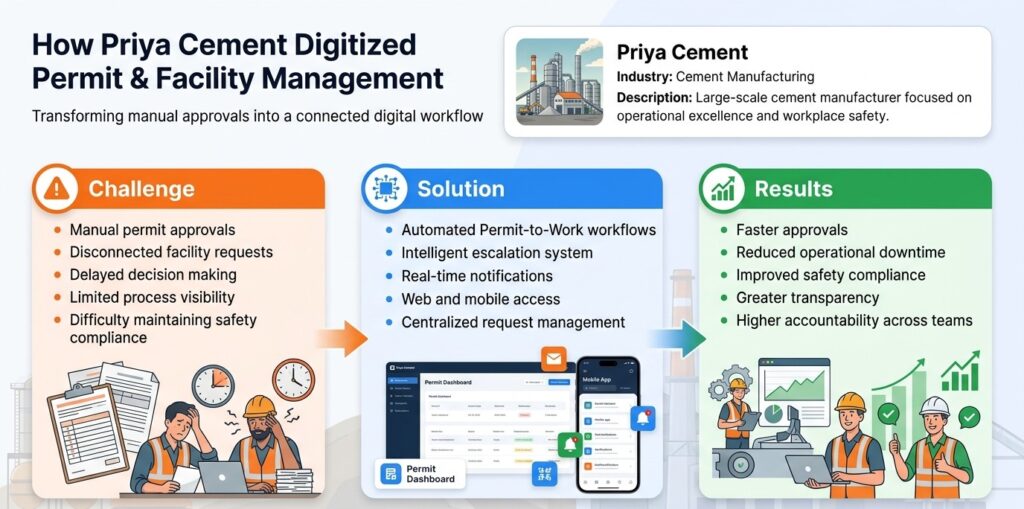
Priya Cement is a prominent player in the Indian cement industry, operating large-scale manufacturing facilities with a strong focus on workplace safety and operational excellence. As its operations grew, the company faced increasing challenges in managing permit approvals and facility-related requests through manual, disconnected processes, making it difficult to maintain efficiency and ensure timely safety compliance.
Challenge, Approach & Result
To overcome these issues, Priya Cement partnered with Soft Designers to implement a customized EHS and Facility Management solution. The digital platform introduced automated Permit-to-Work workflows, intelligent escalation mechanisms, real-time notifications, and a centralized system for managing maintenance requests through web and mobile applications. The result was a faster and more transparent approval process, reduced operational downtime, improved safety compliance, and a more connected, accountable work environment across the organization.
How to Choose the Right EHS Software in Cement Industry
Not all EHS software is built for the specific demands of cement manufacturing. Generic platforms designed for office-based compliance management will struggle with the operational complexity of a multi-kiln integrated plant. The following covers the capabilities that genuinely matter for this industry.
Industry-Specific Modules: A general health and safety platform will have incident reporting, but a cement plant needs considerably more. This includes digital Permit to Work with permit type differentiation, LOTO management with machine-specific isolation procedures, and confined space and work at height controls built into the permit workflow. Contractor safety management must also handle shutdown complexity at scale.
AI Capabilities: AI in EHS software is a functional differentiator, not a marketing claim. Key capabilities for cement plants include PPE detection via computer vision, AI-assisted Root Cause Analysis, and predictive risk assessment using historical data and real-time operational context. AI-powered inspection scheduling based on equipment risk profiles rounds out the core requirement.
Mobile Accessibility: A plant safety officer who must return to the office to complete an inspection finding will delay or skip that step entirely. Genuine mobile-first design and functionality on standard Android devices, usable in dusty and low-connectivity environments, with offline data capture is a core requirement. This is table stakes, not a differentiator.
Manual Safety vs Digital and AI Safety
Comparing the constraints of paper-based EHS with the power of connected, intelligence-driven digital safety systems.
Paper-Based EHS
- Modules work in isolation.
- Near misses go unlinked.
- Inspections follow fixed schedules.
- Audits don't adapt dynamically.
- Knowledge leaves with people.
VS
Digital EHS
- All modules stay connected.
- Near misses inform permits.
- Inspections respond to risk.
- Audits self-adjust automatically.
- AI builds institutional memory.
Key Takeaway
Moving from manual to digital EHS transforms safety from a reactive, fragmented task into a cohesive, intelligence-driven operational strategy.
The Direction of Travel
The cement industry is changing, and that change is not optional. Plants that have already embraced real-time data and digital operations for production and quality control cannot afford to manage safety with paper registers and spreadsheets. That gap between operational sophistication and safety management is where serious incidents happen.
Plants that have made the shift to digital EHS tell a consistent story: fewer incidents, faster permits, better contractor accountability, and a workforce that actually reports near misses. The transition works. The only real question is whether a plant makes it by choice or after something goes wrong.
Modern cement plants deserve safety management that matches their complexity. That means connected, AI-powered platforms that bring every permit, every worker, every hazard, and every inspection into one clear, living system.