Walk into any effective facility today and you’ll likely notice an evolution in the management of safety that means less paper and fewer clipboards. Decisions are made faster, and responses to adverse events are more orderly. This evolution has happened intentionally due to safety management system software teams being provided with better tools.
Safety management system software provides tools that show what’s possible for organizations that actually want to keep their employees safe. This is not just in a theoretical sense but in the reality employees actually face day to day with inspections, incidents, approvals, and audits. Here’s what those changes mean
Automated Headcounts and Workforce Monitoring
In large facilities, and especially in shift-based work, contractors, and rotating crews, being able to know who’s on-site at any given moment is both a compliance requirement and a life-safety issue. Manual head counts are slow, error-prone, and, in an emergency, really dangerous.
Safety management software does this completely automatically. It integrates with access control systems, ID badges, or mobile check-ins to give supervisors an accurate, real-time view of who’s on-site and where. When an evacuation is called, it is not a clipboard and a guess. You know.
Root Cause Analysis That Gets to the Real Cause
The majority of incident investigations proceed as follows: something goes wrong, a report is filed, and the corrective step is to “retrain personnel” or “remind workers to follow protocols.” “Everybody goes on. Then, six months later, the same thing occurs once more.
Not because safety teams don’t give a damn. It’s that in the absence of a systematic procedure, inquiries inevitably end with the first plausible solution, which is rarely the correct one. The true cause is typically hidden a few levels deeper, in a managerial choice, a process flaw, or a system that was never intended to detect the failure.
The depth of an investigation is independent of the person conducting it that day since SMS software provides the team with the appropriate investigative tools at the appropriate moment.
- 5 Whys: Every response sets up the subsequent query. The chain continues until you encounter a real organizational or process failure rather than merely a surface-level incident. Since everything is recorded, the logic can be seen and verified.
- Ishikawa’s Fishbone Diagram: divides the inquiry into six categories: management, people, process, equipment, environment, and materials. Teams are prevented from focusing only on one cause and ignoring the three others that made equal contributions.
- Job Hazard Analysis (JHA): Before beginning a high-risk task, the work is broken down step-by-step, with controls and hazards mapped at each level. Versioned, linked to the work permit, and stored in the system.
- Bow-Tie Analysis: Shows what might cause a crucial event on one side and what would happen if the controls failed on the other. Before an incidence confirms it, it lets you know where your defenses are weak.
- Fault Tree Analysis (FTA): When several factors had to go wrong for an occurrence to occur, FTA follows the reasoning behind their combination. Particularly helpful in settings that emphasize processes and where single-cause reasoning falls short.
- ICAM (Incident Cause Analysis Method): Looks past the immediate cause into task conditions, team factors, and organizational gaps. The method that finds what others leave behind.
- Barrier Analysis: Asks a simple but important question: which controls were supposed to be there, which ones failed, and which ones were never in place at all?
Manufacturing process impact on employee health
This connection is overlooked more than almost anything else in workplace safety. In manufacturing and processing environments, the health risks workers are exposed to can change subtly as the products being manufactured change. It may be a new chemical supplier, a reformulated compound, or a change in the composition of raw materials with the seasons. Any of these can change the exposure of workers without anyone on the floor noticing.
The software can track both production inputs and health/injury data over time, allowing correlations to be made that would otherwise go unnoticed. The software detects a cluster of respiratory complaints that occurred at about the same time a new solvent entered the supply chain, before it becomes a formal diagnosis or a regulatory complaint.
Example: A paint maker changes its source of resin. In weeks, three workers in the mixing department complain of headaches and skin irritation. The system shows all three complaints came within days of the new resin being in production. Before a fourth worker is affected, the safety team catches it, reviews the material data sheet, and updates the PPE requirements and ventilation protocols. It probably would have been dismissed as a coincidence without the software.
Faster Approvals
A particular frustration that safety professionals know well is when a hazard has been identified, the fix is obvious, but it has sat in someone’s inbox for two weeks waiting for sign-off. The risk is not waiting.
SMS software replaces email chains and manual chasing with a structured approval workflow. A permit, a corrective action, or a change request automatically goes to the right person with deadline reminders and escalation paths built into it. It’s got a full audit trail of who approved what and when.” “It used to take weeks. It now takes days.”
Ensuring QHSE and Safety Checklists Are Always Done Right
QHSE Audit, pre-shift inspection, PPE, fire system check, and evacuation route check. Checklists only work if they are completed on time, thoroughly, and by the right person. Paper-based checklists fail on all three requirements more often than organizations realize.
SMS software makes each checklist a scheduled, assigned, trackable task. The system flags if the fire extinguisher inspection is overdue. If a safety officer has signed off without completing each item, the system catches it. This level of accountability matters in settings where a missed inspection on a pressure vessel or electrical system can result in a serious incident.
It also reduces common non-compliance issues. For example, PPE inspections may be skipped when no one is assigned. Evacuation routes can go unchecked if the schedule isn’t visible. Equipment checks might be missed because previous records are buried in a folder.
Scheduled Inspections for Critical Equipment
When a crucial machine misses a maintenance check, it doesn’t only risk a breakdown; it also risks injury and, depending on the equipment, something much worse.
SMS software keeps a list of assets tied to inspection schedules. It automatically creates tasks and reminders before deadlines approach. Technicians know exactly what they need to inspect and when. Managers can quickly see what is current and what is overdue. When an auditor or regulator requests inspection history, the documentation is available: consistent, complete, and timestamped.
Change Management That Doesn’t Leave People Behind
One of the most common sources of workplace incidents is change, yet it’s often overlooked. A process gets altered, equipment gets replaced, or a contractor shows up with a different method. In these transitions, safety measures can easily fall by the wayside.
Formal Management of Change (MOC) processes aim to stop this from happening, but it can be tough to follow them consistently on paper. Sometimes changes get verbal approvals instead of proper documentation. Not all stakeholders receive notifications. SMS software makes MOC easier to manage; it organizes the process into a clear workflow where operations, maintenance, safety, and management each have specific steps and visibility. No one will be caught off guard by a change they weren’t aware of, and no approvals will be overlooked.
Story: A warehouse manager organizes a change in the racking layout to fit a new stock management system. Operations approves it. Procurement is satisfied. Stakeholders in two other warehouse sites agree on the rollout. However, in the rush to implement the new system, the safety review gets overlooked. By Monday, some emergency exit routes are blocked, a fire extinguisher is hidden behind a new rack, and floor crews at all three sites are working in layouts they have not had a safety walkthrough for. The SMS software could have paused the entire change until safety approved it, just like every other stakeholder.
Near Miss Reporting That People Actually Use
A near miss is one of the most valuable things a safety team can capture. It’s an event that almost caused harm but didn’t. It serves as a free warning that something in the system needs attention. Organizations that take near-miss reporting seriously tend to have fewer actual incidents.
The challenge is making reporting easy enough that people will do it and safe enough that they won’t worry about being blamed. SMS software helps with both. Reporting from a mobile phone only takes a few minutes. You can set up workflows so reports go to the right people without creating a blame culture. Over time, the number and pattern of near miss reports show you exactly where your risk is focused before an incident confirms it.
Smarter Trend Detection Across Your Safety Data
A busy facility’s safety team is always in reactive mode, handling inspections, processing reports, and reacting to events. Sitting down with months’ worth of data and searching for trends is something that seldom gets time.
That is done automatically via Safety Management System software. It reveals connections that would not be apparent from day-to-day management, such as a pattern of occurrences that corresponds with specific shift lengths or crew compositions, a cluster of near misses around particular equipment, and a persistent increase in hand injuries on a given line. These are the kinds of things that usually go unnoticed until they have been going on for some time. There is a real difference between finding them after a serious incident and seeing them in a report while there is still time to take action.
Story: Over the course of three months, a warehouse receives a few reports of back discomfort, which are easily disregarded on an individual basis. During the weeks that a second dock was closed for maintenance, the dashboard displays all of them working the same shift in the same bay. Less rotation, heavier loads, and the same crew. The reports ceased after a single temporary lifting help. Nobody would have connected the dots without the trend perspective.
One Dashboard Instead of Four Reports
Safety leaders managing multiple sites, multiple programs, and multiple compliance frameworks spend a significant portion of their time pulling information together by hand. A status update for leadership means asking several people for several different reports, then reconciling them into something coherent.
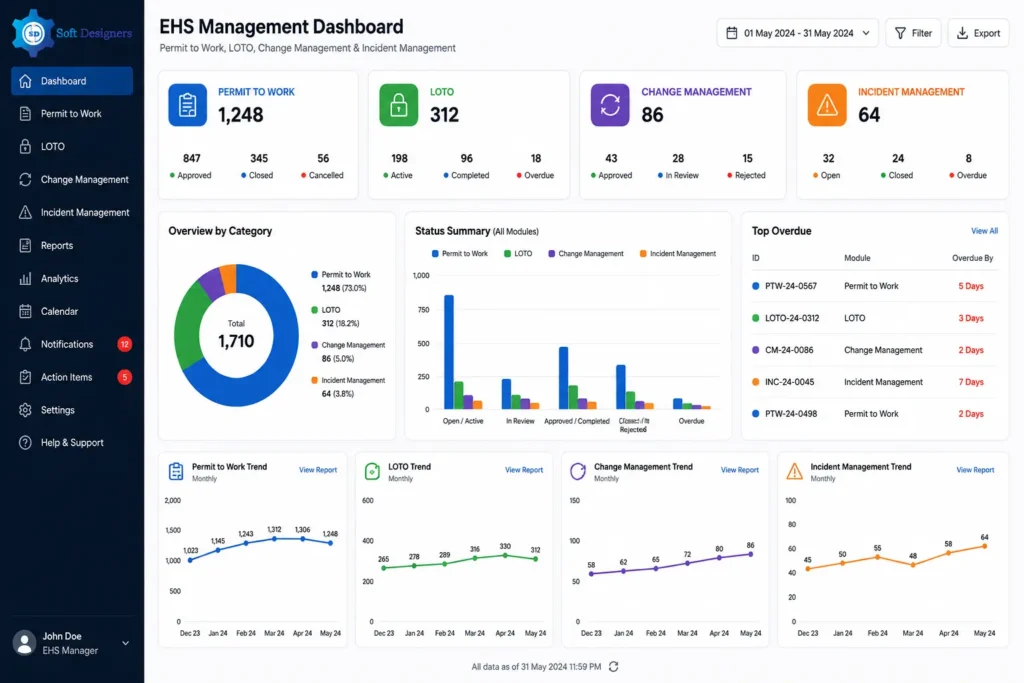
Safety Management System software replaces that process with a single, real-time dashboard. Inspection completion rates, open corrective actions, incident trends, training status, and audit findings are all visible in one place, updated continuously. For multi-site organizations, this means being able to see where attention is needed without waiting for a weekly summary. For leadership reporting, it means credible, current data without the manual assembly work.
Faster Incident Reporting and Investigation
A large amount of time is spent manually compiling information by safety directors who oversee numerous sites, programs, and compliance frameworks. For leadership, a status update entails gathering reports from multiple sources and combining them into a cohesive whole.
Safety Management System software substitutes a single, real-time dashboard for that procedure. A single, constantly updated location displays inspection completion rates, open corrective actions, incident trends, training status, and audit findings. This means that firms with multiple locations can identify areas that require attention without having to wait for a weekly summary. It means reliable, up-to-date information for leadership reporting without the need for manual assembling.
Cross Job Analysis and SIMOPS Management
A single work gone bad is not the cause of some of the most devastating events. They occur as a result of two tasks operating simultaneously in the same area, and no one was fully aware of how they interacted.
Job-by-job safety planning was not intended to capture the dangers introduced by simultaneous operations, or SIMOPS. In isolation, a hot work permit for welding appears to be acceptable. A hydrocarbon line also purges at the same level and shift. When combined, they have a whole distinct dialogue.
Teams can examine all planned and ongoing work on a site in real time with Safety Management System software. Before permits are obtained, not after, cross-job analysis automatically indicates combinations that cause conflict, such as chemical handling near open electricity panels, crane lifts crossing active pedestrian paths, or ignition sources next to volatile discharges.
This shifts from best practice to a fundamental control in complex facilities operating shutdowns, turnarounds, or concurrent construction and production.
Training Compliance You Can Actually See
“Who still requires certification for confined spaces?” That’s a simple question for a small crew. It’s really challenging to respond confidently in a company with hundreds of employees, numerous contractor pools, and a training matrix spanning years.
A complete training register linked to each unique profile is kept up-to-date by Safety Management Software software. It keeps track of what is due, what is expiring, and what is current. When someone is given a task that calls for a certification they haven’t earned, it can alert them. You have a real-time image of the gaps so you can address them before an auditor discovers them or before someone is injured while performing a task for which they were not properly trained, as opposed to depending on spreadsheets and sporadic manual audits.
Conclusion
There are many issues at play when it comes to workplace safety. Who is on-site; if inspections took place, how events are looked into; who is trained; and what was altered last week. Things are overlooked when handling all of that by hand.
It is connected via Safety Management System software. In one location, all checklists, inspections, near misses, approvals, and training records are accessible, movable, and trackable. That is the true appearance of a well-managed safety program.
The companies that are succeeding aren’t doing anything exceptional. They simply stopped depending on optimism and spreadsheets.