
Construction has always been hazardous work; falls, struck-by events, electrical contacts, and trench collapses are common. For decades, the industry managed these risks with paper forms, folders, and a site supervisor’s memory. Forms got lost. Near-misses went unreported. Certifications expired unnoticed. Construction EHS software changes this equation. It removes the friction that lets hazards slip through: digitizing inspections, automating alerts, tracking certifications, and building the real-time safety intelligence that makes proactive prevention possible without replacing the judgment experienced safety professionals bring to a site.
Why Construction Sites Are Uniquely Dangerous
OSHA’s Fatal Four; falls, struck-by incidents, electrocution, and caught-in/between hazards account for more than 60 percent of construction fatalities annually. What makes construction uniquely difficult is its dynamic nature: hazards on day one are largely gone by day ninety, replaced by entirely different risks. High workforce turnover means a significant portion of workers on any given day may be new to a site’s specific conditions. Subcontractor layering creates accountability gaps across overlapping trades. Schedule pressure, the constant push to recover time lost to weather or permitting delays, creates the conditions in which shortcuts happen. These are the realities that construction EHS software is built to address.
Several factors amplify these baseline risks. High workforce turnover means a significant portion of workers on any given day may be unfamiliar with a site’s specific hazards, access routes, and emergency procedures. Subcontractor layering creates accountability gaps when four trades are working in overlapping zones. Language and literacy barriers affect safety communication on multilingual job sites. And schedule pressure, the persistent push to recover time lost to weather or permitting delays, creates the conditions in which safety shortcuts seem justifiable in the moment. These realities do not change by wishing them away. They require systematic tools built specifically for the environment.
What Is Construction EHS Software?
Construction EHS software is a digital platform that manages the environment, health, and safety functions of construction projects. It replaces paper-based processes with structured, searchable, and auditable digital workflows across the full safety lifecycle: pre-task planning, inspections, hazard reporting, permit management, training records, incident investigation, contractor compliance, and regulatory documentation. Accessible on mobile devices because safety work happens in the field, modern platforms also incorporate AI-based visual monitoring for PPE detection and integrate with wearable sensors that track worker health in real time, moving construction EHS from a reactive discipline toward a genuinely predictive one.
The best platforms unify these functions under a single data architecture so that a near-miss report feeds the same database as an inspection finding, a toolbox talk attendance record, and a CAPA task. That integration is what enables meaningful trend analysis and audit-ready reporting. Fragmented point solutions one app for inspections, another for training, and a spreadsheet for incidents generate data silos that defeat the purpose of digitization.
How Construction EHS Software Prevents Accidents
Prevention is a system of interlocking practices, each addressing a different point in the chain of events that leads to an incident. The following capabilities form that system.
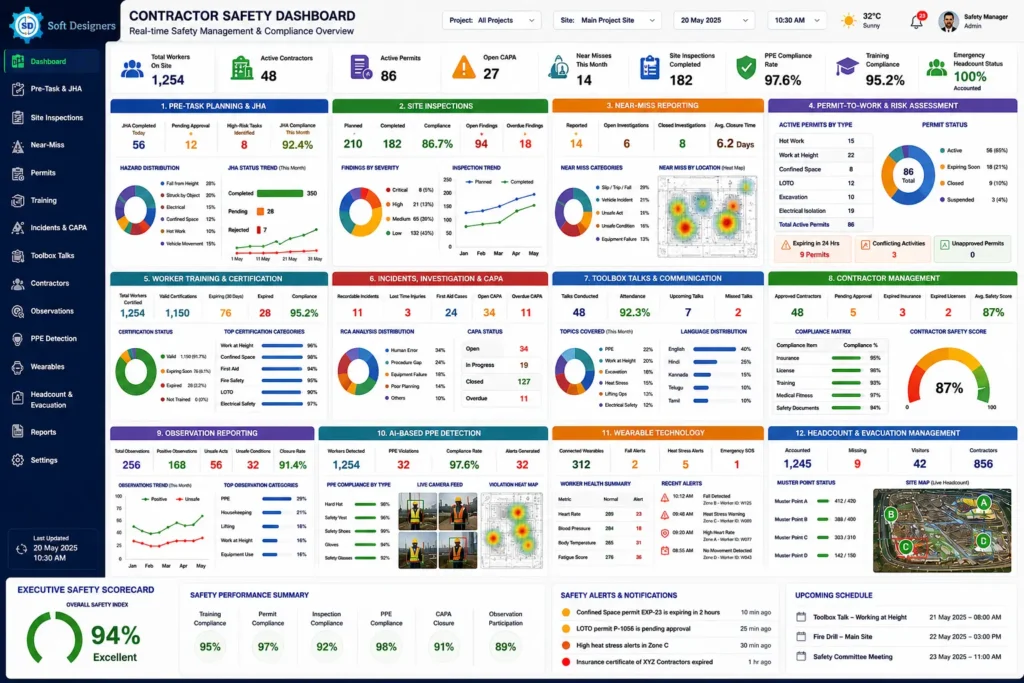
Pre-Task Planning and Job Hazard Analysis
Most construction accidents are predictable, the product of known hazards not identified before work began. EHS software digitalizes Job Hazard Analysis (JHA) with structured mobile forms: workers select the activity, identify hazards, and document controls before each task. The platform routes the JHA for supervisor sign-off, timestamps the approval, and stores it against the work order. The digital record creates accountability; if an incident occurs, the JHA documents exactly what was anticipated, what controls were in place, and who authorized the work.
Site Inspections
EHS software replaces paper checklists with customizable mobile inspection forms. An inspector walks the site, completes checklist items, attaches photographs to findings, and flags items for corrective action the platform assigns tasks to responsible parties, sets due dates, and sends automated reminders. Aggregated over weeks and projects, inspection data reveals patterns invisible in paper files: recurring fall protection deficiencies on a subcontractor’s work areas or missing barricades near excavations on delivery days.
Near-Miss Reporting
Research shows that for every serious injury, dozens of near-misses and hundreds of hazardous conditions precede it. EHS software removes reporting friction: a worker submits a near-miss in under two minutes from their phone, with a photo and GPS-tagged location, immediately visible to the safety team. Anonymous reporting options further increase rates in cultures where workers fear repercussions. Higher reporting rates produce more data — and more data produces more opportunity to intervene before near-misses become incidents
Permit-to-Work and Risk Assessment
High-hazard activities, confined space entry, hot work, work at height, lockout/tagout, and excavation require formal permits. EHS software rebuilds the permit process with structured digital workflows: mandatory fields, integrated risk assessment checklists, required multi-level sign-offs, and automatic permit expiration. A live register of all active permits across the site makes conflicting activities visible before work begins, preventing the kind of overlap that turns individually safe activities into combined hazards.
Worker Training and Certification Tracking
EHS software maintains a centralized training registry for every worker on site: certifications held, training completed, and expiration dates. Automated alerts go to the worker, their supervisor, and the safety team when qualifications approach expiration. Some systems enforce access controls — a worker with a lapsed fall protection certification can be flagged before they are permitted to work at height. Many platforms also issue a digital Safety Pass — a QR-coded credential tied to the worker’s verified training and certification record, scanned at site entry to confirm they are qualified for the work area before they ever step on site. This is both protective for the worker and a liability safeguard for the contractor.
Incident Reporting, Investigation, and Corrective Action
When incidents occur, the quality of investigation determines whether conditions improve or recur. EHS platforms guide investigators through structured Root Cause Analysis (RCA) frameworks: 5-Why methodology drives to underlying causes rather than stopping at the immediate trigger; Fishbone (Ishikawa) analysis categorizes contributing factors across people, equipment, processes, environment, and management. CAPA workflows then assign remediation tasks to named individuals with tracked deadlines and escalation alerts for overdue items turning findings into documented commitments rather than intentions that fade.
Toolbox Talks and Safety Communication
EHS software provides a library of toolbox talk content organized by hazard type and trade, available in multiple languages. Supervisors schedule talks, deliver content digitally, and record worker attendance, creating a regulatory-defensible record that communication occurred. Frequency is what makes toolbox talks effective; the platform’s scheduling and tracking tools make that frequency achievable even across rotating multilingual crews.
Contractor Management
EHS software centralizes contractor compliance in a structured database: company details, license information, insurance certificates with expiration tracking, safety prequalification scores, and approved work duration and scope. Worker-level records capture blood group, health screening results, and emergency contact information. When insurance lapses or prequalification expires, alerts fire before work continues, maintaining a living compliance record rather than a paper file that was accurate on day one and out of date by day thirty.
Observation Reporting
Observation reporting captures both positive and negative safety behaviors in the field. Aggregated over time, observation records identify which work areas generate the highest rates of unsafe behavior, which supervisors have the strongest safety culture on their crews, and which activities are most associated with PPE non-compliance. This behavioral data is a leading indicator, a signal of risk that precedes incidents rather than following them.
AI-Based PPE Detection
Computer vision cameras integrated with EHS platforms automatically detect whether workers are wearing required PPE hard hats, high-visibility vests, safety glasses, and gloves. Non-compliance triggers immediate alerts to the supervisor’s phone and logs a timestamped, location-tagged image. The primary value is speed of correction: a worker without their hard hat receives a prompt within seconds rather than going unnoticed for hours. Over time, the data identifies specific areas and conditions associated with higher non-compliance rates.
Wearable Technology
Wearable sensors extend EHS monitoring to the physical condition of workers. Blood pressure and cardiac monitoring wearables flag workers whose physiological readings exceed safe thresholds during heat exposure or heavy exertion, enabling supervisors to intervene before a medical emergency occurs. Fall detection devices use accelerometers to detect the sudden movement characteristic of a fall and automatically alert the safety team with GPS location, enabling rapid response even when the worker cannot call for help. All wearable data feeds into the EHS platform for real-time visibility and trend analysis.
Headcount and Evacuation Management
EHS software manages site access and headcount through digital check-in systems. QR code or RFID-based entry points that log arrivals and departures in real time. A live dashboard shows everyone currently on site, searchable by company, trade, or work area. In an emergency, supervisors pull the verified headcount to any mobile device within seconds and conduct mustering against an accurate list rather than relying on memory. Post-evacuation, the platform documents the timeline and data needed for drill improvement.
From Lagging Indicators to Leading Indicators
Traditional construction safety measurement is retrospective: injury rates, lost-time incidents, and OSHA recordables. By the time these metrics register, harm has already occurred. Leading indicators, inspection completion rates, near-miss reporting frequency, certification currency, and open CAPA closure rates measure the conditions and behaviors that predict incidents before they happen. EHS software makes leading indicator tracking possible at scale because the data feeding those metrics is generated as a natural byproduct of daily platform use. Dashboards surface trends in real time, relocating the point of intervention from after the incident to before it.
The distinction matters in practice. A safety manager reviewing lagging indicators at month-end is reading a historical record. A safety manager reviewing a leading indicator dashboard mid-week is reading a forecast and has time to act on it. That shift in timing is where EHS software’s accident prevention value is most directly expressed.
OSHA Compliance and Audit-Ready Documentation
OSHA’s 29 CFR Part 1926 standards impose specific recordkeeping obligations across virtually every phase of construction work, including fall protection plans, scaffolding inspection records, confined space entry permits, training logs, and more. Construction EHS software builds compliance into the daily workflow: inspection forms capture the exact fields. OSHA requires incident reports to generate 300 log entries automatically, and permit records carry the authorization chains regulators expect. When an unannounced inspection occurs, the safety manager retrieves organized, timestamped records from a single platform rather than assembling paper files under pressure. OSHA serious violations run up to $16,550 per citation and willful or repeat violations up to $165,514. The documentation discipline EHS software enforcement is also the discipline that reduces incident frequency; compliance and safety performance are the same practice.
The table below maps the primary OSHA standards that construction EHS software directly supports.
| OSHA Standard | Regulation | Description |
|---|---|---|
| 29 CFR 1926.20 | Subpart C – General Safety & Health | Requires employers to initiate safety programs, conduct frequent site inspections, and designate competent persons for hazard oversight. |
| 29 CFR 1926.59 | Subpart Z – Hazard Communication | Mandates written HazCom programs, SDS availability, proper chemical labeling, and worker training on hazardous substances. |
| 29 CFR 1926.100–106 | Subpart E – Personal Protective Equipment | Requires hazard assessments, provision of ANSI-compliant PPE, and employer-funded equipment including hard hats, safety glasses, and gloves. |
| 29 CFR 1926.150–159 | Subpart F – Fire Protection & Prevention | Establishes requirements for fire extinguisher placement, hot work controls, flammable material storage, and evacuation planning. |
| 29 CFR 1926.400–449 | Subpart K – Electrical | Requires GFCI protection, grounding of temporary systems, and qualified electrician oversight for temporary power installations. |
| 29 CFR 1926.450–454 | Subpart L – Scaffolding | Requires scaffold design by a qualified person, weekly inspections with documented tags, guardrail systems, and trained crews. |
| 29 CFR 1926.500–503 | Subpart M – Fall Protection | Mandates fall protection at 6 feet or more, covering guardrails, personal fall arrest systems, safety nets, and leading-edge controls. |
| 29 CFR 1926.600–652 | Subpart P – Excavations | Requires daily competent person inspections of trenches, soil classification, and protective systems for all excavation work. |
| 29 CFR 1904 | Recordkeeping and Reporting | Requires employers to maintain OSHA 300 logs and report hospitalizations within 24 hours and fatalities within 8 hours. |
| 29 CFR 1926.1200–1213 | Subpart AA – Confined Spaces | Governs permit-required confined space entry, including atmospheric testing, rescue planning, and entry permit documentation. |
The Real Cost of Construction Accidents
A single lost-time injury carries significant direct costs for a contractor, and a fatality represents a far greater toll. But direct costs are only part of the picture. Indirect costs, project delays, equipment downtime, investigation time, productivity loss, and crew morale impact typically run three to five times the direct cost, capable of eliminating an entire project’s margin. At the company level, safety performance shapes EMR scores, insurance premiums, bonding capacity, and bid eligibility on public projects and safety-conscious owner contracts. EHS software reduces incident frequency, improves documentation quality, and contributes directly to EMR improvement over time.
There is also a reputational dimension that does not appear on an incident cost worksheet. Owners increasingly evaluate contractor safety performance as a prequalification requirement. A poor safety record, even one built up across several years of individually manageable incidents, can disqualify a contractor from entire market segments. The contractors winning the most competitive bids in safety-conscious sectors are not just technically capable; they have the safety data and audit-ready documentation to prove they manage risk systematically.
Case Study: How a Scaffolding Incident Traced Back to a Failed Safety Training Program
A mid-size commercial contractor’s worker fell from fifth-floor scaffolding, sustaining serious injuries. The 5-Why investigation traced the immediate cause of failure to secure a personal fall arrest system before repositioning back through normalized unsafe behavior to a supervisor who had never received formal scaffolding hazard communication training and to a training spreadsheet last updated eight months prior. The supervisor’s scaffolding safety certification had expired six months before the incident. No one had noticed. An EHS platform with automated certification tracking would have flagged the lapse before the assignment was made. A structured toolbox talk module would have covered repositioning hazards. A digital JHA would have required explicit fall protection documentation for the activity. The contractor received an OSHA citation under 29 CFR 1926.502 and lost three weeks to investigation-related delays. Eighteen months after implementing a construction EHS platform, their recordable incident rate had dropped 47 percent.
Key Safety Insight
This case illustrates why construction EHS software is needed: a single missed certification, sitting unnoticed in an outdated spreadsheet, was the thread connecting a training gap to a serious injury. It is exactly the kind of risk that automated certification tracking, digital Job Hazard Analyses (JHAs), and structured toolbox talks are designed to identify and address before it develops into a workplace incident.
How to Choose the Right Construction EHS Software
Platform selection depends on your organization’s size, project types, regulatory context, and operational maturity. Anchor your evaluation on these criteria:
- Field usability. Test the mobile interface on an actual job site. If reporting is not fast and simple, it will not happen consistently.
- Module coverage. Look for a platform covering the full safety lifecycle, from pre-task planning through CAPA closure, to avoid data gaps from switching between systems.
- Configurability. Inspection forms, JHA templates, and permit workflows must reflect your specific operations and regulatory requirements.
- Integration capability. Evaluate API connectivity to project management, HR, and contractor management systems your organization already uses.
- Analytics and reporting. Real-time dashboards and trend analysis tools are how investment in data collection translates into actual safety improvement.
- Regulatory alignment. Confirm documentation standards and templates align with your jurisdictional requirements, including multi-state and federal contracts.
Run a pilot on a single project before enterprise rollout. Use that period to evaluate adoption rates, field usability, and data quality, not just the feature list.
One evaluation step that is often skipped: assess how the platform handles failure. What happens when a mobile device goes offline in a basement or remote site? How does the system handle data sync conflicts when two inspectors submit overlapping records? What is the vendor’s SLA for outages? A platform that works well in ideal conditions but degrades unpredictably in the field conditions your sites actually present is not the platform you need.
Conclusion
Construction is not going to stop being dangerous. The physical nature of the work, the variability of the environment, and delivery schedule pressure will always create conditions where hazards exist. The question is whether the tools available are adequate to manage them. Paper-based programs were the best available option for a long time. They are no longer. Construction EHS software brings the same data-driven approach that has transformed project scheduling and cost control to safety management, and the results are measurable: fewer incidents, stronger compliance, lower insurance costs, and workers who go home in the same condition they arrived.
If your organization is still running safety on clipboards and spreadsheets, the gap between your current program and what purpose-built EHS software makes possible represents both a risk and an opportunity. The technology exists. The evidence for its effectiveness is documented across projects and contractors of every size. The next step is implementing it with the same discipline and commitment you bring to every other aspect of your work