
In today’s fast-paced business environment, maintaining quality and meeting compliance requirements is a constant challenge for organisations across industries. Issues such as product defects, process deviations, customer complaints, and audit findings can directly impact operational performance and business reputation. To manage these effectively, organisations rely on Corrective and Preventive Action, commonly known as CAPA.
What Is CAPA And Why Does It Matter?
CAPA stands for Corrective Action and Preventive Action. At its core, it is a structured process for identifying problems, investigating their root causes, fixing them, and making sure they do not happen again or that similar problems are prevented from occurring in the first place.
Regulatory bodies, including the US FDA, ISO 9001, ISO 14001, and OSHA, all require documented CAPA processes. But experienced practitioners will tell you that the real value of CAPA has nothing to do with compliance checkboxes. A mature CAPA system is a feedback loop, one that continuously feeds real-world failures, near-misses, and audit findings back into your quality management system, making it stronger with every cycle.
The two components, corrective and preventive, are related but distinct, and conflating them is one of the most common mistakes I see in the field.
Corrective Action vs. Preventive Action
| Corrective Action | Preventive Action | |
|---|---|---|
| Trigger | An actual nonconformance or failure that has already occurred | Data trends, risk assessments, and audits before a failure occurs |
| Nature | A reactive response to what has happened | Proactively eliminates potential causes before harm occurs |
| Goal | Eliminate the root cause so the same problem does not recur | Eliminate the conditions that could lead to a problem |
Think of corrective action as firefighting with investigation. You put out the fire, then figure out why it started and make sure it cannot start again. Preventive action is fire-proofing your building before the first spark.
The Nine-Step CAPA Process
Across the organisations I have worked with, from pharmaceutical manufacturers to food processing plants, the most effective Corrective and Preventive Action implementations follow a disciplined eight-step cycle. The steps themselves are not complicated. The discipline to follow them every single time, even for minor issues, is what separates high-performing quality teams from those that keep closing the same findings year after year.
- Identify the Issue: Document the nonconformance clearly. What happened, where, when, and what was affected? Vague issue statements produce vague investigations.
- Contain the Problem: Implement immediate containment measures to prevent the defect from reaching the customer or causing further harm. In manufacturing, this might mean quarantining a batch. In a service context, it could mean a temporary process freeze.
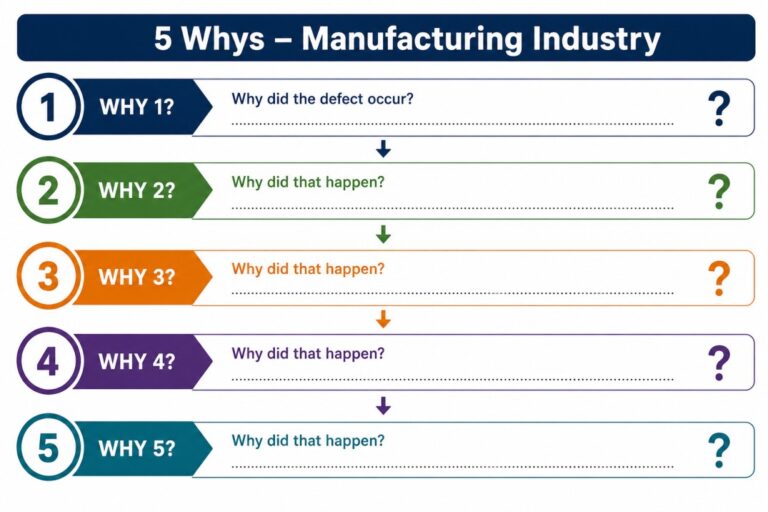
- Analyse Root Cause: This is where CAPA either succeeds or fails. Use structured root cause analysis techniques to identify the actual issue, not just the visible symptom. Common methods include 5 Whys for deeper questioning, Fishbone (Ishikawa) Diagram for categorising contributing factors, Pareto Analysis for identifying the most impactful causes, Fault Tree Analysis (FTA) or tracing failure pathways, and Failure Mode and Effects Analysis (FMEA) for evaluating risk and potential failures. The goal is to go beyond assumptions and uncover the true system-level cause before deciding on corrective actions.
- Define Corrective Action: Based on your root cause analysis, design a specific action that addresses the underlying cause, not just the symptom. Assign ownership and a clear deadline.
- Define Preventive Action: Need to ask, ‘Where else in the system could this same root cause produce a similar failure? Design controls that prevent recurrence across all applicable areas.
- Implement Actions: Execute both corrective and preventive actions with documented evidence. Change management procedures, update work instructions, retrain staff, modify supplier qualification criteria, or whatever the root cause demands.
- Assign Responsibility & Timeline: Clearly assign each CAPA action to the responsible person and define an expected completion date. This creates accountability, improves tracking, and ensures actions are completed on time without delays. Ownership and deadlines are essential for keeping the CAPA process effective and transparent.
- Verify Effectiveness: This step is skipped far too often. Set a defined review period and specific success criteria before you close the CAPA. Did the nonconformance recure? Did related metrics improve? Evidence-based verification is what makes a CAPA system credible to auditors and regulators.
- Close CAPA: Only close the record once effectiveness has been verified and documented. A CAPA closed prematurely is a liability, not a resolution.
Internal Quality Management vs. External Quality: Two Different Lenses
One of the frameworks I find most useful in practice is the distinction between internal quality management and external quality management. Both feed into your CAPA system, but they originate from very different data sources and carry different implications.
Internal Quality
Internal quality refers to the performance of your own processes, equipment, materials, and workforce measured against your own standards. When your production line generates a higher than normal reject rate, when a batch fails in process testing, or when an internal audit uncovers a deviation from a documented procedure, these are internal quality signals.
A practical example: imagine a pharmaceutical packaging line where foil seal integrity failures have been running at 1.2% over the past three months, well above the 0.3% internal benchmark. An internal CAPA would be triggered. Root cause investigation reveals that the sealing jaw temperature is drifting outside specification during extended runs due to a worn thermocouple. Corrective action: replace the thermocouple and recalibrate. Preventive action: add thermocouple condition to the preventive maintenance schedule and introduce a mid-shift in-process check on seal temperature. Effectiveness verified over 60 days with rejection rates returning to below 0.3%.
Internal quality CAPAs are your earliest warning system. They catch problems before they become customer issues, regulatory findings, or recalls. Organisations that invest in robust internal monitoring and honest self-reporting will always outperform those that rely on external pressure to surface problems.
External Quality
External quality is measured through the eyes of your customer and your regulator. Customer complaints, field failures, product returns, adverse event reports, post-market surveillance data, and regulatory inspection findings all fall into this category.
External quality CAPAs carry higher urgency and higher stakes. A customer complaint about a foreign object in a food product, for instance, requires not just an investigation but containment assessment, traceability analysis, and often regulatory notification all under time pressure. The reputational and legal exposure is immediate.
The distinction matters for how you resource and prioritise your CAPA system. External quality issues typically require senior leadership visibility and faster closure timelines. Internal quality issues give you more room to investigate thoroughly without the clock pressure of a dissatisfied customer or a regulator waiting for a response.
In practice, the two are deeply connected. Strong internal quality programmes generate the early signals that prevent external quality failures. The Maggi case is a textbook illustration of what happens when internal signals are either absent or ignored: the problem eventually surfaces externally, and the consequences are catastrophically larger.
When Should You Raise a CAPA?
A question I get asked frequently, particularly by teams new to formalised quality systems: when does an issue warrant a full CAPA versus a simpler corrective note or immediate fix? There is no universal threshold, but here are the criteria I use in practice.
Trigger a CAPA When:
- A product or service defect has reached or could have reached a customer
- An internal metric has trended outside the specification or benchmark for two or more consecutive measurement periods
- A regulatory or third-party audit has identified a nonconformance or observation
- A risk assessment flags a significant potential failure mode with no existing control
- The same issue has been addressed by an immediate fix more than once. A recurring correction without root cause resolution is a strong signal that a proper CAPA is overdue
- Any incident involving safety, environmental release, or product integrity, regardless of severity
- A supplier qualification assessment reveals systemic gaps in a critical supplier’s quality system
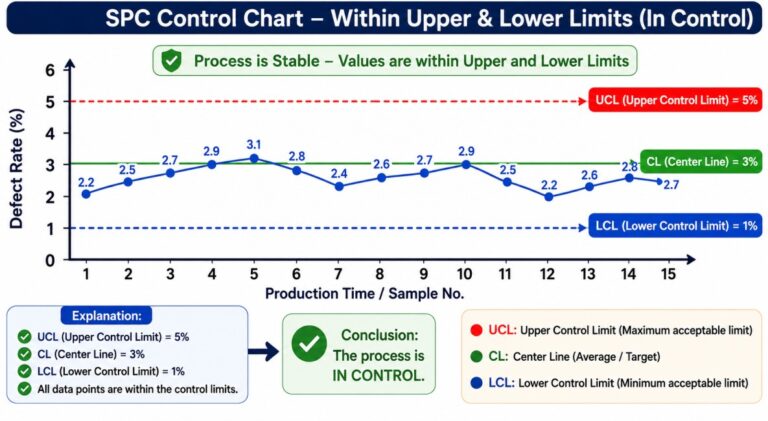
- SPC trends show an unusual shift, drift, or repeated variation beyond control limits, indicating a possible process instability
I want to be direct about something here: one of the most damaging patterns I have seen in quality departments is the practice of closing issues with quick fixes and never elevating them to a formal CAPA. It feels efficient in the short term. You close the ticket, the line keeps running, and everyone moves on. But you are building technical debt in your quality system. Those unresolved root causes accumulate, and eventually one of them becomes your Maggi moment.
Root Cause Analysis: Going Deeper Than the Obvious
The quality of your CAPA is only as good as the quality of your root cause analysis. This is where I have seen the most significant variation between teams that have mature quality cultures and those that are still developing one.
The 5 Whys Technique: Finding the Real Cause
The 5 Whys method is a simple but powerful root cause analysis tool used across manufacturing industries. It helps teams move beyond the obvious problem by repeatedly asking “why” until the actual process weakness is uncovered.
For more complex problems involving multiple variables, an Ishikawa (Fishbone) diagram maps potential causes across the standard six Ms: Man, Machine, Material, Method, Measurement, and Mother Nature (environment). This is particularly useful when the problem is not linear and multiple contributing factors need to be systematically evaluated before the primary root cause can be confirmed.
Effectiveness Verification: The Step That Creates Real Change
One of the most overlooked parts of the CAPA process is checking whether the corrective action actually solved the problem. In many cases, actions are completed, and records are closed without confirming that the issue has been prevented from happening again.
To make CAPA effective, teams should define clear results to measure, set a review period, and assign responsibility for follow-up. This ensures there is proof that the action worked as expected.
During audits, effectiveness checks are often reviewed closely. If this step is missing, it can show weaknesses in the quality system and suggest the focus is more on closing tasks than improving processes.
Building a CAPA Culture, Not Just a CAPA Process
Procedures, forms, and software platforms are infrastructure. A CAPA system only works if the culture around it supports honest reporting, thorough investigation, and genuine accountability.
In organisations where quality is truly embedded, people raise issues without fear of blame. Near-misses are reported proactively. Line operators flag concerns before they become defects. Supervisors escalate rather than quietly fix and move on. That culture does not develop because of a policy. It develops because leadership consistently demonstrates that finding a problem early is valued and that hiding a problem until it becomes a crisis is not acceptable.
If your CAPA managemnet is generating very few records in a complex operation, that is not a sign that things are going well. It is almost always a sign that reporting is suppressed. A healthy CAPA system in a manufacturing or services operation generates a steady stream of low-severity CAPAs that get resolved quickly and those frequent small improvements are what prevent the large catastrophic failures.
Case Study
In June 2015, Nestlé India pulled every packet of Maggi instant noodles off shelves across the country. Regulators had found lead levels in tested samples up to 17 times above the permissible limit, along with undeclared MSG. More than 38,000 tonnes of product were destroyed. The brand reportedly lost an estimated ₹450 crore in under five months, making it one of the largest food safety recalls in Indian history.
I have spent over a decade working across EHS and quality functions, and I can tell you this: the Maggi crisis was not simply a production error. It was the visible outcome of a system that had failed repeatedly, quietly, and without correction. The root causes of gaps in supplier qualification, inconsistent monitoring protocols, and the absence of a closed-loop corrective action process had gone unaddressed long before regulators ever showed up at the door.
That is what a broken CAPA process looks like at scale. And it is exactly why every quality and compliance team needs to understand CAPA not as a paperwork exercise, but as one of the most powerful tools in their arsenal.
“The failure was not a one-time production error. It pointed to gaps in systematic monitoring, supplier qualification, and closed-loop corrective action that had gone unaddressed for far too long.”
Conclusion
CAPA is not a bureaucratic obligation. Used with discipline and genuine commitment, it is how organisations learn. Every defect, every near-miss, every audit finding is data. CAPA is the process that converts that data into a stronger, safer, more reliable operation.
The Nestlé India recall did not have to happen at the scale it did. The signals were there. What was missing was a quality system with the rigour to catch them, investigate them, and act on them before the consumer, the regulator, and the media forced the issue. That is the real cost of treating CAPA as a checkbox.
Your quality system deserves better than that. So do your customers.