
Introduction
Incident management system implementation has become one of the clearest markers separating organizations that treat safety as a compliance checkbox from those that treat it as an operating discipline. Walk onto any shop floor, drilling rig, or hospital ward, and you’ll find incidents happening every day, some trivial, some near-misses that could have ended very differently, and occasionally one that changes everything for a worker and their family. The difference between organizations that learn from these events and organizations that keep repeating them usually comes down to one thing: how they capture, investigate, and act on incident data.
Two decades of implementing safety systems across manufacturing floors, chemical plants, pharmaceutical facilities, oil rigs, construction sites, mines, and hospitals point to one consistent lesson: paper forms and spreadsheets fail not because people don’t care, but because they can’t keep pace with how fast operations move. This article breaks down what actually makes an incident management system effective, based on what separates a system that gets used from one that gets ignored after month three.
What Is an Incident Management System?
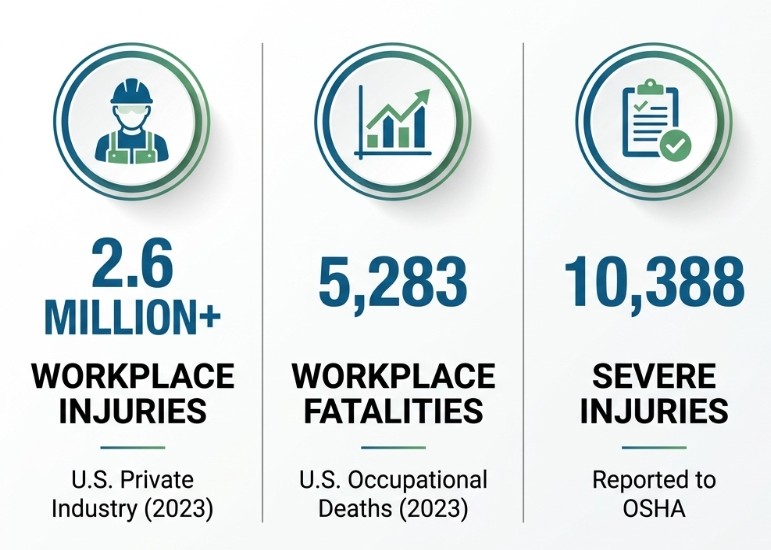
An incident management system is a structured process usually supported by digital software that allows organizations to report, investigate, classify, and resolve workplace incidents while tracking corrective actions through to closure. It’s not just a reporting form. A genuine incident management system covers the entire lifecycle: from the moment something goes wrong on the floor to the moment leadership confirms the root cause has been eliminated and won’t recur.
What separates a real system from a glorified logbook is the workflow logic behind it. Reporting is the easy part, making sure the right people get notified, the investigation happens on time, the corrective action gets verified, and the data rolls up into meaningful trends is where most organizations struggle without dedicated software.
Types of Incidents Managed
A mature incident management system needs to handle far more than lost-time injuries. In practice, safety teams track:
- Workplace Injuries – anything from a minor cut requiring first aid to a serious lost-time injury
- Near Misses – events that almost caused harm but didn’t, often the richest source of predictive data
- Unsafe Acts – behaviors like bypassing a guard or skipping a lockout step
- Unsafe Conditions – hazards such as blocked exits, exposed wiring, or damaged flooring
- Property Damage – equipment collisions, structural damage, forklift incidents
- Fire Incidents – from small electrical sparks to full evacuation events
- Environmental Incidents – spills, emissions breaches, waste mishandling
- Equipment Failures – mechanical breakdowns that create safety risk
- Occupational Illnesses – exposure-related conditions that develop over time, such as hearing loss or respiratory issues
- Accidents – unplanned events resulting in injury, property damage, environmental impact, or operational disruption, including slips, trips, falls, vehicle collisions, and machinery accidents
Treating all of these categories within one incident management system, rather than scattering them across different forms and departments, is what gives safety teams a genuine picture of organizational risk.
Regulatory Compliance Requirements for Incident Management
OSHA Incident Recording & Reporting
In the United States, OSHA sets the baseline for incident recordkeeping under 29 CFR Part 1904. This regulation governs three core documents that any US-based facility needs to maintain accurately:
- OSHA 300 Log – the running record of recordable injuries and illnesses
- OSHA 301 Incident Report – the detailed report completed for each recordable case
- OSHA 300A Summary – the annual summary posted for employee visibility
Facilities that still manage these manually often discover errors only when an auditor points them out by then, the damage to credibility (and potentially the penalty exposure) is already done.
ISO 45001
ISO 45001 is the international benchmark for occupational health and safety management systems, and its incident-related requirements sit largely under Clause 10.2 Incident, Nonconformity, and Corrective Action. This clause requires organizations to:
- React to the incident in a controlled manner
- Examine incident and determine its causes
- Execute corrective action appropriate to the effects experienced
- Evaluate the effectiveness of corrective action taken
The continual improvement requirement running through ISO 45001 essentially demands that incident data feed back into risk assessments, procedures, and training not sit in a filing cabinet.
ISO 14001
For environmental incidents specifically, ISO 14001 requires similar rigor around identifying nonconformities, correcting environmental impact, and preventing recurrence which is why environmental spills and emissions events belong inside the same incident management system as safety incidents, not a separate silo.
Local Factory & Labour Regulations
Beyond international standards, most countries carry their own factory and labour law obligations reporting timelines, notification authorities, and investigation documentation requirements that vary by jurisdiction and often by state or province. A system built only around OSHA or only around ISO 45001 tends to fall short the moment an organization operates across multiple regions.
Industry-Specific Compliance Requirements
Industry | Key Compliance Focus |
Manufacturing | Machine guarding incidents, LOTO violations, ergonomic injuries |
Chemical | Process safety events, chemical exposure, spill reporting |
Pharmaceutical | Contamination incidents, GMP deviations tied to safety |
Oil & Gas | Process safety, permit to work violations, hydrocarbon releases |
Construction | Fall incidents, struck-by events, scaffolding failures |
Mining | Ground control incidents, gas exposure, equipment entrapment |
Healthcare | Needlestick injuries, patient handling injuries, exposure incidents |
Manual vs Digital Incident Management
Parameter | Manual Incident Management | Digital Incident Management System |
Reporting Speed | Delayed, often end-of-shift | Real-time, from the point of occurrence |
Data Accuracy | Prone to transcription errors | Structured forms reduce input errors |
Investigation Tracking | Email threads, easy to lose | Centralized workflow with status tracking |
CAPA Follow-up | Manual reminders, frequent slippage | Automated due dates and escalations |
Regulatory Reporting | Manually compiled OSHA/ISO reports | Auto-generated compliance reports |
Trend Analysis | Limited, retrospective | Real-time dashboards and predictive analytics |
Audit Readiness | Time-consuming document retrieval | Instant audit trail retrieval |
Multi-Site Visibility | Fragmented, site-by-site | Consolidated across sites and departments |
How an Incident Management System Works

Understanding the workflow end-to-end matters more than any single feature, since the real value of an incident management process comes from how the stages connect.
- Incident Occurs – something happens on the floor, in the field, or in a facility.
- Incident Reporting – the worker or supervisor initiates a report, ideally within minutes.
- Capture Incident Information – location, time, people involved, and description are recorded.
- Injury Assessment – if there’s an injury, severity is assessed and medical response is triggered.
- LTIR Recording – lost-time cases are flagged for statistical tracking.
- Incident Submission – the report is formally submitted into the system.
- Automated Notifications – relevant supervisors, EHS managers, and department heads are alerted instantly.
- Investigation Assignment – an investigator or team is assigned based on incident type and severity.
- Evidence Collection – photos, CCTV footage, statements, and equipment logs are gathered.
- Root Cause Analysis – the investigation team determines what actually caused the incident.
- Incident Classification – the event is categorized by type and severity for reporting purposes.
- Impact Assessment – the operational, financial, and human impact is documented.
- CAPA Assignment – corrective and preventive actions are assigned to responsible owners.
- Action Tracking & Escalation – progress is monitored, with automatic escalation for overdue items.
- Department Review – the relevant department signs off on findings and actions.
- Management Approval – leadership reviews and approves closure.
- CAPA Verification – the effectiveness of the corrective action is verified in practice, not just on paper.
- Incident Closure – the case is formally closed with complete documentation.
Skipping any stage is usually where things fall apart, an action assigned but never verified, or an investigation closed before the root cause is confirmed.
Real-World Example: Texas City Refinery Explosion (2005)
On March 23, 2005, an explosion occurred at the BP Texas City Refinery during the startup of a processing unit after maintenance. A distillation tower was overfilled, releasing a large cloud of flammable hydrocarbons that ignited. The explosion killed 15 workers, injured more than 170, and caused extensive damage. Investigations found failures in process safety management, inadequate communication, and unresolved safety issues.
Incident Management Capability | How It Could Have Helped |
Incident & Near-Miss Reporting | Captured early warning signs and unsafe conditions before they escalated. |
Automated Notifications | Alerted supervisors and safety teams immediately when critical hazards were reported. |
Root Cause Analysis | Identified underlying causes of recurring safety issues for effective prevention. |
CAPA Management | Assigned, tracked, and verified corrective actions to ensure hazards were resolved before startup. |
Trend Analysis | Detected recurring incidents and process safety risks through historical data analysis. |
Management Dashboard | Provided real-time visibility into unresolved hazards, overdue actions, and high-risk areas. |
Essential Features of an Effective Incident Management System
Report Incidents in Real Time
The single biggest improvement digital systems bring over paper is speed. Real-time incident reporting means a supervisor knows about a spill or near miss within minutes, not at the next shift handover. That speed directly affects how much evidence is preserved and how quickly hazards get controlled.
Mobile Access for Incident Reporting
On a construction site or in a warehouse, nobody’s carrying a laptop. Mobile incident reporting lets a worker log an incident from a phone on the spot and attach a photo of the hazard dramatically increasing reporting rates, especially for near misses that would otherwise go unrecorded.
Smarter Incident Reporting Starts with AI
AI incident reporting tools increasingly pre-fill incident details from voice input, suggest categories based on description text, and flag potential duplicate reports reducing the administrative burden that often stops workers from reporting at all.
Near Miss Reporting
Near miss reporting is the most underused data source in most safety programs every serious injury has a stack of unreported near misses behind it. A system that makes near miss reporting genuinely fast, under a minute, captures data that predictive safety models depend on.
Hazard Identification
Hazard reporting complements near miss reporting by capturing conditions before they cause an event: a loose railing, a leaking valve, worn PPE. Combining hazard identification with incident data gives a fuller risk picture than incident records alone.
Configurable Incident Forms
No two industries capture the same incident details. A chemical plant needs exposure and substance fields; a construction site needs fall-height and scaffold-tag fields. Configurable incident forms let each site or department adapt the reporting structure without needing a developer involved.
Automated Notifications
Automated notifications ensure the right people are alerted the moment an incident is logged, based on severity, location, or type rather than relying on someone remembering to forward an email.
Investigation Management
Investigation management brings structure to what used to be ad hoc: assigning investigators, setting deadlines, and tracking progress through defined stages so nothing stalls indefinitely.
Evidence Collection
Photos, videos, CCTV clips, equipment maintenance logs, and scanned documents all need a home. Built-in evidence collection keeps everything attached to the incident record instead of scattered across email attachments and shared drives.
Witness Statement Recording
Witness statement recording, ideally done digitally and time-stamped, preserves accounts before memories fade or get influenced by later conversations which matters enormously for accurate root cause analysis.
Root Cause Analysis
Effective incident investigation software supports multiple root cause analysis methods, because different incidents call for different tools:
Method | Best Used For |
5 Whys | Simple, single-cause incidents |
Fishbone Diagram | Incidents with multiple contributing factors |
4M Analysis | Man, Machine, Material, Method breakdowns |
5M / 6M Analysis | Adds Measurement and Mother Nature (environment) for complex process incidents |
Having all four available inside one incident investigation software platform means investigators aren’t forced to fit every incident into the same template.
Corrective and Preventive Action (CAPA)
Corrective and preventive action is where most of the real safety improvement happens or fails to happen. A CAPA management needs to cover:
- Action Tracking – clear ownership and current status for every action
- Due Dates – realistic deadlines tied to risk severity
- Escalations – automatic alerts when actions run overdue
- Effectiveness Verification – confirming the fix actually worked, not just that it was implemented
- Closure Validation – a final sign-off step before the incident is considered resolved
CAPA Workflow at a glance:
Stage | Owner | Outcome |
Action Assignment | EHS Manager | Responsible person identified |
Implementation | Department Lead | Corrective measure applied |
Verification | Safety Officer | Confirms action addressed root cause |
Approval | Management | Formal sign-off |
Closure | System | Incident marked resolved |
Injury & Safety KPIs
Safety KPIs turn raw incident counts into comparable, trackable metrics:
KPI | What It Measures |
LTIR | Lost Time Injury Rate per standard hours worked |
TRIR | Total Recordable Incident Rate across all recordable cases |
LTIFR | Lost Time Injury Frequency Rate |
Medical Treatment Cases | Injuries requiring treatment beyond first aid |
Restricted Work Cases | Cases where duties were modified |
First Aid Cases | Minor injuries treated on-site |
Fatalities | The most severe outcome, tracked with zero tolerance |
Beyond the headline numbers, deeper analysis adds real value: repeated injury analysis flags workers or roles with recurring cases, injury trend analysis shows whether the safety program is improving month over month, injury analysis by body parts highlights where PPE or ergonomic fixes are needed most, and incident severity analysis helps prioritize which categories deserve the most attention.
Incident Classification & Severity Assessment
Classifying incidents consistently by type, severity, and potential consequence is what makes aggregate reporting meaningful. Without a standard classification scheme, comparing incidents across sites becomes guesswork.
Regulatory Compliance Tracking
Regulatory compliance tracking keeps a running record of reporting obligations met, deadlines hit, and documentation filed critical for OSHA compliance, ISO 45001 certification audits, and any local regulatory inspection.
Audit Trail
An audit trail that logs every action, timestamp, and user automatically is non-negotiable for compliance management. When an auditor asks “who approved this closure and when,” the answer needs to be one click away, not a week of digging through files.
Dashboard & KPI Monitoring
Dashboards turn incident data into something leadership actually looks at. Useful widgets include:
- Open Incidents
- Closed Incidents
- Overdue CAPAs
- Department-wise Incidents
- Site-wise Incidents
- Incident Status breakdown
- LTIR Dashboard
- Safety KPIs summary
Safety Performance Board
A safety performance board, often displayed on-site or shared company-wide, keeps safety visible day-to-day. Common indicators include:
- Days Since Last Accident
- Days Since Last Lost Time Injury
- Safety Score
- Compliance Score
- Open CAPAs
AI-Powered Analytics and Predictive Safety
Predictive safety is where incident management is heading fastest. AI-powered analytics can flag pattern recognition across seemingly unrelated incidents, predict where a repeat incident is likely based on historical data, and generate smart recommendations for preventive action before an incident occurs rather than after.
Multi-Site Incident Management
For organizations running multiple facilities, multi-site incident management consolidates data centrally while letting each site manage its own day-to-day workflow giving corporate safety teams comparative visibility without micromanaging local operations.
Cloud & Mobile Accessibility
Cloud-based EHS software means safety data isn’t trapped on one server at one location. Combined with mobile accessibility, it lets safety teams review and act on incidents from the plant floor or off-site.
Role-Based Access Control
Role-based access control ensures workers can report incidents without seeing sensitive investigation details meant for management, while auditors get exactly the visibility they need, nothing more.
Integration with Other EHS Modules
An incident management system delivers the most value when it doesn’t operate in isolation. Integration with the following modules closes the loop between prevention and response:
Module | How It Connects to Incident Management |
Risk Assessment | Incidents feed back into updated risk ratings |
Permit to Work | Incidents linked to permit violations get flagged automatically |
Audit Management | Audit findings can trigger incident-style investigations |
Inspection Management | Inspection failures can be converted directly into incidents |
Training Management | Root causes tied to training gaps trigger refresher assignments |
Contractor Management | Contractor-related incidents feed into contractor safety scoring |
Document Management | Investigation reports and evidence stay linked to the incident record |
Future of Incident Management Systems
The next generation of incident management software is moving from reactive documentation toward genuine prevention. Artificial intelligence is already reshaping how incidents get classified and investigated, and predictive safety models are starting to flag high-risk conditions before an incident happens rather than after.
IoT sensors on equipment can detect abnormal conditions and auto-generate incident alerts. Wearables can monitor worker fatigue, gas exposure, or fall detection in real time. Computer vision is being used to detect unsafe acts missing PPE, unauthorized zone entry directly from camera feeds. Voice reporting is lowering the barrier to reporting even further, letting workers log an incident hands-free while still on the job.
All of this is converging into a digital safety ecosystem where incident management, risk assessment, permits, training, and inspections feed a single business intelligence layer. Organizations that adopt this connected approach early tend to see safety performance improve faster than those treating each module as a separate tool.
AI Capabilities in Incident Management System
AI Capability | Business Benefit |
Intelligent Incident Reporting | Faster and more accurate reporting |
Automated Classification | Consistent incident categorization |
Predictive Analytics | Prevent incidents before they occur |
Smart Root Cause Analysis | Faster investigations and better accuracy |
AI-Recommended CAPAs | Improved corrective action effectiveness |
Pattern Recognition | Early identification of recurring risks |
Intelligent Dashboards | Better management visibility |
Compliance Monitoring | Improved audit readiness |
Predictive KPI Monitoring | Proactive safety performance management |
Conclusion
An incident management process is the discipline behind how it’s used, but the right platform removes most of the friction that causes discipline to break down. Real-time reporting, structured investigation workflows, root cause analysis, CAPA tracking, and predictive analytics together turn incident data from a compliance obligation into a genuine safety improvement engine. Organizations serious about reducing LTIR, meeting OSHA and ISO 45001 requirements, and building a proactive safety culture need more than a logbook; they need a connected incident management system that captures every incident, near miss, and hazard, and drives it through to a verified, effective resolution. That’s what separates safety programs that plateau from ones that keep getting measurably safer year after year.