
Introduction
Every hazardous task on an industrial site carries its own set of risks, and no single form can account for all of them. This is why the types of permit to work exist as a family of documents rather than one universal template. A crew welding a pipeline faces a different set of dangers than one entering a storage tank or lifting a load with a crane, and the paperwork authorizing each activity needs to reflect that difference. Companies that rely on a single generic permit for every job often find, once an investigation is underway, that the specific check that mattered most was never on the form to begin with. This article walks through the main types of permit to work used across high-hazard industries, looks at why so many categories exist, and closes with a practical guide to matching permit types with different sectors.
What Is a Permit-to-Work System
A permit-to-work system is the formal process an organization uses to authorize specific people to carry out a defined hazardous task within set time limits and under agreed conditions. In practice, this means a written application, a risk assessment, sign-off from someone competent to grant approval, and a formal handback once the job is finished. Instead of a supervisor giving a verbal go-ahead, the permit leaves behind a paper trail showing that hazards were identified, controls were put in place, and named individuals took responsibility before the work started.
Paper-based permit books are gradually giving way to digital platforms that route approvals electronically, flag permits that have run past their expiry, and keep a searchable log for audits or incident reviews. The format matters less than the outcome: nobody should be starting the job until the right permit is signed off and everyone on site understands what it says.
A functioning system also spells out who does what. The applicant requests the work, the issuer reviews and approves it, and the permit holder stays accountable for the task on the ground. Larger sites often add an area authority or shift supervisor to the chain, whose job is to check that nothing else happening nearby will conflict with the new permit. Without this kind of structure, a permit is little more than a signature on a form rather than a working safety control.
Why Different Types of Permits Exist
A form built for hot work will not catch the atmospheric testing an entry into a confined space demands, and a permit written for excavation says nothing about isolating a live circuit. Because a single generic checklist cannot cover every hazard, safety practitioners built out separate permit categories, each shaped around one type of risk.
Splitting permits this way lets each one carry a checklist and set of competency requirements suited to its own hazard, rather than a bloated document trying to cover everything at once. It also lines up with how regulators think about risk: OSHA and standards such as ISO 45001 expect controls to match the specific hazard rather than a blanket approach. The practical result is a set of permits where the document matches the job, and fewer chances for something important to slip through.
There’s a training payoff as well. When a worker is certified against one permit category, say confined space entry or radiation work, the course content stays focused on that hazard instead of trying to touch on every risk an operation might face. That narrower focus tends to produce a better-trained crew and gets new hires up to speed faster on the specific tasks they’ll actually be doing.
The Main Types of Permit to Work
Terminology shifts a bit from one organization to the next, and jurisdictions don’t always draw the lines in exactly the same place, but the categories below cover the permit framework found in most mature EHS programs.
1. Hot Work Permit
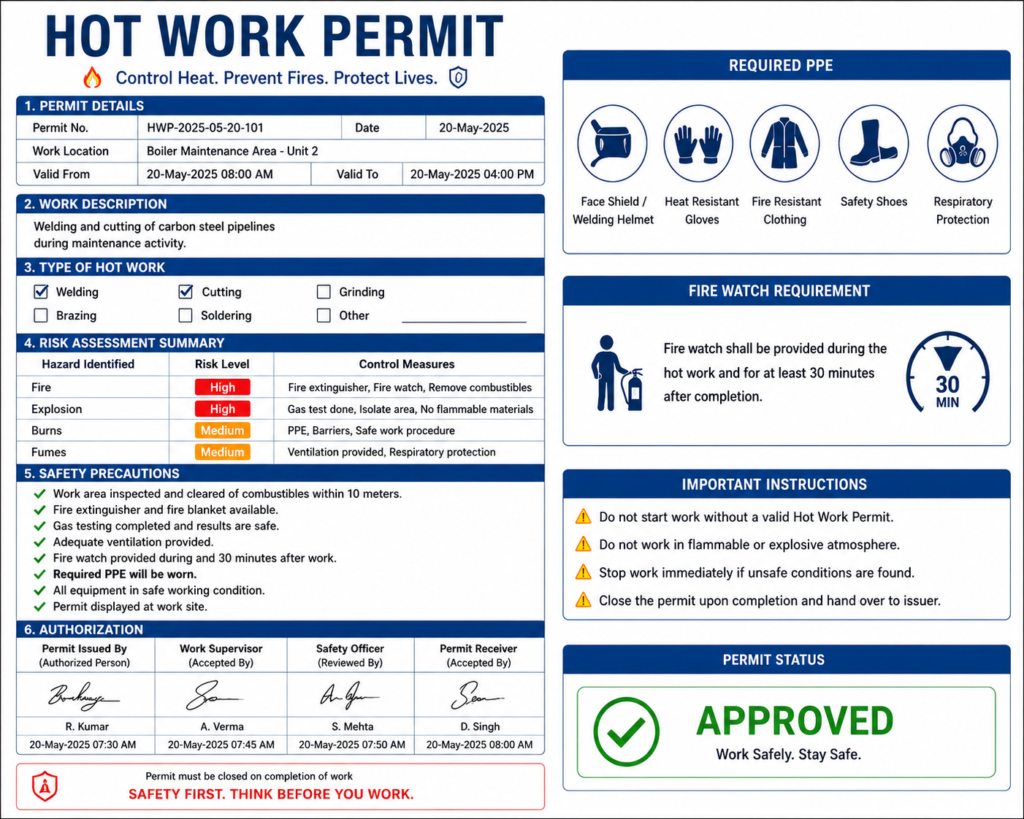
Welding, cutting, grinding, brazing: anything that produces heat, sparks, or an open flame falls under a hot work permit. Since these jobs introduce an ignition source, the sign-off depends on clearing flammable material from the area, assigning someone to watch for fire, and having extinguishing equipment within reach before the first spark flies. Most hot work permits also call for a watch period once the visible work is done, because smoldering debris can catch fire again well after the tools have been put away. Few permit categories get enforced as strictly as this one, especially anywhere flammable liquids or gases are stored nearby.
2. Cold Work Permit
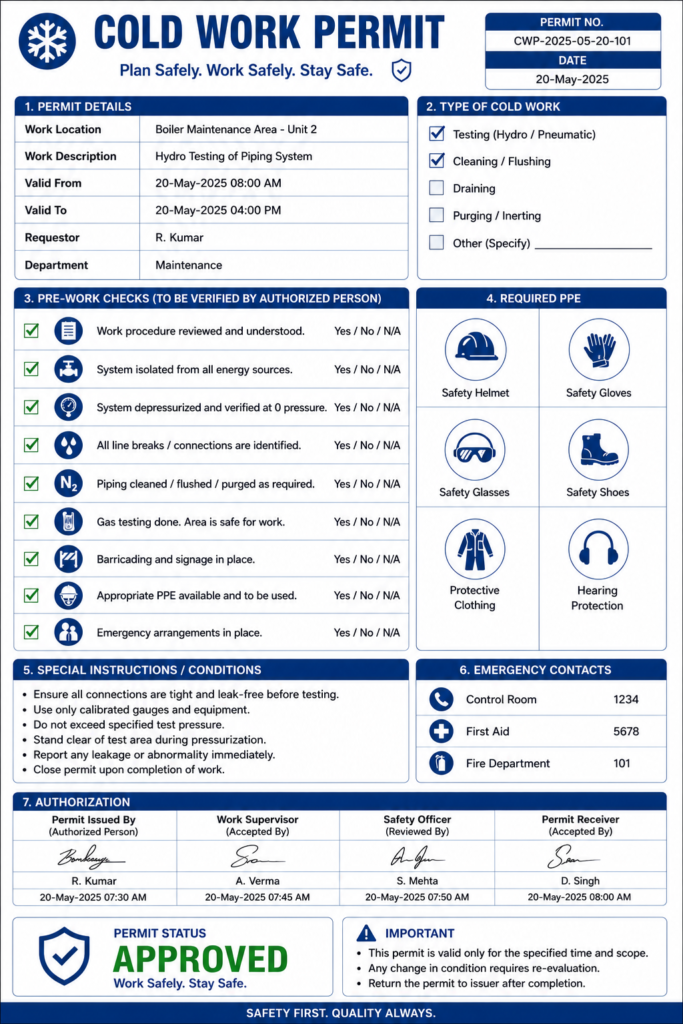
Not every maintenance job involves flame or spark. A cold work permit covers tasks like pipe fitting, carpentry, or routine equipment checks, where the risk comes from mechanical, chemical, or physical hazards instead. The bar for approval is lower than hot work, but a risk assessment is still required, along with confirmation that the area has been checked for pinch points, stored energy, or any nearby activity that could turn an ordinary job into a dangerous one.
3. Confined Space Entry Permit
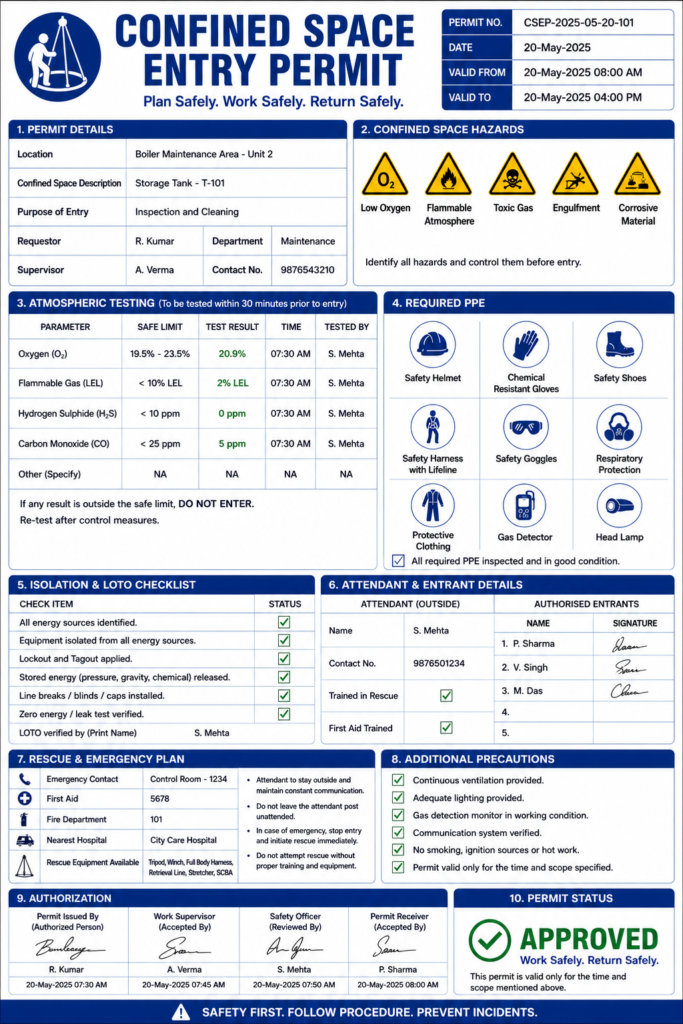
Few permits get scrutinized as closely as this one, and for good reason: low oxygen levels, trapped toxic gas, and a limited escape route make confined spaces one of the more dangerous places to send a worker. Before anyone climbs in, the air has to be tested, ventilation set up where needed, an attendant posted outside, and a rescue plan written down. Entry doesn’t happen until gas readings come back within safe limits, and most sites re-test throughout the job rather than checking once at the start and calling it done.
4. Excavation Permit
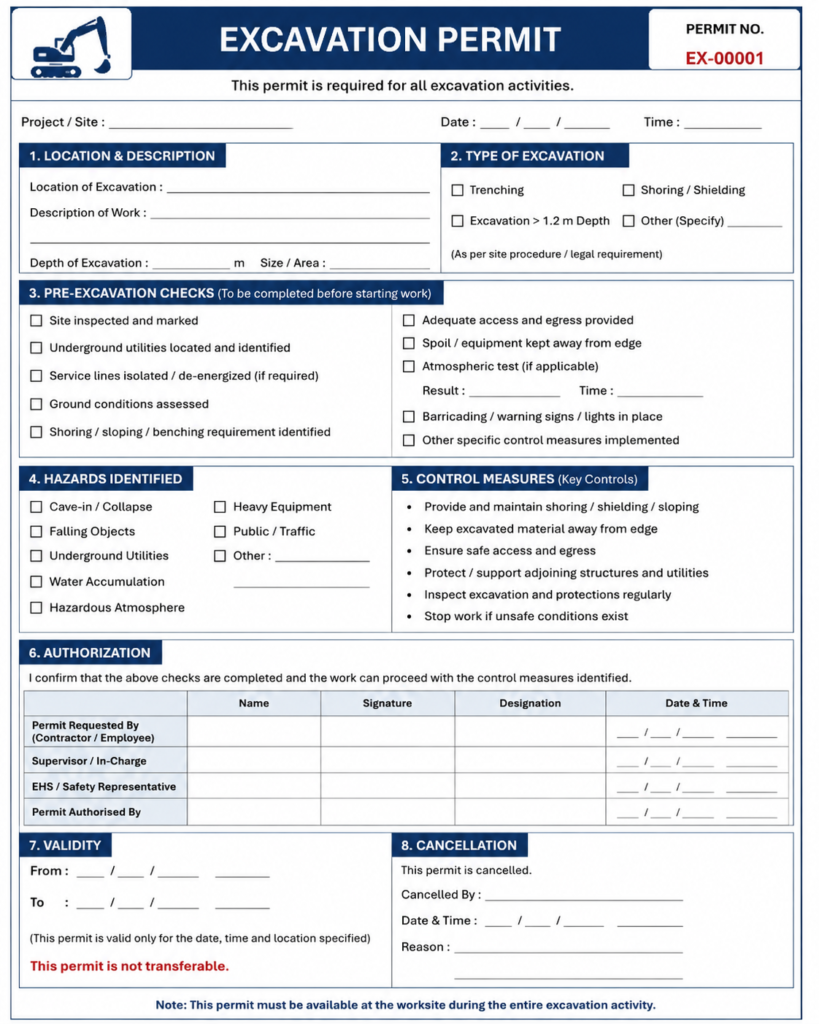
Digging anywhere on an industrial site risks striking a buried utility, destabilizing the surrounding soil, or opening up a fall hazard, which is why an excavation permit calls for utility clearance drawings, a look at soil type and shoring needs, and barricades around the perimeter before the first shovel goes in. This one matters most where gas lines, electrical cable, or water mains might be running underground, and it typically only covers the exact area and depth agreed to at the time of approval.
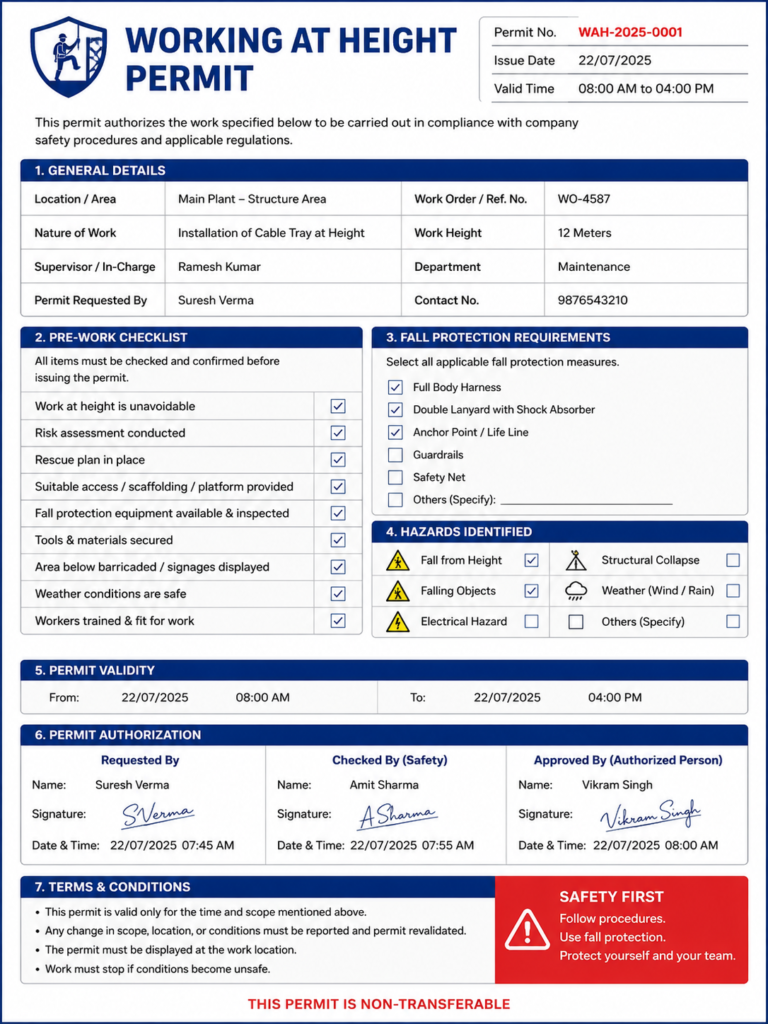
5. Working at Height Permit
Scaffolding, roof access, elevated platforms: anything performed above a set elevation threshold needs a working at height permit. Before the job starts, someone confirms that harnesses, guardrails, or safety nets are both present and inspected, and that the crew has the training to use them. Wind speed and other weather factors get checked too, and many permits are written to suspend automatically if conditions worsen past an agreed point mid-task.
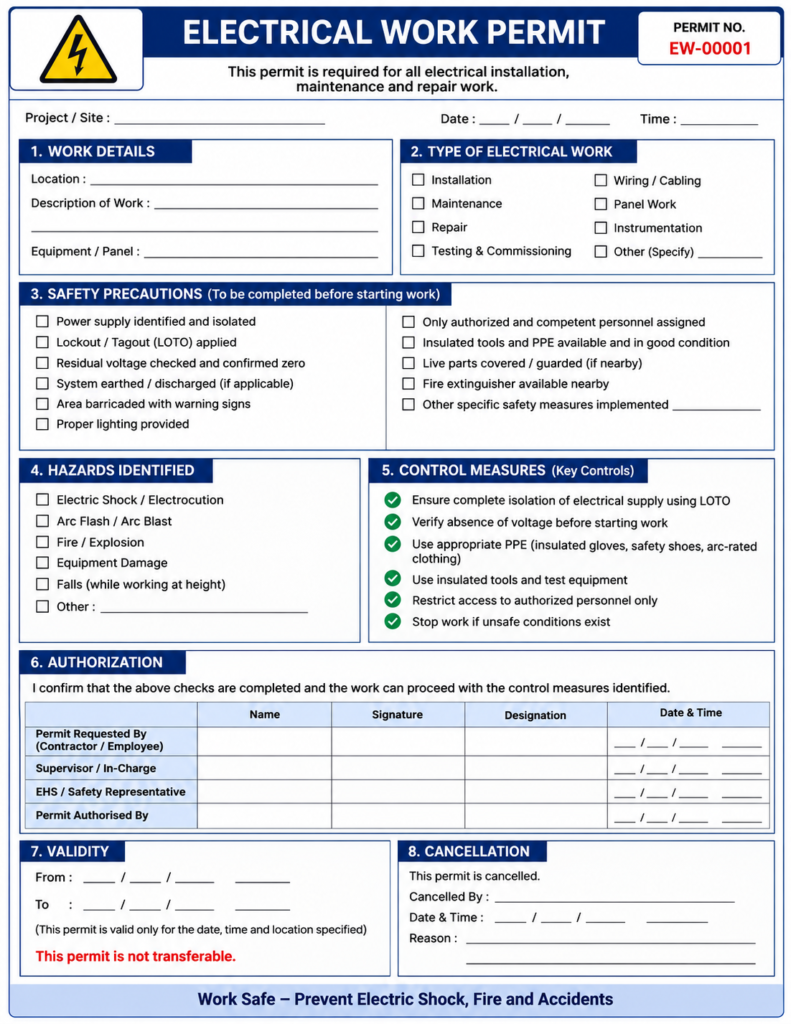
6. Electrical Work Permit
Any job that puts a worker near live or de-energized electrical systems needs an electrical work permit. It ties directly into lockout tagout procedures for isolating energy sources, testing to confirm a zero-energy state with approved equipment, and making sure only qualified electricians are doing the work. Because the consequences of getting this wrong are so severe, most organizations build in a second, independent check before treating any conductor as safe to touch.
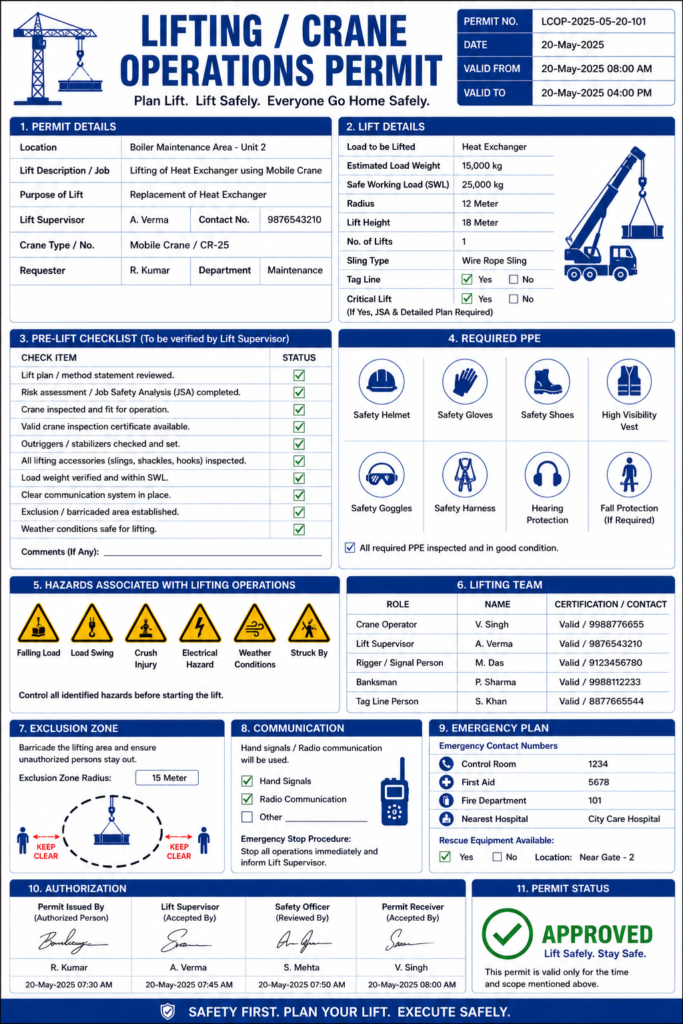
7. Lifting/Crane Operations Permit
Moving a heavy or awkward load with a crane or hoist calls for its own permit, built around a lift plan that spells out load weight, rigging setup, and the exclusion zone around the operation. The permit also confirms that the crane operator and rigging crew hold current certifications, and reviews ground conditions and nearby power lines before the lift goes ahead. Tandem or otherwise complex lifts usually need engineering sign-off on top of the standard paperwork.
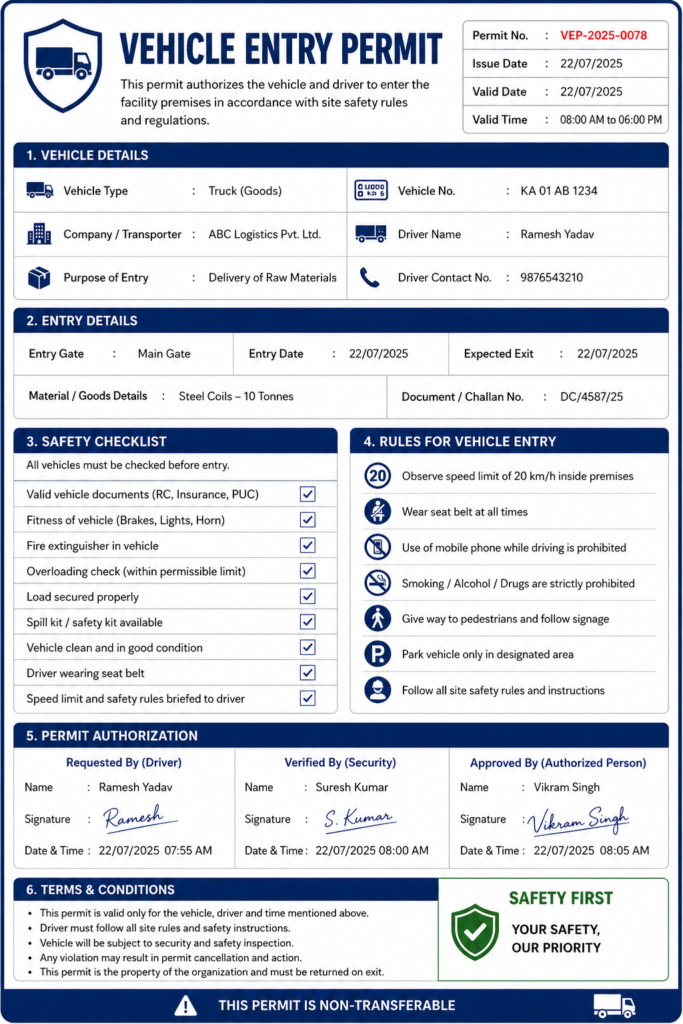
8. Vehicle Entry Permit
Trucks, forklifts, and other mobile equipment moving through restricted or high-traffic zones fall under a vehicle entry permit, which sets out approved routes, speed limits, and escort requirements where needed. This keeps vehicle and pedestrian traffic apart on construction sites and industrial yards where the two are constantly crossing paths, and it’s often paired with a quick check of the driver’s competency before entry is granted.
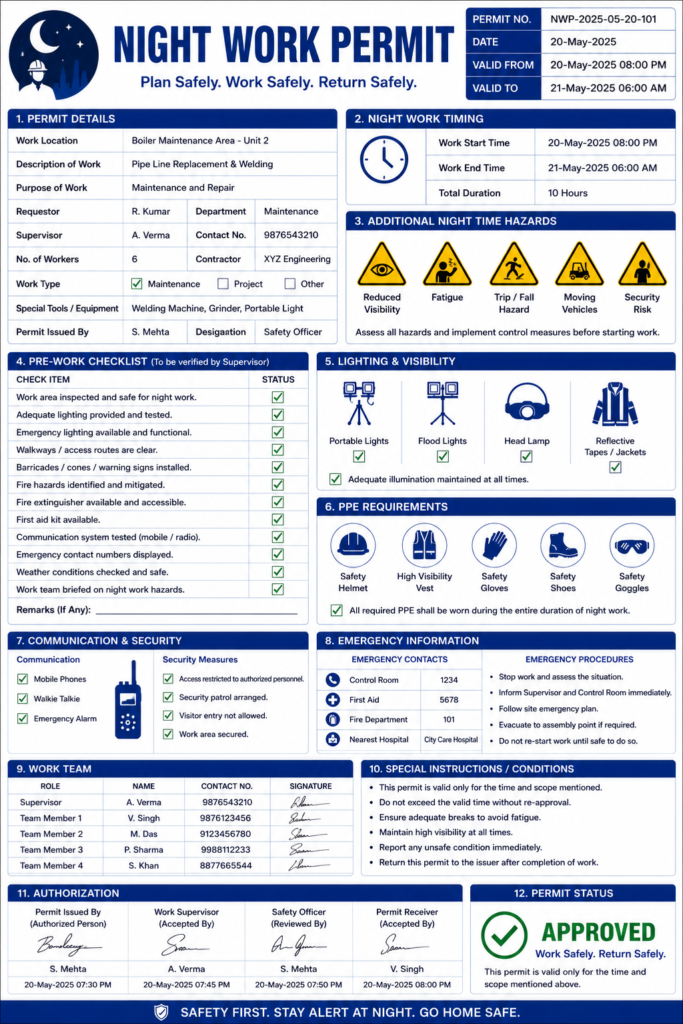
9. Night Work Permit
Darkness changes the risk profile of almost any task, cutting visibility, adding fatigue, and often reducing the supervisory presence on site. A night work permit accounts for this by requiring adequate lighting, confirming communication protocols between crews, and checking that emergency response resources are still reachable outside standard working hours.
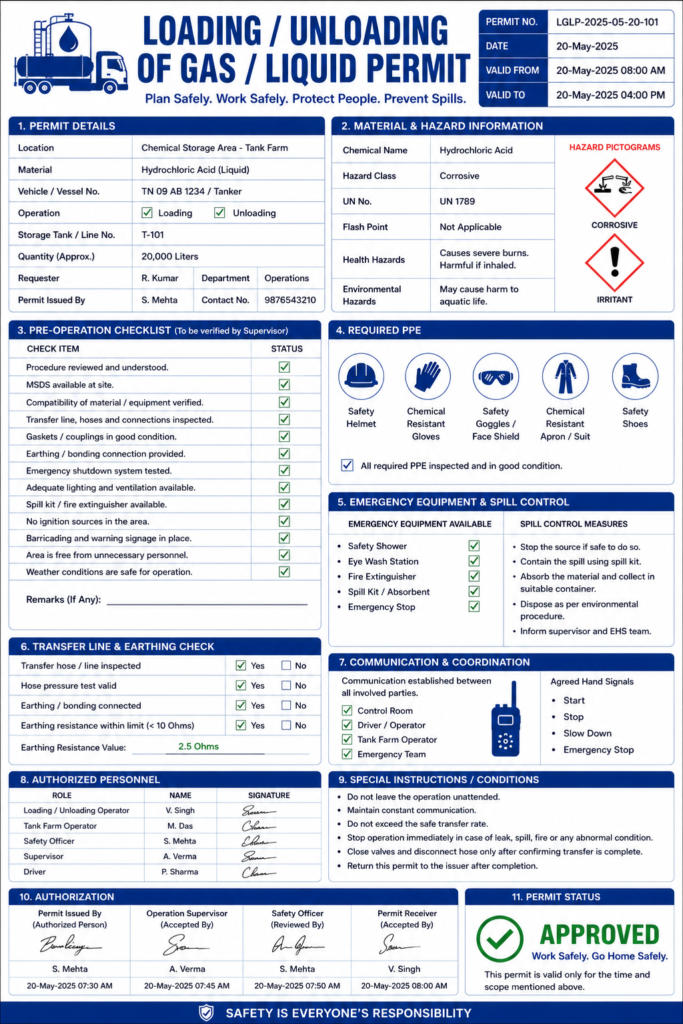
10. Loading/Unloading of Gas/Liquid Permit
Transferring flammable, toxic, or pressurized gases and liquids between tankers, storage vessels, and process equipment carries its own risks, chiefly static discharge and spills. This permit checks grounding and bonding connections, confirms the integrity of the transfer connection, and verifies containment measures are ready before the transfer begins.
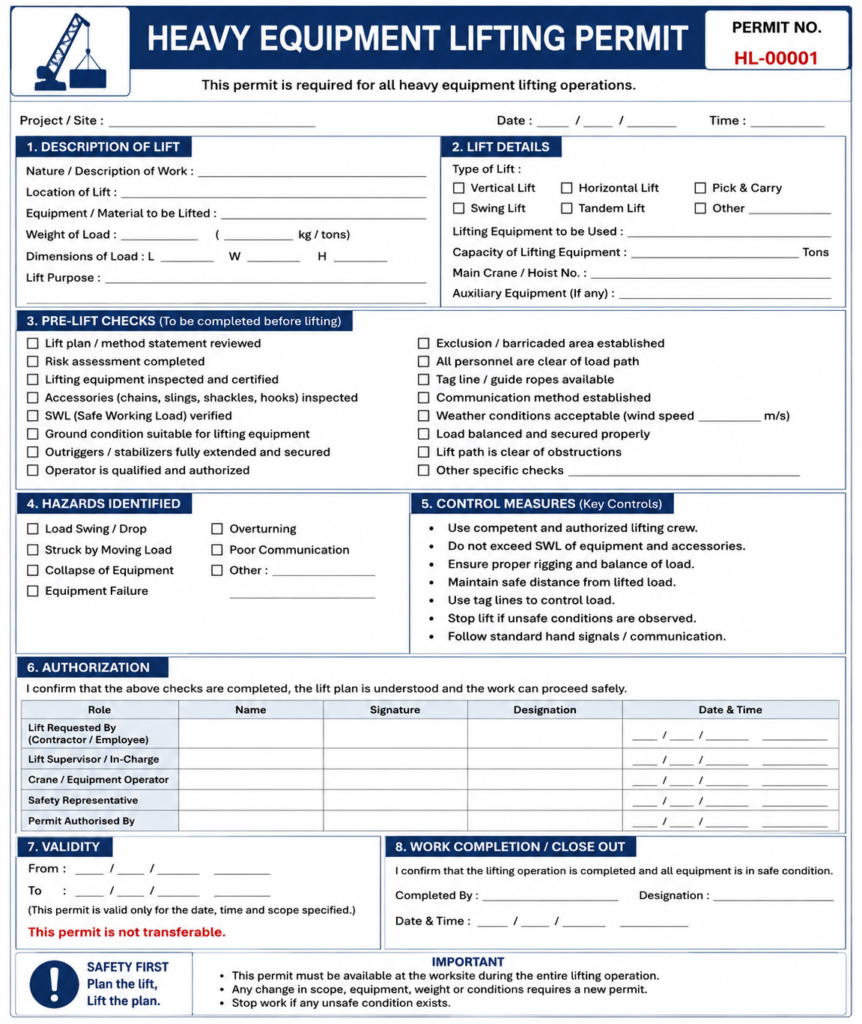
11. Heavy Equipment Lifting Permit
This one is separate from a standard crane permit and applies specifically to oversized machinery, structural steel, or process modules that need a closer engineering review. Expect load calculations, a multi-point rigging plan, and coordination across several crews, since lifts of this scale rarely go smoothly without everyone working from the same plan.
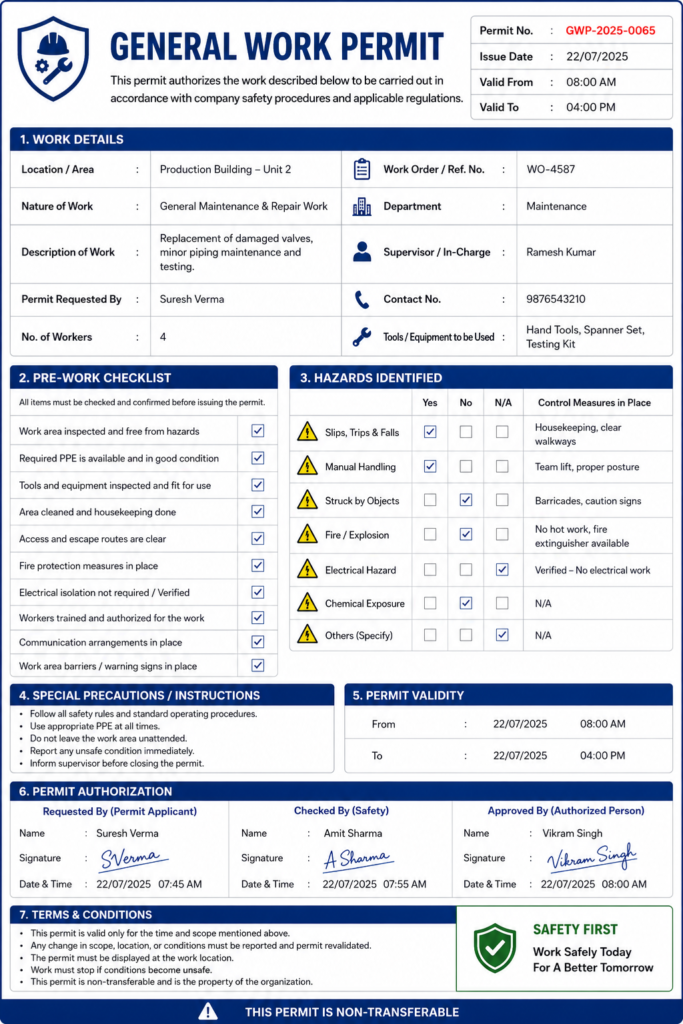
12. General Work Permit
Not every task fits a specialized category, but that doesn’t mean it should skip documentation altogether. A general work permit acts as a baseline authorization for lower-risk activities, keeping a record of what’s happening, a basic hazard check, and a line of communication to site supervision, so there’s always a clear picture of who is working where.
13. IT Work Permit
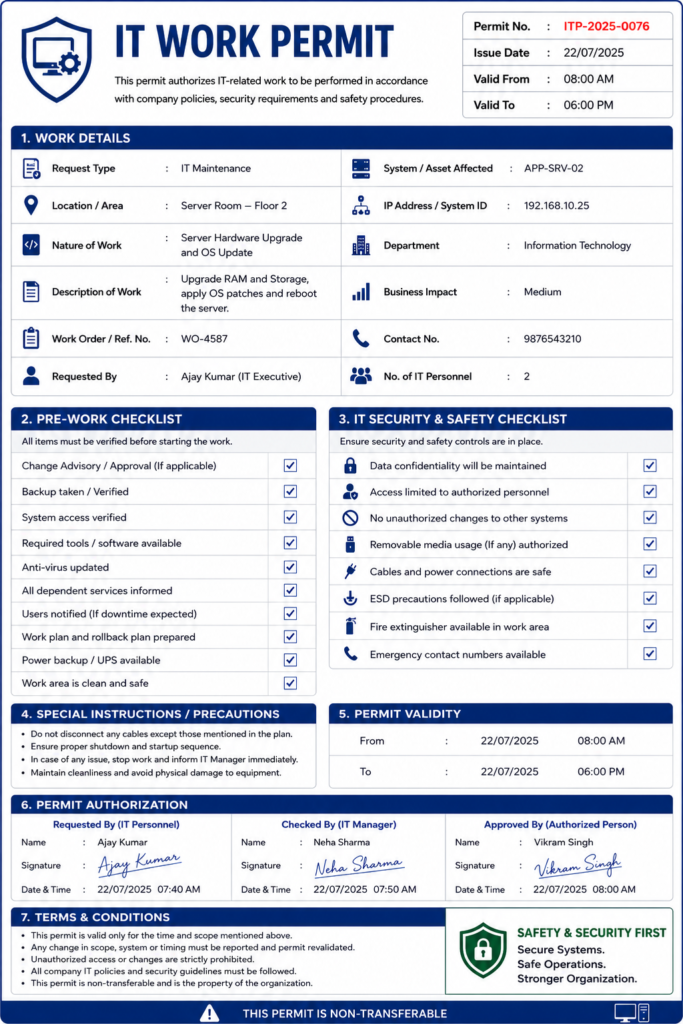
Servers, network infrastructure, and control systems get their own permit category, particularly where IT equipment ties into process safety systems. The concerns here are different from physical hazards: unplanned outages, data integrity, and unauthorized access. Coordination with process control engineers is usually part of the sign-off, since even a small network change can ripple into connected safety instrumentation in ways that aren’t obvious at first glance.
14. Radiation Work Permit
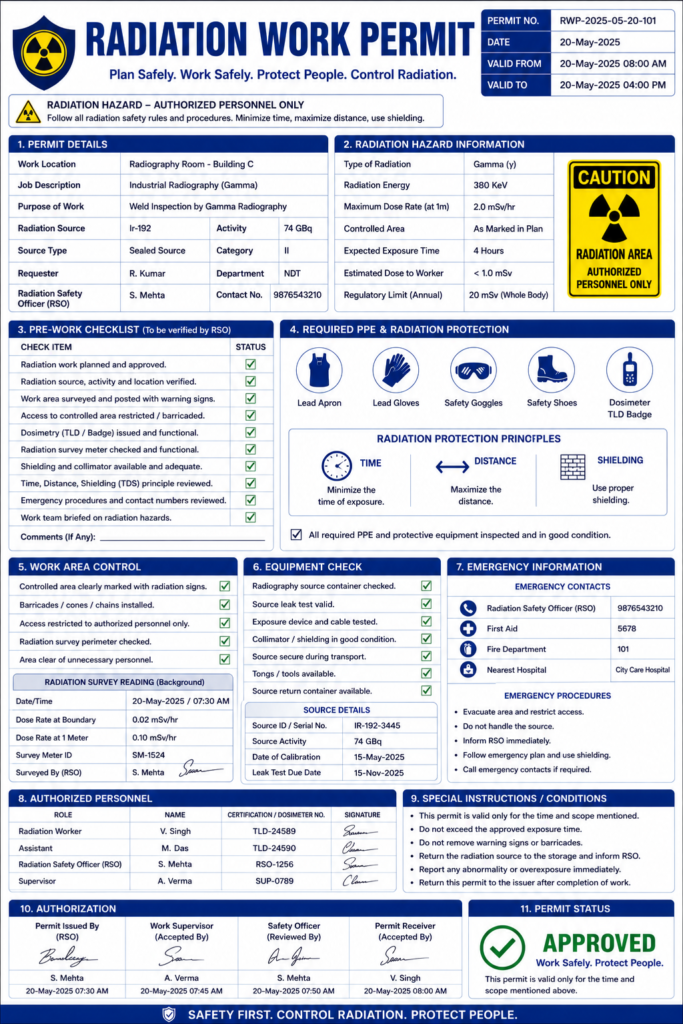
Radioactive sources and radiography equipment, the kind used for weld inspection, fall under a radiation work permit. Given the health risks involved, this one calls for dosimetry monitoring, a barricaded exclusion zone, and sign-off from a radiation safety officer before anyone gets near the source.
Regulatory Compliance of Different Types Permit to Work
Regulators haven’t left the types of permit to work up to individual interpretation. In the United States, OSHA addresses several permit categories directly through specific standards, while ISO 45001 provides the broader framework internationally, requiring organizations to identify hazards and put controls in place that match the level of risk. The table below lines up each permit type with its main regulatory reference and the compliance point auditors tend to check first.
Permit Type | Regulatory Reference | Key Compliance Requirement |
Hot Work Permit | OSHA 29 CFR 1910.252; NFPA 51B | Fire watch, clearance of combustibles, extinguishing equipment on site |
Cold Work Permit | ISO 45001 operational control clause | Documented risk assessment prior to task start |
Confined Space Entry Permit | OSHA 29 CFR 1910.146 | Atmospheric testing, attendant, rescue plan |
Excavation Permit | OSHA 29 CFR 1926 Subpart P | Utility clearance, shoring assessment, barricading |
Working at Height Permit | OSHA 29 CFR 1926 Subpart M | Fall protection systems, trained personnel, weather checks |
Electrical Work Permit | OSHA 29 CFR 1910.147 (LOTO) | Energy isolation, zero-energy verification |
Lifting/Crane Operations Permit | OSHA 29 CFR 1926.1400 | Certified operator, lift plan, exclusion zone |
Vehicle Entry Permit | Site traffic management plan; ISO 45001 | Approved routes, speed limits, escort where required |
Night Work Permit | ISO 45001 operational control clause | Lighting, communication protocol, emergency coverage |
Loading/Unloading of Gas/Liquid Permit | OSHA 29 CFR 1910.106; DOT regulations | Grounding/bonding, spill containment |
Heavy Equipment Lifting Permit | OSHA 29 CFR 1926.1400; engineering codes | Load calculations, multi-point rigging plan |
General Work Permit | ISO 45001 operational control clause | Basic hazard assessment, supervisory sign-off |
IT Work Permit | Internal change management policy | Coordination with process control, access control |
Radiation Work Permit | OSHA 29 CFR 1910.1096; NRC regulations | Dosimetry monitoring, radiation safety officer sign-off |
Having a permit template on file isn’t the same as being compliant. Auditors want to see that permits were issued by someone authorized to do so, that a risk assessment happened before work started, that gas testing or isolation steps were documented, and that the permit was formally closed out once the job wrapped up. Sites running a permit-to-work software process usually find this easier to prove, since the system keeps a timestamped record and won’t let a permit get backdated or waved through without the required approvals.
Record retention matters too. Many jurisdictions expect permit records, along with the gas testing logs and isolation certificates tied to them, to stay on file for a set period after the work is finished, especially where confined space entry or hazardous substances were involved. That paper trail comes in handy for incident investigations, insurance claims, and spotting patterns in where high-risk work tends to happen on site.
Regulatory Compliance by Country
The types of permit to work described above sit under different regulatory umbrellas depending on where a site operates. OSHA and ISO 45001 cover much of the ground in the United States and internationally, but several other countries and regions layer their own specific requirements on top. The table below highlights how permit-to-work compliance is enforced in a few major markets.
Country / Region | Key Regulation | Notes |
India | Factories Act, 1948; Indian Electricity Rules; Static and Mobile Pressure Vessels Rules | State factory inspectorates enforce permit-to-work compliance through site inspections, with additional oil and gas requirements from the Petroleum and Explosives Safety Organisation (PESO) |
United States | OSHA 29 CFR 1910 and 1926 series | Federal standards set specific permit requirements for confined space, hot work, LOTO, and fall protection, with some states running their own OSHA-approved plans |
United Kingdom | Health and Safety at Work Act 1974; Confined Spaces Regulations 1997 | The Health and Safety Executive (HSE) enforces compliance and expects a documented permit-to-work system for high-risk tasks such as confined space entry and hot work |
United Arab Emirates and GCC | OSHAD-SF (Abu Dhabi); Dubai Municipality codes | Regional authorities require permit-to-work systems aligned with international standards, with additional oversight from client organizations such as ADNOC on energy sites |
European Union | OSH Framework Directive 89/391/EEC | Sets the baseline for member states, each of which transposes the directive into national law with its own enforcement body and permit documentation requirements |
Organizations operating across more than one of these jurisdictions generally find it easier to build a permit management framework around the strictest applicable requirement in each category, then layer in local variations rather than maintaining entirely separate systems for each country. This approach keeps the underlying permit categories consistent while still satisfying regional inspectors and auditors.
Choosing the Right Permit Types for Your Industry
Picking the right types of digital permit to work starts with a hazard identification exercise specific to the site or project at hand. What matters most shifts a lot from one industry to the next, since each sector carries its own dominant hazards, equipment, and regulatory exposure. Here’s how permit priorities tend to break down across major industries.
- Aerospace: hot work, electrical work, and confined space entry carry the most weight here, covering welding on airframes, avionics and systems work, and entry into fuel tanks or fuselage sections during build and maintenance.
- Construction: excavation, working at height, lifting and crane operations, and vehicle entry are the permits you’ll issue most, given how much trenching, scaffolding, structural lifting, and heavy equipment movement happens on an active site.
- Automotive: electrical work, lifting, and hot work take priority on the plant floor, where robotic assembly lines, press and stamping equipment, and welding are constant.
- Food and Beverage: cold work, electrical work, and general work permits cover most of what comes up, from sanitation-sensitive maintenance to packaging line equipment and refrigeration servicing.
- Chemical: confined space entry, hot work, and loading or unloading of gas and liquid matter most, given how much reactive, flammable, or toxic material moves through tanks, reactors, and pipelines.
- Warehouse: vehicle entry and general work permits do most of the heavy lifting, managing forklift traffic, dock activity, and keeping pedestrians clear of moving equipment.
- Electronic: IT work, electrical work, and confined space entry stand out, reflecting cleanroom equipment, electrostatic-discharge controls, and maintenance inside enclosed fabrication or testing chambers.
- Cement Industry: hot work, confined space entry, and heavy equipment lifting cover kiln maintenance, silo entry, and the scale of crushing and conveying machinery running on site.
- Oil and Gas: confined space entry, hot work, electrical work, and loading or unloading of gas and liquid all take priority, given the flammable hydrocarbons, pressurized systems, and process vessels that need regular entry for inspection or repair.
- Mining: excavation, confined space entry, and heavy equipment lifting matter most, given underground access points, blasting-adjacent work, and the scale of extraction machinery involved.
- Shipbuilding: hot work, working at height, and confined space entry dominate, covering welding on hulls, scaffolding along vessel exteriors, and entry into ballast tanks and compartments.
- Industrial Machinery: electrical work, lifting, and cold work permits come up most often, tied to fabrication, heavy component handling, and mechanical assembly and testing.
Conclusion
Knowing the different types of permit to work gives safety professionals and operations managers the framework they need to keep high-risk activities under control before anyone picks up a tool. Hot work and confined space entry, electrical isolation, radiation exposure, each permit type is built around its own hazard, with verification steps and regulatory expectations to match. Organizations that put in the effort to build a clear, well-documented permit-to-work system, backed by digital EHS tools where it makes sense, end up in a stronger position to protect their workforce, stay on the right side of regulators, and cut down on the incidents that come from skipped steps. As sites get more complex and regulators keep raising the bar, a well-maintained set of permit types stops being a box to check and becomes a real part of how risk gets managed day to day.