Introduction
Environmental, health, and safety teams are under more pressure than ever to prove compliance, reduce incidents, and do it all with a leaner headcount. Spreadsheets and paper checklists can no longer keep pace with multi-site operations, contractor workforces, and regulators who expect real-time data rather than quarterly reports. This is why organizations across manufacturing, energy, construction, and logistics are turning to AI-powered EHS software to modernize how they manage risk.
Choosing the right platform, however, is not simply a matter of picking the vendor with the flashiest demo. It requires understanding which regulatory frameworks the software must support, which modules genuinely need artificial intelligence versus which are fine as digital forms, and how to separate real AI capability from marketing language. Procurement teams that skip this diligence often end up with a system that looks impressive in a sales pitch but adds administrative overhead rather than removing it, because the AI layer was never built for the specific hazards and compliance obligations their sites face.
This guide walks through exactly what to evaluate before you sign a contract in 2026 — from the regulatory frameworks a platform must map to, through every core EHS module, to the implementation decisions that determine whether the rollout actually succeeds. By the end, you should have a clear framework for separating genuine AI-powered EHS software from a digitized version of the same paper-based process you’re trying to leave behind.
Why AI Is Becoming Core to EHS Software
For years, EHS software meant digitizing paper forms: incident reports, permits, and audits moved from clipboards to tablets, but the underlying process stayed reactive. Someone had to notice a pattern, someone had to remember a certification was expiring, and someone had to manually cross-reference an incident against a regulatory clause.
Artificial intelligence changes that equation. Instead of EHS teams pulling insights out of data, the system pushes insights to them. Machine learning models trained on historical incident records can flag a recurring root cause before a third similar injury occurs. Computer vision can scan a job site photo and identify a missing hard hat in seconds. Natural language processing can read a near-miss report and route it to the right department automatically, without a human triaging every submission.
This shift matters because EHS risk is fundamentally a pattern-recognition problem, and pattern recognition is exactly what modern AI does well. A platform that only digitizes forms is still one step behind the risk; a genuinely AI-powered EHS software platform is designed to anticipate it. That difference — anticipation versus documentation — is the single biggest reason AI has moved from a “nice to have” to a baseline expectation in EHS procurement conversations this year.
Regulatory Compliance Frameworks the Software Must Support
Before evaluating features, confirm the platform can actually map to the regulatory frameworks your sites operate under. A tool that looks polished but can't produce an audit-ready record against your applicable standard is not a serious contender.
| Framework | Applies To | What the Software Must Support |
|---|---|---|
| OSHA 29 CFR 1910 / 1926 | General industry and construction sites in the U.S. | Recordkeeping, hazard communication documentation, and PPE standards, including the ability to generate 300, 300A, and 301 logs without manual reformatting |
| ISO 45001 | Organizations with a formal occupational health and safety management system | Alignment with the OH&S management system structure, including leadership commitment, worker participation, and continual improvement evidence for external audits |
| ISO 14001 | Sites with environmental management obligations | Mapping of incident and inspection data to environmental management system clauses, not just occupational safety data |
| EPA Reporting | Facilities handling emissions, effluent discharge, or hazardous waste | Manifest tracking and reporting formats that match EPA submission requirements |
| FDA / GMP | Regulated manufacturing and pharmaceutical sites | Traceability and documentation controls that satisfy Good Manufacturing Practice expectations, including validated audit trails |
How AI Auto-Maps Logged Data to the Correct Standard
This is where the AI layer earns its place. Rather than an EHS manager manually tagging every inspection or incident against the relevant clause of ISO 45001 or an OSHA standard, a well-built AI-powered EHS software platform reads the content of the record—the hazard type, the location, the equipment involved—and automatically maps it to the applicable regulatory clause. If a logged observation suggests a hazard communication gap, the system flags it against the relevant OSHA subsection in real time, rather than waiting for a quarterly compliance review to surface the gap. This real-time flagging of non-conformance is one of the clearest, most measurable returns on investment AI brings to compliance work, because it converts audit preparation from a scramble into a continuous background process.
Core Evaluation Criteria Before Shortlisting Vendors
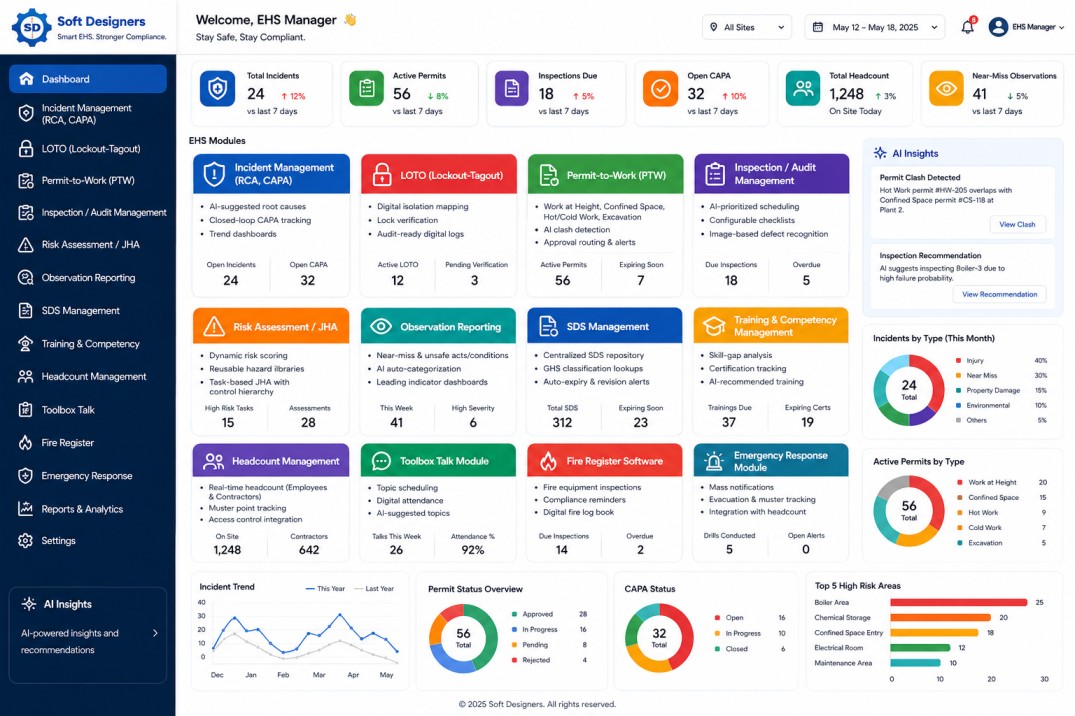
Once you’ve confirmed regulatory coverage, the next step is module-by-module evaluation. EHS platforms are rarely single-purpose tools; they are suites, and the quality of each module varies significantly between vendors. Here is what to look for in each.
Incident Management (RCA, CAPA)
Incident management is the backbone of any EHS platform. Beyond simple logging, look for AI-suggested root causes based on historical pattern matching across your own incident history and, ideally, industry benchmarks. The corrective and preventive action (CAPA) process should be closed-loop: assignment, tracking, and effectiveness verification all need to happen inside the same system, not in a follow-up email chain. Trend dashboards broken down by site, department, and hazard type turn incident data from a compliance record into a genuine leading-indicator tool.
LOTO (Lockout-Tagout) Software
Lockout-tagout errors remain one of the most serious sources of catastrophic injury, so this module deserves close scrutiny. Digital isolation point mapping lets crews visualize exactly which energy sources need to be locked before work begins. Lock verification with multi-authorization workflows ensures no single person can bypass a control step, and audit-ready digital LOTO logs replace the paper logbooks that are notoriously easy to falsify or lose.
Permit-to-Work (PTW)
A strong permit-to-work module needs to cover the full range of high-risk activities: work at height, confined space entry, hot work, cold work, and excavation permits, each with its own approval logic. The AI advantage here is permit clash and conflict detection, for example, automatically catching a hot work permit that overlaps with an active confined space permit in the same zone, a combination that has caused fatal incidents historically. Automated approval routing and expiry alerts keep permits moving without bottlenecking on a single approver’s inbox.
Inspection Management / Audit Management
Inspection management scheduling should be risk-prioritized by AI rather than fixed on a calendar, so higher-risk assets or areas get inspected more frequently based on their actual incident and near-miss history. Configurable checklists by asset or area type keep inspections relevant rather than generic, and image-based defect recognition — where a photo of a damaged guardrail or corroded pipe is automatically flagged — dramatically speeds up closure times.
Risk Assessment / JHA Module
Job hazard analysis (JHA) has traditionally been a static document created once and rarely revisited. A modern platform should generate dynamic risk scores that update automatically as new incident or observation data comes in. Reusable hazard libraries organized by task type save significant time for safety teams building assessments across similar job categories, and task-based JHA generation with hierarchy-of-controls mapping ensures assessments actually drive engineering and administrative controls, not just PPE recommendations.
Observation Reporting
Near-miss and unsafe-act/condition reporting is one of the richest sources of leading-indicator data an organization has, but only if people actually submit reports and someone acts on them. AI auto-categorization and severity tagging remove the friction of manual triage, and leading-indicator dashboards make it possible to intervene before a near-miss becomes a recordable incident.
SDS Management
Safety data sheet management sounds administrative, but a centralized, searchable repository with GHS classification lookups and auto-expiry or revision alerts saves EHS teams from the scramble of tracking down outdated SDS documents during an audit or emergency response.
Training & Competency Management
Look for skill-gap analysis tied to job role and site risk profile, not a generic training matrix. Certification expiry tracking with automated renewal reminders prevents workers from operating equipment on lapsed credentials, and AI-recommended refresher training based on recent incident trends closes the loop between what’s actually happening on site and what training is being assigned.
Headcount Management Module
Real-time headcount across both employees and contractors is essential for accurate emergency response, not just payroll reconciliation. Muster point tracking during drills and actual emergencies, combined with integration into access control or turnstile systems, ensures the headcount figure reflects who is genuinely on site at any given moment.
Toolbox Talk Module
Toolbox talks are only useful if they’re relevant and their completion is tracked. AI-suggested talk topics based on recent site risk data keep the content aligned with what’s actually happening on the ground, and completion tracking by crew or shift gives supervisors an easy way to confirm coverage.
Fire Register Software
Digital fire equipment inspection logging with statutory compliance reminders for extinguisher checks and alarm tests replaces the manual fire log book that inspectors still frequently find incomplete or out of date. A centralized digital register also makes multi-site fire compliance far easier to audit from a single dashboard.
Emergency Response Module
Mass notification capability across site systems and mobile devices, real-time evacuation and muster status tracking, and integration with headcount data for accountability during emergencies are non-negotiable in 2026. This module is often the one that gets the least attention during procurement, yet it is the one your organization will depend on most in a genuine crisis.
AI-Based Advice in the EHS Module
Beyond the module-by-module checklist, it’s worth evaluating the specific AI-driven advisory capabilities that separate leading platforms from the rest:
- AI CAPA — recommending corrective and preventive actions based on what has actually resolved similar issues historically, rather than a generic template.
- AI RCA — surfacing likely root causes by pattern-matching against your incident history, cutting investigation time significantly.
- AI-generated checklist points — building inspection or audit checklist items automatically based on asset type, past findings, and regulatory requirements.
- Incident reporting quality scoring — flagging vague or incomplete incident reports at the point of submission, prompting the reporter for more detail before the record is finalized.
- AI risk advisory—providing proactive recommendations on where risk is trending upward across a site or business unit before it shows up as a recordable incident.
AI-Powered EHS Software Trends Worth Watching
The pace of change in this space is fast, and a few emerging capabilities are worth asking vendors about directly, even if you don’t need them on day one:
- AI PPE detection — computer vision models that scan site camera feeds or uploaded photos to confirm required PPE is being worn.
- AI unsafe act/condition detection — extending PPE detection to broader behavioral and environmental hazard recognition.
- AI-assisted JHA — automatically drafting job hazard analyses from a task description, which a safety professional then reviews and refines.
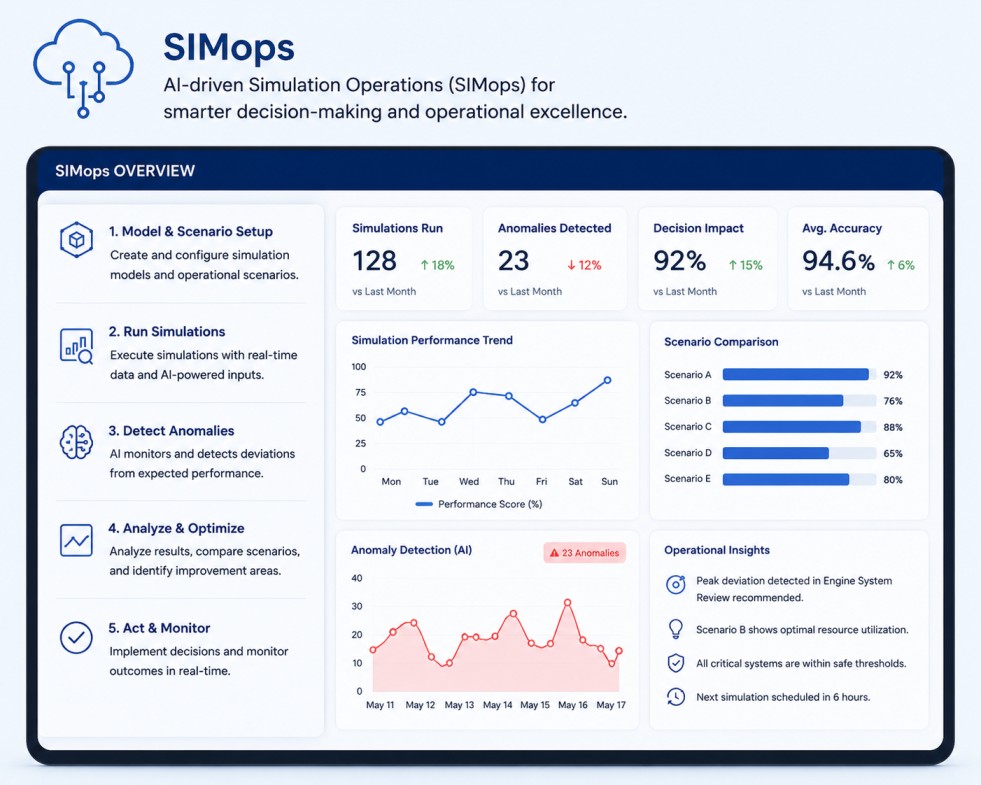
- Anomaly detection in aerospace and other high-precision industries — identifying process or equipment anomalies that fall outside normal operating patterns, often before a human would notice.
- SIMOps (Simultaneous Operations) management — using AI to flag conflicts and risks when multiple operations run concurrently in the same physical area, an increasingly common scenario on complex industrial and construction sites.
These trends signal where the market is heading, and a platform’s roadmap in these areas is a reasonable proxy for how seriously the vendor is investing in AI versus simply relabeling existing features. Ask prospective vendors for a concrete example of each capability running in production at a customer site, rather than a conceptual description on a slide the gap between a roadmap item and a deployed feature is often wider than it appears during a sales cycle.
What Makes These Modules "AI-Powered" vs. Traditional
It’s worth pausing on a distinction that gets blurred in vendor marketing. A traditional EHS module digitizes and stores data: it lets you log an incident, fill out a permit, or complete a checklist electronically. That’s valuable, but it’s fundamentally passive; a human still has to review the data, spot the pattern, and decide what to do next.
A genuinely AI-powered EHS software module does three things a traditional module cannot: it learns from historical data to make predictions, it acts on data without waiting for a human trigger, and it improves its own accuracy over time as more data flows through it. Root-cause suggestion, dynamic risk scoring, and image-based defect recognition are AI-powered in this true sense. A digital checklist with a dropdown menu, by contrast, is not AI just because it runs on a tablet.
When evaluating vendors, ask them directly what data their models are trained on, how often those models are retrained, and whether the AI features work meaningfully differently across industries or are a one-size-fits-all layer bolted onto a generic form builder. Vendors that can answer specifically tend to have built real capability; vendors that answer vaguely usually haven’t.
Implementation Considerations
Even the best-evaluated platform can fail in practice if implementation is rushed. A few considerations deserve attention before signing:
- Data migration—Historical incident, inspection, and training data need to migrate cleanly, since AI features depend on that history to generate useful predictions from day one.
- Integration — Confirm the platform integrates with existing HR, access control, and ERP systems rather than becoming another data silo.
- Change management — Field workers and contractors need training and a genuinely simple mobile experience, or adoption will stall regardless of how capable the backend AI is.
- Data privacy and model governance — Understand where AI models are hosted, how site data is used for training, and whether your data remains isolated from other customers’ data.
- Phased rollout — Start with one or two high-impact modules, such as incident management and permit-to-work, before expanding to the full suite, so teams build confidence in the system incrementally.
- Executive sponsorship — AI-driven EHS initiatives tend to succeed or stall based on visible leadership backing; without it, site teams often default back to familiar paper or spreadsheet workarounds within the first few months.
- Vendor support model — Confirm whether ongoing model tuning, regulatory updates, and technical support are included in the contract or billed separately, since AI features generally require more ongoing calibration than static digital forms.
Taken together, these considerations matter as much as the feature checklist itself. A platform with excellent AI capabilities but a poorly planned rollout will underperform a simpler system that’s implemented well and genuinely adopted by the workforce using it every day
Conclusion
Choosing the right AI-powered EHS software in 2026 is not about finding the vendor with the longest feature list. It’s about confirming regulatory coverage across the frameworks your sites actually operate under, evaluating each module for genuine AI capability rather than surface-level automation, and planning an implementation that gives your teams time to adopt the system properly. Organizations that get this right will move from reactive compliance to proactive risk management catching problems before they become incidents and turning EHS data into a genuine competitive advantage rather than a regulatory obligation.