
Safety Management Systems have long been the backbone of industrial risk control, giving organizations a structured way to identify hazards, enforce procedures, and stay compliant with regulations like OSHA 29 CFR 1910 and ISO 45001. But most Safety Management Systems in use today were designed for a paper-and-spreadsheet world. They were never built to process the volume, speed, or complexity of data that modern plants, sites, and multi-facility operations now generate every shift.
Artificial intelligence is changing that. Rather than replacing the fundamentals of safety management, AI is being layered into existing Safety Management Systems to close the gaps that have persisted for decades: delayed reporting, missed inspections, reactive incident response, and safety data that sits in silos instead of driving decisions. This shift is not theoretical. EHS teams across manufacturing, oil and gas, and construction are already using AI-powered modules for PPE detection, predictive risk scoring, and automated compliance tracking. This article looks at where traditional Safety Management Systems fall short, what AI actually adds to the equation, and what safety leaders should weigh before adopting it.
The Limitations of Traditional Safety Management Systems
Even well-run Safety Management Systems built on spreadsheets or first-generation EHS software carry structural weaknesses that show up under pressure. These recurring limitations are not failures of effort but a natural result of relying on manual, disconnected processes:
- Delayed inspections: Inspections get logged after the fact instead of in real time, leaving gaps between when a hazard appears and when it is recorded.
- Disconnected data: Near-miss data lives in one department’s file while the incident trends that could explain it sit somewhere else, so patterns go unnoticed.
- Lapsed training records: Training records lapse without anyone noticing until an auditor asks for proof, leaving competency gaps that go undetected for months.
- Stretched headcount: Safety teams are often stretched across multiple sites with limited headcount, and traditional systems demand substantial manual effort simply to remain current, let alone to anticipate risk.
- Reactive documentation: The result is a Safety Management System that documents what already happened rather than one that helps prevent what is about to happen, leaving a gap between record-keeping and prediction.
- Limited cross-site visibility: A plant manager in one facility often has no easy way to see whether a similar hazard was already flagged at a sister site last quarter, so lessons learned in one location rarely travel to another without someone manually compiling and circulating a report.
Traditional Safety Management Systems were not designed to surface cross-site patterns of this kind, and it is one of the clearest examples of where more computing power, applied correctly, changes the outcome.
What "AI-Powered" Actually Means in Safety Management
The term is often used loosely, so it is worth being precise. In practice, an AI-powered Safety Management System applies machine learning, computer vision, and natural language processing to the same data EHS teams already collect, but it acts on that data continuously instead of waiting for a scheduled review.
Three levels of maturity are often grouped under the same label, even though they are functionally distinct. A digitized system simply moves paper forms onto a screen, replacing a clipboard with a mobile app but still requiring someone to review, interpret, and act on every entry manually. An automated system extends this further, using fixed rules to route approvals or trigger reminders, such as sending an email when a permit is about to expire. An AI-powered system is different in kind, not just degree: it learns from patterns in historical data and adjusts its output as new information arrives, rather than following a static rule set that has to be manually updated every time conditions change.
What ties these technologies together in a Safety Management System is that they all feed the same underlying record instead of operating as isolated tools. A PPE detection alert, a permit condition, and a near-miss report about the same work area are connected data points rather than outputs of three separate systems that do not exchange information. That connectivity is what allows an AI-powered Safety Management System to move from reporting on safety performance after the fact to supporting decisions about it in real time, which is the shift the rest of this article explores in more detail.
Flaws in Traditional Safety Systems

Here is how AI addresses the recurring flaws in traditional systems:
- Time-saving: AI automates data entry, report generation, and routine checklist review, cutting hours of administrative work down to minutes and freeing safety officers to spend time on the floor instead of on paperwork.
- Documentation: Every inspection, permit, and corrective action is captured digitally with timestamps and photo evidence, replacing scattered paper trails with a single, searchable record.
- Alert and notification: Instead of relying on someone to notice an overdue task, AI-driven systems push real-time alerts for expiring permits, missed inspections, or PPE non-compliance the moment they occur.
- Safety regulations: AI cross-references site activity against applicable standards such as OSHA 1910.119 or ISO 14001, flagging gaps before they become violations rather than after an audit.
- Slow training: Competency tracking and microlearning modules adapt to each worker’s role and expiry dates, shortening the cycle between hire, training, and certification.
- No integrated dashboard: AI-powered platforms consolidate incident, inspection, and risk data from every site into one dashboard, so leadership sees the full picture instead of piecing together separate reports.
- Audit-ready: Because documentation is continuous and centralized, generating an audit-ready report becomes a matter of a few clicks rather than weeks of preparation.
- Missed inspections: Risk-based scheduling and automated reminders make sure high-priority equipment and areas are never quietly skipped in a busy month.
- Stakeholder visibility: Role-based notifications ensure that when a procedure or permit condition changes, everyone affected, from contractors to plant managers, is informed at the same time.
- Data collection: Mobile and IoT-based capture replaces manual logging, so data enters the system at the point of work instead of being transcribed later, which reduces errors and delays.
- Headcount: Automated headcount tools during evacuations or muster events give an accurate count in seconds, removing the guesswork of manual roll calls during an emergency.
- Paperless operations: AI-powered systems remove reliance on paper-based logs and forms, capturing every entry digitally at the point of work, which eliminates lost records and version conflicts that come with manual paperwork.
Taken together, these capabilities turn a Safety Management System from a passive record of compliance into an active tool that supports faster, better-informed decisions on the ground.
Key Areas Where AI is Transforming Safety Management
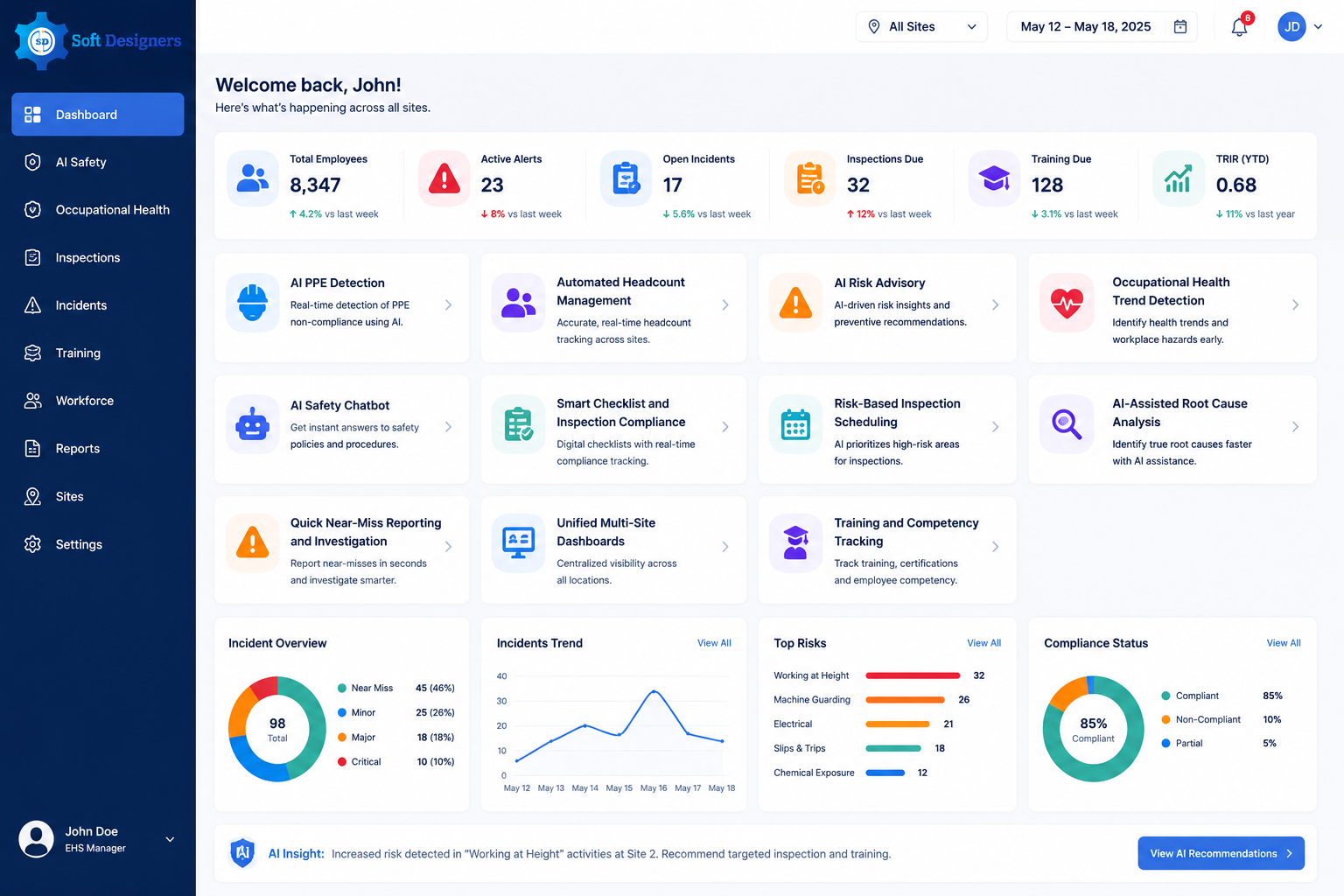
AI is not a single feature bolted onto existing software. It shows up across nearly every function within a modern Safety Management System. The areas below reflect where safety teams are seeing the most practical impact.
- AI PPE Detection: Computer vision cameras monitor work areas continuously and flag PPE compliance gaps, such as a missing hard hat or harness, in real time rather than during a periodic walkthrough.
- Automated Headcount Management: During an evacuation, AI-based tracking gives an instant, accurate headcount instead of relying on manual roll calls that can take critical minutes and still miss people.
- AI Risk Advisory: Predictive risk scoring draws on historical incident and near-miss patterns to surface trends that safety teams might miss in raw data, including correlations between production volume spikes and rising injury rates.
- Occupational Health Trend Detection: By tracking patterns across production data, raw material exposure, and employee health outcomes, AI can flag early signs of an occupational illness cluster before it becomes a compliance issue.
- AI Safety Chatbot: Workers get instant answers on procedures, permit requirements, or SDS lookups without waiting for a supervisor, which keeps work moving without cutting corners on safety.
- Faster Permit-to-Work Approvals: AI cross-checks permit conditions against real-time hazard data, which speeds up approvals for routine permits while still catching conditions that need closer review.
- Smart Checklist and Inspection Compliance: QEHSS checklists covering equipment, PPE, fire systems, and evacuation routes are tracked automatically, closing the non-inspection gaps that slip through manual scheduling.
- Risk-Based Inspection Scheduling: Instead of a fixed calendar, critical machinery is prioritized for inspection based on actual risk exposure, so attention goes where it matters most.
- AI-Assisted Root Cause Analysis: Pattern recognition across past incidents accelerates 5 Whys, fishbone, and job hazard analysis, helping investigators find the real cause rather than the most obvious one.
- Quick Near-Miss Reporting and Investigation: Mobile, AI-assisted capture shortens the gap between when a near miss happens and when it gets investigated, which keeps the lesson relevant while details are still fresh.
- Unified Multi-Site Dashboards: Safety leaders overseeing several facilities get a single-screen view of plans, inspections, and risk status across every site instead of compiling separate reports.
- Training and Competency Tracking: Automated visibility into who is trained, whose certification is expiring, and who needs retraining keeps competency records current without manual chasing.
Different Evolution in Safety Management Over Time
The shift toward AI is the latest step in a longer evolution of how organizations manage safety data, illustrated in the timeline below.
Paper-Based Safety
Pre-1990s
Manual logs,
filed reports
filed reports
Digital Excel Sheets
1990s to Early 2000s
Spreadsheet tracking,
email reporting
email reporting
Digital EHS Software
Mid-2000s to 2010s
Centralized databases,
workflow automation
workflow automation
AI-Based EHS Software
2020s Onward
Predictive analytics,
real-time alerts
real-time alerts
Each stage solved a real problem of its time. Spreadsheets replaced paper filing cabinets. Dedicated EHS software replaced scattered spreadsheets with structured workflows. AI is now solving the problem those systems could never fully address: turning stored data into forward-looking insight instead of a historical record.
Case-in-Point: From Reactive CAPA to Predictive Prevention
Consider a typical CAPA cycle in a traditional Safety Management System. An incident occurs, a root cause analysis is conducted, and a corrective action is assigned, often weeks after the underlying condition first appeared in near-miss reports that nobody had time to analyze in aggregate.
An AI-powered system changes the sequence. Suppose a specific piece of equipment, such as a hydraulic press or a compressor, has generated several minor incidents and near misses over recent months. In a traditional system, each event is logged and closed individually, and the pattern across incidents is rarely connected unless someone happens to review the equipment’s full history. An AI-powered Safety Management System continuously analyzes incident and inspection data tied to that asset, recognizes the rising frequency, and recommends a preventive maintenance action, such as an inspection or component replacement, before the equipment causes a more serious failure. The CAPA process still applies the same rigor of RCA and JHA, but it starts from a predictive signal instead of waiting for the next reportable event.
This also changes what a CAPA looks like on paper. A traditional corrective action often reads as a response to a single event: repair the guard, retrain the operator, or close the ticket. A predictive CAPA reads differently because it addresses a pattern rather than an incident, for example, scheduling preventive maintenance across an entire equipment class once the data shows a common failure mode developing across multiple units. The underlying discipline of CAPA does not change, but the trigger point moves earlier, and the corrective action tends to be broader and more preventive in scope.
Regulatory and Compliance Considerations
| Regulation / Standard | Core Requirement | How AI Supports Compliance |
|---|---|---|
| OSHA 29 CFR 1910 / 1926 | Recordkeeping, hazard communication, and PPE standards across general industry and construction | Keeps documentation continuous and flags PPE or procedural gaps before they become violations |
| OSHA 1910.119 (PSM) | Process safety management for highly hazardous chemicals | Cross-checks permit conditions and hazard data in real time before work is approved |
| ISO 45001 | Occupational health and safety management system requirement | Centralizes inspection, training, and corrective action records for management review |
| ISO 14001 | Environmental management system requirements | Tracks environmental monitoring data alongside safety metrics in one dashboard |
| EPA regulations | Environmental compliance reporting and permitting | Automates monitoring alerts and reporting deadlines to avoid missed filings |
| RIDDOR | Reportable incident and near-miss disclosure | Speeds up evidence compilation so reportable incidents are documented within required timeframes |
Benefits Beyond Compliance
Compliance is the baseline, but the value of an AI-powered Safety Management System extends further. Faster PTW approvals mean less downtime waiting on paperwork. Fewer missed inspections mean fewer surprises during equipment failures. Better training visibility means fewer competency gaps on the floor.
There is also a cultural benefit. When workers see near misses acted on quickly instead of filed and forgotten, reporting rates tend to improve, since people trust that flagging a hazard actually leads to a fix. Over time, that builds a safety culture where AI is seen as backing up the workforce rather than replacing their judgment.
Multi-site organizations gain a further advantage that is easy to underestimate: benchmarking. Once inspection, incident, and near-miss data sit in one AI-powered Safety Management System instead of separate site-level spreadsheets, leadership can compare facilities on consistent metrics for the first time. A site with an unusually high rate of LOTO deviations, for instance, becomes visible against the network average rather than looking normal in isolation. This type of comparison is difficult to perform manually across more than two or three sites, but it becomes routine once the data is centralized.
Challenges and Considerations When Adopting AI in Safety Management
AI adoption is not without friction, and safety leaders should go in with realistic expectations.
- Data quality: AI predictions are only as good as the historical incident and inspection data feeding the model, so organizations with thin or inconsistent records will see weaker results at first.
- Integration effort: Connecting AI modules to existing PTW, LOTO, and inspection workflows takes planning, especially across multiple sites with different legacy systems.
- Workforce trust: Without clear communication, workers may see AI monitoring as punitive rather than protective, which can undermine reporting culture if not managed carefully.
- Over-reliance risk: Predictive scores and automated checklists support decisions, but they should not replace trained safety judgment or the human review that regulators expect.
- Upfront investment: Rolling out AI-powered modules across a multi-site operation requires budget and change management resources, which need to be weighed against the long-term reduction in incidents and administrative time.
None of these challenges are reasons to avoid AI adoption. There are reasons to plan the rollout deliberately, starting with the areas of the Safety Management System where data is strongest and the payoff is clearest, such as inspection scheduling or PPE detection, before expanding into predictive risk advisory.
A phased rollout also gives the safety team time to validate AI outputs against their own field experience before leaning on predictive scores for higher-stakes decisions like permit approvals. Starting narrow and expanding once trust is established tends to produce better long-term adoption than a single, organization-wide launch.
Conclusion
Traditional Safety Management Systems were built to document safety after the fact. AI is turning them into systems that anticipate risk before it becomes an incident, closing gaps in documentation, inspection coverage, training visibility, and stakeholder communication that have existed for decades. Organizations that gain the most from this shift are not the ones pursuing every available feature but the ones applying AI to the specific weak points in their existing Safety Management System, one workflow at a time.
For safety leaders evaluating this transition, the starting point is not the technology itself but the gap it needs to close: where inspections are being missed, where near misses go uninvestigated, or where headcount during an evacuation still relies on a manual roll call. AI works best when it is matched to that gap, not adopted for its own sake.

