Category: Ehs software solutions

EHSEHS ManagementEhs software solutions

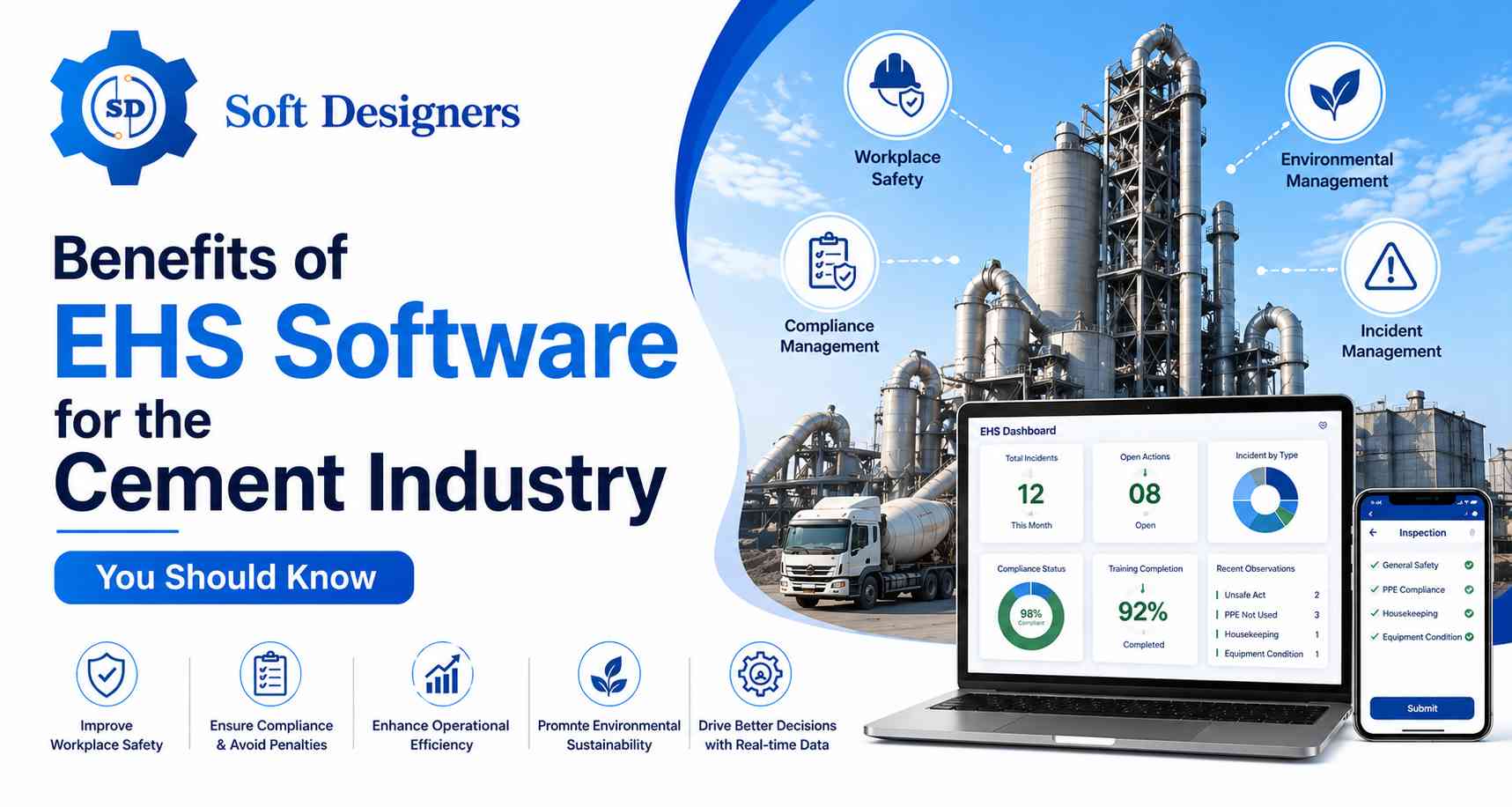
EHS Software in Cement Industry | Soft Designers

Introduction:

Step inside any cement plant and the hazards are immediate. Kilns exceeding 1,400°C, vast conveyor systems, dust-filled confined spaces, and contractors who know their trade but not this specific plant. A paper permit system rarely reflects what is actually happening on the ground. EHS software for the cement industry introduces a hazard-free environment. 

Cement manufacturing consistently ranks among industry’s most dangerous sectors. Extreme heat, heavy rotating machinery, work at height, live electrical systems, and complex multi-contractor shutdowns demand more than spreadsheets and clipboards. AI-powered EHS software was built precisely for this level of complexity.

The Real Safety Challenges Addressed by EHS Software in Cement Industry

Most manufacturing plants deal with one or two dominant hazard categories. Cement plants deal with nearly all of them simultaneously. Kiln maintenance alone involves confined space entry, hot work, work at height, LOTO isolation, and contractor management often within the same 48-hour shutdown window. A single procedural gap during that window can be catastrophic. 

The specific hazards that define cement manufacturing risk: 

  • Nonstop machinery makes equipment isolation extremely difficult during maintenance activities. 
  • Kiln operations present constant risks of severe burns and dangerous gas buildup that are hard to detect early. 
  • Confined space entry checks are frequently skipped or inadequately completed under operational pressure. 
  • Falls from height often result from missed inspections and informal anchor point practices. 
  • Hot work conducted near combustible dust creates serious ignition risks without rigorous controls. 
  • Managing multiple contractor crews simultaneously during shutdowns creates significant coordination and compliance gaps. 

Where Paper Systems Break Down

The core failure of paper-based safety management is not laziness or negligence, it is structural. Paper permits can be backdated, Checklists can be pre-filled, Near-miss books go unreported because nothing links the observation to an action. Audit findings sit in folders waiting for someone to schedule a follow-up. Contractor inductions get signed off without being properly verified. 


Major Cement Plant Hazard 

Potential Consequences 

Traditional Challenge 

Digital EHS Solution 

Kiln maintenance and entry 

Fatal burns, toxic gas, explosion 

Paper permits, manual gas logs 

Digital PTW with atmospheric monitoring integration 

Confined space entry 

Suffocation, H2S exposure 

Manual checklists, informal standby 

Digital workflow, AI alerts, mandatory gas test fields 

Working at height 

Falls, fatalities 

Incomplete inspection records 

AI-scheduled inspections, mobile photo evidence 

Hot work near combustibles 

Fire, explosion, burn injuries 

Permits issued without an area check 

Digital PTW with area clearance workflow 

LOTO failures 

Unexpected energisation 

Human error, missing steps 

Digital LOTO with step-by-step verification 

Contractor activities 

Unauthorised work, untrained workers 

Poor visibility, paper sign-in 

Safety Pass, digital induction, competency tracking 

Dust-related incidents 

Respiratory disease, explosions 

Manual monitoring logs 

Digital observation reporting with escalation 

Emergency evacuation 

Incomplete headcount, delayed response 

Manual register, radio roll call 

Digital headcount with geofencing and real-time count 

Core Benefits of EHS Software in Cement Industry

Each of the following modules represents a distinct layer of protection,  

1] Safety Pass Management

Paper-based safety passes collect signatures but rarely check if certifications are still valid, a gap that contributed to a 2022 Southeast Asian petrochemical fatality, where a worker entered a confined vessel without the required competency. Digital safety pass systems fix this by automatically blocking access if certifications have lapsed, removing the need for manual checks. Safety managers also get a live view of who is on site, which zones they are cleared for, and when certifications expire. 

Mandatory EHS Step 

Why It Matters 

What Happens if Missed 

Site-specific induction completion 

The worker understands local hazards 

The worker enters the area without hazard awareness 

Certification and competency verification 

Confirms the worker is qualified for the task 

An unqualified person performs high-risk work 

Medical fitness check 

Ensures fitness for confined space or height work 

Medical incident during or after high-risk activity 

Gate pass issuance with expiry 

Controls authorised access 

Expired credentials go undetected 

Contractor company vetting 

Ensures the hiring company meets safety standards 

Substandard contractor brings unmanaged risk 

2] Permit to Work (PTW)

The permit-to-work system is arguably the single most important administrative control in a cement plant. Done properly, it creates a documented trail of authorisation, hazard identification, isolation verification, and sign-off that keeps high-risk work from proceeding until every prerequisite is genuinely satisfied. 

A PTW lifecycle begins at the gate with worker verification, moves through hazard identification, risk assessment, and multi-level approval, then confirms physical isolation before work starts. A toolbox talk briefs the crew on controls, work proceeds within permit conditions, and any unexpected change triggers an immediate suspension. Once complete, the area is cleared and the permit formally closed out. 

Mandatory EHS Step 

Why It Matters 

What Happens if Missed 

Hazard identification 

Surfaces hidden risks 

Known hazard goes uncontrolled 

Isolation verification 

Confirms energy sources are dead 

A worker contacts live electrical or mechanical energy 

Toolbox talk 

Ensures crew understands permit conditions 

Worker unaware of the controls they must comply with 

Shift handover of active permits 

Maintains continuity of control 

The incoming crew is unaware of the work in progress 

Permit closure and area check 

Confirms safe restoration 

Tools or workers left in a hazardous space 

2.1 Work at Height

Falls remain a leading cause of fatal injury in cement plants, with the preheater tower presenting numerous simultaneous hazards during shutdowns. In one European incident, a technician fell when an anchor point that had never been formally rated or inspected, highlighting the danger of informal practices. Digital tools address this directly by photographing every anchor point, recording rated capacity, and blocking permit progression if inspection intervals have lapsed. 

2.2 Confined Space

Confined space entry is cement’s most unforgiving hazard, where a single skipped atmospheric test or absent standby attendant can prove fatal. Several South Asian fatalities traced to workers entering incompletely purged coal mill chambers share one root cause: procedural gates that could be bypassed. Digital confined space management eliminates this risk by requiring timestamped gas test results and tester identification before entry authorisation becomes available. 

2.3 Hot Work Management

Hot work permits must function as genuine safety controls rather than paperwork formalities. A 2018 North African cement facility fire, linked to hot work near a bag filter with residual coal dust accumulation, resulted from a post-work fire watch being informally reduced to five minutes, allowing the fire to spread undetected. Digital EHS platforms enforce mandatory fire watch durations within the permit workflow, ensuring no step can be skipped or shortened without authorisation.

3] Incident Management and CAPA

How an organisation responds to an incident determines whether it happens again. Fast, honest reporting is the foundation of a learning safety culture, while delayed or incomplete reporting breeds repeat incidents. [Text Wrapping Break][Text Wrapping Break]A complete incident management process covers immediate reporting, scene preservation, first aid, root cause analysis using structured methodologies like 5 Whys and RCA, corrective and preventive actions, closure verification, and company-wide learning communication. For cement plants managing complex multi-system incidents, digital platforms significantly reduce investigation time while improving analytical depth. 

Mandatory EHS Step 

Why It Matters 

What Happens if Missed 

Immediate reporting within minutes 

Preserves scene and witness memory 

Evidence lost; investigation compromised 

Root cause analysis 

Identifies systemic failures, not just symptoms 

Only surface causes addressed; incident recurs 

Corrective action closure verification 

Confirms the fix was actually implemented 

Action raised but never executed; hazard persists 

Learning communication across the organisation 

Spreads the lesson beyond the immediate site 

The same incident occurs at a different plant or area 

4] Headcount Management

During a major kiln shutdown, a cement plant can have upwards of 500 workers and contractors on site simultaneously. If an emergency evacuation is required, gas leak, fire, or structural failure, knowing exactly who is where becomes a matter of life and death. Manual registers, sign-in books, and radio-based roll calls cannot answer: who is currently inside which area, who left for lunch and has not returned, and whether three contractors who arrived at 14:00 have completed their induction, Headcount Management helps in filling this gap.   

5] Management of Change (MoC)

In cement manufacturing, even minor changes can trigger serious consequences across interconnected systems. A temporary interlock bypass on a kiln drive, a fuel blend adjustment in the precalciner, or a replacement gearbox with different torque specifications can each introduce risks that were never formally assessed. Management of Change ensures every modification, whether to equipment, process parameters, safety systems, or personnel, is evaluated before implementation. This is particularly critical in cement plants where an unreviewed change in one area can quietly affect pressure dynamics, gas flow, or mechanical load in an adjacent system. 

Mandatory EHS Step 

Why It Matters 

What Happens if Missed 

Hazard review before implementation 

Identifies new risks created by the change 

A hidden hazard was introduced into the operating system 

Approval by qualified personnel 

Ensures change is technically validated 

Engineering error creates a safety-critical failure mode 

Workforce communication 

Ensures operators understand the change 

Operator responds incorrectly to modified system behaviour 

Post-change review 

Confirms change achieved its intent safely 

Adverse consequences discovered only after an incident 

6] Observation Reporting

Safety observation reporting is one of the most overlooked tools in any EHS programme. The barrier is rarely awareness. Most workers can spot an unsafe act or condition when they see one. The real barrier is effort: paper forms, unclear ownership, and no way to know if anything was done. A digital platform removes that barrier, letting employees report from their phone in under a minute with photos and location attached, while automatically sending the observation to the right person and assigning corrective action. Built-in AI-guided 5 Whys questioning helps teams find the root cause rather than just closing out observations without real follow-through.  

7] Inspection Checklists and Smart Scheduling

Inspections in paper-based systems follow one of two failure modes: they happen too infrequently for the actual risk level, or they happen on schedule but with no connection between what is found and what happens next. AI-powered inspection management addresses both. Risk-based scheduling means high-risk equipment, such as the kiln drive, bag filter systems, and coal mill isolation valves, gets inspected more frequently and with greater thoroughness. Mobile tools let field workers complete checklists on a phone and submit findings in real time. 

8] Lockout Tagout (LOTO)

LOTO failures are responsible for a significant proportion of the most severe injuries in heavy manufacturing. In cement plants, unexpected re-energisation can mean crush injuries from crusher jaws, entanglement in conveyor drives, burns from kiln shells and preheater components, or electrocution from high-voltage motor control centres. 

Proper Lockout Tagout requires complete identification of all energy sources (electrical, pneumatic, hydraulic, thermal, stored kinetic), a documented step-by-step isolation sequence for each specific machine, individual lock application by every worker in the isolation group, a try-out procedure confirming the machine is truly de-energised, clear tagging with worker identity and permit reference, and a documented restoration sequence. 

Mandatory EHS Step 

Why It Matters 

What Happens if Missed 

Complete energy source identification 

Ensures no stored energy remains 

Residual pneumatic or hydraulic energy releases during maintenance 

Individual lock application by each worker 

Ensures no single person can remove all locks 

Supervisor removes the group lock while the worker is still inside the machine 

Try-out verification procedure 

Confirms isolation is effective 

Machine starts while worker is in contact with it 

Restoration sequence documentation 

Ensures safe re-energisation 

Equipment damaged or worker endangered during startup 

Equipment requiring critical LOTO attention in cement plants: raw mill drives, kiln main drive, clinker conveyor drives, coal mill grinding circuits, preheater fan drives, and all crusher and hammer mill systems. Digital LOTO management provides each machine with a scannable equipment tag that the worker receives the isolation procedure, confirms each step with a timestamped digital signature, and receives a system-issued permit only when the procedure is complete.

9] Waste Management

Cement plants deal with a wide variety of waste, from hazardous and chemical to bio-medical, non-hazardous, and recyclable, and managing all of it properly isn’t straightforward. The waste management module takes that complexity in stride by letting you configure waste types and chemicals specific to your facility, broken down by department. When disposal is due, department heads fill out a form with the type, quantity, and classification of waste, which then goes straight to the relevant vendor. Once the vendor completes the disposal and verifies it in the system, it moves to the safety officer for a final check and closure. For hazardous waste, the required government forms are already built into the workflow so nothing gets missed on the compliance side. And if anything goes wrong on the ground, the spillage reporting form and periodic waste audit form make sure it’s captured and followed up on. 

10] Risk Assessment

Traditional risk assessments are static documents rated on a 5×5 matrix and filed. If conditions change, the area is now adjacent to active hot work, the team has changed, the task is now happening in wet weather, the risk profile has changed, but the assessment has not. AI-based risk assessment introduces dynamic risk scoring: historical incident and near miss data inform the baseline, current permit activity in adjacent areas is factored in, atmospheric conditions contribute to live risk updates, and AI-generated recommendations suggest additional controls based on similar past tasks. 

Mandatory EHS Step 

Why It Matters 

What Happens if Missed 

Contextual hazard identification 

Surfaces area-specific and task-specific risks 

Generic assessment misses site-specific hazard 

Control effectiveness validation 

Confirms controls are adequate 

Inadequate controls approved without challenge 

Post-task review 

Improves future assessments 

The same inadequate assessment is used repeatedly 

AI pattern analysis 

Identifies risk clusters humans miss 

Systemic risk pattern undetected until incident occurs 

11] SDS (Safety Data Sheet) Management

Every hazardous chemical on a cement plant site, from grinding aids and fuel additives to lab reagents, comes with a Safety Data Sheet covering hazards, safe handling, first aid, and emergency response under the standardized 16-section GHS format. In paper-based systems, these sheets sit in binders at fixed locations, and a spill at 2 AM during a shutdown means hunting for the right SDS, and the right revision, under pressure. Digital SDS management fixes this with instant mobile access from anywhere on site, automatic detection of manufacturer revisions so outdated sheets never get used, and direct linkage to chemical inventory so nothing on site goes undocumented. 

Mandatory EHS Step 

Why It Matters 

What Happens if Missed 

Current SDS version availability 

Ensures accurate hazard and first aid information 

First aider uses outdated guidance; incorrect treatment given 

Location-specific and shift-wide access 

SDS readily available wherever and whenever chemicals are used 

Workers on off-shifts have no access; HazCom compliance gap 

Emergency response guidance 

Surfaces spill, PPE, and first aid sections instantly during incidents 

Responder improvises; spill response delayed or worsened 

Chemical inventory linkage 

Tracks all hazardous substances on site against their SDS 

Unregistered chemical in use with no SDS available 


12] Fire Equipment Register

Passive fire protection is only as good as the inspection regime behind it. A fire extinguisher that has not been serviced in 24 months, a sprinkler head blocked by stored material, a hydrant with a seized valve, these are documented realities in facilities where paper-based equipment registers are the norm. Digital fire safety register maintains an asset register for all firefighting equipment by location and type, inspection schedules with automated reminders, service history, hydrant and deluge system test records, and an emergency equipment inventory covering breathing apparatus, fire blankets, and emergency showers. 

13] Accident Reporting

When a serious accident occurs, the quality of the immediate response determines both the human outcome and the quality of the subsequent investigation. Digital accident reporting enables simultaneous notification to the safety manager, plant manager, and emergency response team, automated escalation based on severity classification, time-stamped photo and witness account capture before scene disturbance, AI Root Cause Analysis pattern matching during the investigation, CAPA workflow with assignment and escalation, and one-tap access to hospital contacts, emergency services, and corporate safety leadership. 

Mandatory EHS Step 

Why It Matters 

What Happens if Missed 

Immediate severity classification 

Triggers an appropriate level of response 

Serious incident treated as minor; inadequate response 

Evidence preservation 

Maintains the integrity of the investigation 

Physical evidence disturbed; root cause unidentifiable 

AI Root Cause Analysis 

Surfaces systemic patterns beyond the immediate cause 

Investigation focuses on immediate cause only; systemic factor is missed 

CAPA closure verification 

Confirms action was actually taken 

Action raised, never implemented; incident recurs 

Learning communication across the organisation 

Spreads prevention beyond the immediate site 

Lesson contained to one site; same incident at another 


How AI is Transforming EHS in the Cement Industry

The shift from digital EHS to AI-powered EHS is not a marketing distinction, it represents a fundamental change in what a safety management system can do. Digital platforms eliminate paper and add structure. AI adds predictive intelligence, pattern recognition, and autonomous monitoring that no human supervisor can match at scale. 

AI PPE Detection:

Computer vision deployed at entry points, critical work areas, and conveyor access zones provides continuous, objective PPE monitoring. The camera does not have favourites, does not get tired, and does not look the other way when someone removes their helmet mid-shift. AI PPE detection generates compliance trend data that tells safety managers exactly which areas, which shifts, and which contractor companies have the highest non-compliance rates — enabling targeted intervention rather than generic reminders. 

AI-Powered Inspections:

AI inspection scheduling analyses equipment failure history, recent incident data, environmental conditions, and production intensity to calculate a dynamic risk score for each asset. High-risk assets are inspected more frequently and lower-risk assets can be inspected less often without compromising overall safety. This means safety teams spend their time where it matters most, rather than executing a flat calendar schedule that treats a critical conveyor drive the same as a storeroom door hinge. 

AI Risk Assessment:

Every permit issued, every incident reported, every near miss logged contributes to the AI risk assessment engine’s understanding of the plant’s risk profile. Over time, the system identifies risk clusters, for example, that most incidents involving contractor welders occur in the evening shift in the grinding area, which would take a human safety analyst months of manual data mining to surface.

AI Root Cause Analysis:

Traditional RCA often depends on the investigator’s experience, leading to inconsistent results. AI-assisted RCA improves consistency by matching patterns from past incidents, analyzing causal chains, and suggesting proven corrective actions. Through AI-driven 5 Why questioning, each answer prompts a relevant follow-up, helping investigators uncover the true root cause faster without replacing human judgment.  

Case Study: Priya Cement

Company Overview

Priya Cement is a prominent player in the Indian cement industry, operating large-scale manufacturing facilities with a strong focus on workplace safety and operational excellence. As its operations grew, the company faced increasing challenges in managing permit approvals and facility-related requests through manual, disconnected processes, making it difficult to maintain efficiency and ensure timely safety compliance.

Challenge, Approach & Result

To overcome these issues, Priya Cement partnered with Soft Designers to implement a customized EHS and Facility Management solution. The digital platform introduced automated Permit-to-Work workflows, intelligent escalation mechanisms, real-time notifications, and a centralized system for managing maintenance requests through web and mobile applications. The result was a faster and more transparent approval process, reduced operational downtime, improved safety compliance, and a more connected, accountable work environment across the organization.

How to Choose the Right EHS Software in Cement Industry

Not all EHS software is built for the specific demands of cement manufacturing. Generic platforms designed for office-based compliance management will struggle with the operational complexity of a multi-kiln integrated plant. The following covers the capabilities that genuinely matter for this industry. 

Industry-Specific Modules: A general health and safety platform will have incident reporting, but a cement plant needs considerably more. This includes digital Permit to Work with permit type differentiation, LOTO management with machine-specific isolation procedures, and confined space and work at height controls built into the permit workflow. Contractor safety management must also handle shutdown complexity at scale. 

AI Capabilities: AI in EHS software is a functional differentiator, not a marketing claim. Key capabilities for cement plants include PPE detection via computer vision, AI-assisted Root Cause Analysis, and predictive risk assessment using historical data and real-time operational context. AI-powered inspection scheduling based on equipment risk profiles rounds out the core requirement. 

Mobile Accessibility: A plant safety officer who must return to the office to complete an inspection finding will delay or skip that step entirely. Genuine mobile-first design and functionality on standard Android devices, usable in dusty and low-connectivity environments, with offline data capture is a core requirement. This is table stakes, not a differentiator. 

Manual Safety vs Digital and AI Safety

Comparing the constraints of paper-based EHS with the power of connected, intelligence-driven digital safety systems.

Paper-Based EHS

  • Modules work in isolation.
  • Near misses go unlinked.
  • Inspections follow fixed schedules.
  • Audits don't adapt dynamically.
  • Knowledge leaves with people.
VS

Digital EHS

  • All modules stay connected.
  • Near misses inform permits.
  • Inspections respond to risk.
  • Audits self-adjust automatically.
  • AI builds institutional memory.

Key Takeaway

Moving from manual to digital EHS transforms safety from a reactive, fragmented task into a cohesive, intelligence-driven operational strategy.

The Direction of Travel

The cement industry is changing, and that change is not optional. Plants that have already embraced real-time data and digital operations for production and quality control cannot afford to manage safety with paper registers and spreadsheets. That gap between operational sophistication and safety management is where serious incidents happen. 

Plants that have made the shift to digital EHS tell a consistent story: fewer incidents, faster permits, better contractor accountability, and a workforce that actually reports near misses. The transition works. The only real question is whether a plant makes it by choice or after something goes wrong. 

Modern cement plants deserve safety management that matches their complexity. That means connected, AI-powered platforms that bring every permit, every worker, every hazard, and every inspection into one clear, living system.  


Ehs software solutions

How Does EHS Software Improve Safety in Oil and Gas Operations?

Introduction

Ask any safety manager who has worked an offshore rig or a refinery turnaround what keeps them up at night, and the answer is rarely a single catastrophic scenario. It is the small things: the permit issued without a gas test, the training record nobody updated, the near-miss the night crew forgot to write down. Oil and gas EHS software exists to close those gaps, not by adding rules, but by making sure the right information reaches the right person in time.

Oil and gas sits at the top of the industrial risk ladder for good reason. The substances are flammable or toxic, equipment runs under extreme pressure, and the workforce rotates constantly. Oil and gas EHS software does not eliminate hazards, but it closes the information gaps that let hazards become fatalities.

Key Safety Risks in Oil and Gas Operations

The hazard profile in oil and gas is genuinely different from most industries. A hydrocarbon release at a processing plant is not like a chemical spill at a warehouse; the ignition potential and escalation speed are in a different category entirely.

The recurring risks include loss of containment events that trigger fires and explosions; fatal falls from derricks and scaffolding; confined space entries that go wrong due to atmospheric hazards; H₂S and flammable gas exposure that reaches lethal levels within seconds; energy release injuries from inadequate lockout/tagout; and environmental damage from spills and emissions exceedances. All are preventable. Each has a known control sequence. The challenge is making sure those controls are in place every time, across every crew and contractor on site

What Is Oil and Gas EHS Software?

At its core, oil and gas EHS software replaces disconnected paper processes with a single platform where safety data lives, moves, and drives action. A permit gets issued with all preconditions verified. An inspection finding generates a corrective action automatically. A training record flags before the worker boards the crew-change flight. What software does is make good safety management consistent and auditable at scale.

Platforms built for oil and gas reflect the actual permit types used, the regulatory requirements of OSHA and EPA, and the realities of multi-contractor worksites. The right platform feels like it was designed for your operation. The wrong one makes you work around it.

Core Features That Improve Safety

What separates effective oil and gas EHS software from a digital filing cabinet is integration. When a failed inspection triggers a work stoppage or a training gap blocks a worker from a permit, the software is doing its job. Standalone modules that do not connect deliver none of this. Field data needs to flow to management in real time, compliance needs to be embedded in daily work, and performance trends need to be visible before they become incident statistics.

Essential EHS Software Modules for Oil and Gas

1. Incident Management (RCA and CAPA)

Every incident should generate three things: a factual record, an honest analysis of why it happened, and actions to prevent recurrence. RCA tools like the 5 Whys or bow-tie method guide investigators to systemic factors rather than surface causes, and CAPA items are assigned to named owners with deadlines and escalation paths. On a rig, CAPA items need to survive shift handovers without getting lost on the doghouse whiteboard.

2. Lockout/Tagout (LOTO) Software

Energy isolation failures are among the most preventable causes of serious maintenance injury and among the most consistently mismanaged. LOTO software stores verified procedures for every piece of equipment and walks crews through each step on a mobile device. On a rig, where top drives, mud pumps, and shakers come offline in rotation, the right procedure needs to be in the field, not in a binder. Group lockout for multi-trade maintenance is managed in the platform rather than coordinated verbally.

3. Permit-to-Work (PTW) System

A digital PTW system enforces the conditions that make permits valid: gas tests and fire watch for hot work; logged atmospheric readings, rescue plan, and standby attendant for confined space; and precondition checklists for cold work, work at height, and excavation. When permits overlap in the same hazard zone, the conflict is flagged before either is issued. On a rig, incompatible activities across the drill floor, mud system, and derrick are caught before work starts.

4. Inspection Management

Digital inspection software gives field personnel configurable templates on mobile devices with photos, real-time deficiency flagging, and automatic corrective actions. Rig-specific demands go further: BOP function tests record pressures and pass/fail status per component. Lifting equipment follows LOLER color-code cycles. Gas detector calibration records carry overdue alerts. Rig audits run against IADC or IMCA protocols, and third-party certificates carry expiry monitoring that escalates to the rig manager before anything lapses.

5. Risk Assessment and Job Hazard Analysis (JHA)

A JHA is only useful if it reflects the actual task on the day it is done. Software-based tools prompt crews through each step, identify hazards, and select controls from a structured hierarchy. Completed assessments link to the relevant permit and are visible to auditors. On a rig the risk picture shifts with every well phase, and a JHA from spud is not valid for a workover three weeks later. The module lets the toolpusher update assessments as conditions change.

More advanced platforms apply predictive permit analysis to JHA data, cross-referencing historical JHAs, incident records, and near-miss reports against the current task, location, and crew profile to flag elevated risk combinations before work begins. If a task sequence has generated repeated CAPA items across similar operations, that pattern surfaces as a prompt during the JHA rather than after something goes wrong.

6. Observation Reporting

Near-misses almost always precede serious incidents. The gap between spotting a hazard and recording it is where most of that intelligence disappears, particularly on rigs where shift change is fast. Mobile reporting removes the friction: a roughneck spots a loose handrail bracket, takes a photo, and submits it before the crew bus leaves. Anonymous submission matters because not every crew culture supports open reporting without it. Over time the data reveals patterns no supervisor reviewing paper forms would connect.

7. Safety Data Sheet (SDS) Management

A drilling rig carries a substantial chemical inventory: drilling fluids, cement additives, biocides, H₂S scavengers, and completion chemicals. Managing SDS documents in a binder that may not be accessible when a spill happens at 0200 is not workable. Digital SDS management links the chemical library to the mud program so when a fluid system changes, handling procedures update before the chemical reaches the rig floor.

8. Training and Competency Management

Crew change is one of the highest-risk transition points in rig operations. The platform tracks every certification: IWCF or IADC WellSharp well control, H₂S survival, rigging, and offshore survival, flagging gaps before the hitch begins. If a crew member’s well control certification lapsed last month, the system catches it before mobilization. Field competency assessments build a verified profile beyond course attendance records.

9. Environmental Monitoring Module

Environmental obligations in oil and gas are continuous. The software captures readings from emissions sensors, flare meters, and effluent points and alerts operators before permit limits are breached. On a drilling rig, the scope covers mud pit volumes, overboard discharge prevention, venting during well testing, and bund integrity. Offshore adds produced water discharge monitoring and sea surface observation, all feeding a continuous record that supports regulatory submissions.

10. Headcount Management Module

On an offshore installation, knowing who is on board is what the emergency coordinator needs during a muster. A paper POB register is not reliable enough. Digital headcount management keeps a live register updated through check-in at access points, integrating helicopter and vessel arrivals. Personnel scan in at muster stations, and the dashboard updates in real time. The same system verifies visitors and contractors hold current inductions and medical fitness before boarding.

11. Toolbox Talk Management

A toolbox talk with no connection to what the crew is doing is background noise. On a rig, value comes from specificity: the toolpusher covering the actual task sequence, active permits, and live hazards for that shift. The software gives supervisors a structured library to build briefings around the day’s work. Attendance is recorded digitally, and inconsistencies in briefing frequency show up in the data rather than going unnoticed until an audit.

12. Fire Register Software

Fire protection on a hydrocarbon-handling facility is a life safety system, not a static inventory. Detectors go offline for calibration, deluge sections are isolated for pipe work, and panels go out of service during upgrades. Each impairment requires a documented response: OIM notified, compensatory measures in place, impairment closed on restoration. Fire register software tracks every detector, deluge head, extinguisher, and suppression system by location and inspection interval. On a rig where hydrocarbons are constantly present, a gas detector offline for two weeks without anyone noticing is a serious exposure.

13. Emergency Response Management

Emergency preparedness means more than a plan in a binder. The OIM should access the hydrocarbon release procedure on the same device used for permits. Post-drill CAPA items should be tracked to closure. The platform stores responses. plans for every scenario, including well control events, blowouts, and lifeboat deployment, and connects them to the headcount module so accountability data is live during an actual event.

Regulatory Compliance

The regulatory load in oil and gas is substantial. What oil and gas EHS software changes is not just record-keeping efficiency but the underlying dynamic: instead of compliance being assembled for an audit, it becomes a by-product of how daily operations are run.

Standard / CFR Citation Regulatory Requirement How EHS Software Addresses It
29 CFR 1910.119 OSHA Process Safety Management, applies to facilities with threshold quantities of highly hazardous chemicals Supports PHA documentation, management of change workflows, incident investigation records, and pre-startup safety review checklists
29 CFR 1910.146 Permit-required confined space entry, atmospheric testing, rescue planning, attendant duties Enforces all preconditions in the digital confined space permit; maintains a complete, timestamped entry record
29 CFR 1910.147 Control of Hazardous Energy (LOTO), isolation procedures, lockout device management, group lockout Stores equipment-specific LOTO procedures; enforces step-by-step isolation with digital confirmation at each stage
29 CFR 1910.1200 Hazard Communication Standard, SDS availability, labeling, chemical hazard training Maintains centralized, current SDS library linked to exposure registers and training requirements
40 CFR Part 112 EPA Spill Prevention, Control, and Countermeasure (SPCC) Plan requirements Records spill events with containment details; tracks corrective actions; generates regulatory documentation
40 CFR Part 98 EPA Greenhouse Gas Reporting Program, mandatory emissions inventory for covered facilities Captures continuous monitoring data; generates GHG inventory reports from operational data already in the system
API RP 754 Process Safety Performance Indicators, Tier 1 through Tier 4 event classifications Categorizes incident and near-miss records against RP 754 tiers; generates performance indicator dashboards
API RP 755 Fatigue Risk Management Systems, work hour limits and fatigue controls for petroleum operations Tracks worker hours against fatigue thresholds; flags approaching violations before shifts are assigned

Reducing Incidents Through Data and Analytics

Safety data is only useful if someone is looking at it before an incident happens. Most organizations are good at counting injuries after the fact, TRIR, LTIR, and severity rates. Fewer are good at reading the signals that precede them. Oil and gas EHS software changes the data available, but more importantly, it changes what safety leaders can do with it.

When observation reporting drops on a rig during a high-production period, that is worth investigating before an incident confirms it. When CAPA items from one crew consistently close late, that is worth addressing before it repeats. When permit rejection rates at one asset run three times higher than comparable sites, something deserves attention. None of these patterns appear in a lagging indicator report.

Leading vs. Lagging Indicators

The operators who get the most from EHS software are the ones who have stopped treating TRIR as their primary safety measure. They track observation-to-incident ratios, permit rejection rates, inspection deficiency aging, and CAPA completion trends, metrics that tell them where the system is under stress while there is still time to do something about it.

Choosing the Right EHS Software for Oil and Gas

Not every EHS platform is built with oil and gas in mind, and the difference shows quickly when you try to configure a confined space entry permit or run a PSM-compliant PHA. Evaluating options for this industry means asking specific questions:

  • Does the PTW module handle oil and gas permit types with the right precondition logic, or does it need heavy customization?
  • Will it work offline? Offshore and remote sites have connectivity limits that make a cloud-dependent system unworkable in the field.
  • How does it connect to existing systems? A CMMS that does not talk to the EHS platform means isolation records are still managed separately.
  • Can it handle multi-employer permit scenarios? Most rig operations involve multiple contractors under the same PTW system.
  • What does the analytics layer give you? Preset regulatory reports are table stakes; leading indicator dashboards are what drive improvement.
  • How does the vendor support implementation? A well-configured platform adopted in the field outperforms a technically superior one that nobody uses.

Conclusion

There is a version of this conversation that focuses on compliance: meeting OSHA requirements, satisfying EPA reporting, and passing the next audit. That is a legitimate reason to invest in oil and gas EHS software, but it is not the main one. People working in oil and gas face serious hazards every day, and the quality of information available to them and their supervisors directly affects whether those hazards are managed or ignored.

The thirteen modules covered here represent what a capable oil and gas EHS software platform delivers. On a drilling rig, where the crew rotates and the risk profile shifts with every well phase, that information chain needs to hold under pressure. Digital EHS software is how you build one that does.

EHS Software in Oil & Gas FAQ

What is EHS software in the oil and gas industry?
EHS software is a digital solution that helps oil and gas companies manage environmental, health, and safety processes. It centralizes data, automates workflows, and provides real-time insights to improve safety, compliance, and operational efficiency.
How does EHS software reduce accidents in oil and gas operations?
EHS software reduces accidents by enabling real-time incident reporting, proactive risk assessments, and continuous monitoring of safety activities. It helps identify hazards early and ensures timely corrective actions, preventing incidents before they escalate.
Why is compliance important in the oil and gas sector?
Compliance is critical because the industry operates under strict safety and environmental regulations. Failure to comply can lead to legal penalties, operational shutdowns, and reputational damage. EHS software helps ensure all compliance requirements are consistently met.
Can EHS software be used in remote oil and gas locations?
Yes, modern EHS software includes mobile capabilities that allow workers to report incidents, perform inspections, and access safety data even in remote locations. Offline functionality ensures that data can be captured without internet connectivity and synced later.
How does EHS software improve safety culture?
EHS software promotes a strong safety culture by encouraging employee participation, improving transparency, and providing continuous feedback through data and analytics. It helps organizations move from reactive safety practices to a proactive mindset.
What are the key features of EHS software for oil and gas?
Key features include incident management, risk assessment tools, compliance tracking, Permit to Work systems, audit management, training tracking, and real-time analytics dashboards.
Ehs software solutionsEmployee Training Tracker Software

EHS Learning Management System by Soft Designers

Workplace safety is a serious matter. Companies that deal with chemicals, machines, high-risk tasks, or hazardous environments must ensure that their employees are properly trained. This is where EHS (Environment, Health & Safety) Training comes in. To handle EHS training more effectively, many organizations rely on a Learning Management System. It helps in organizing, tracking, and improving safety training across the company.

Let’s look at how these systems help make EHS compliance easier and improve safety at the workplace.

1. Different Types of EHS Training

There are different types of training needed depending on the job and the industry:

a. Induction Training

This is the first training given to new employees. It helps them understand the safety rules, site-specific hazards, emergency exits, and how to use personal protective equipment (PPE).Induction training helps new employees understand safety protocols right from their first day.

b. Periodic Safety Training

Safety training is not a one-time event. Workers need to attend training regularly—every 3 months, 6 months, or once a year—to refresh their knowledge. Regular training keeps employees updated on new risks and safe practices.

c. On-the-Job Training

This type of training is conducted directly at the job site during real work activities. It teaches employees how to safely perform specific tasks, use equipment, and avoid hazards during their daily activities. It’s very practical and useful.

d. Self-Paced Training

Some systems offer videos, quizzes, and e-learning modules that employees can take by themselves. This is useful when training needs to be flexible and available anytime.

2. Importance of Training Intervals

Training must happen at the right time. If workers miss their training schedule, they may forget safety rules or not be aware of updated procedures.

A Learning Management System can automatically keep track of training intervals and send reminders. This way, no one misses important sessions, and companies stay compliant with safety laws.

3. Easy Handling of Training Certificates

A certificate indicates that an individual has met all the requirements of the assigned training. Earlier, these were kept in files and folders, which were hard to manage. Now, with digital systems, certificates can be generated automatically and stored online. During audits or inspections, you can easily download and show proof that all employees are properly trained. This saves time and avoids penalties.

4. Training Calendar and Alerts

With many departments and employees, it’s hard to manually schedule training for everyone. A Training Calendar helps plan and organize upcoming sessions.

Also, alerts and reminders can be sent to employees and supervisors to make sure training is not missed.This helps keep all employees aware, ready, and safe.

5. Behavior-Based Training Assignments

Sometimes, workers may show unsafe behavior—like not wearing a helmet or standing in unsafe areas. Supervisors can note this and assign a quick training module to that worker.

This is called behavior-based training. It helps correct unsafe actions immediately and prevents bigger accidents in the future.


EHS Training & LMS


EHS Training & Learning Management

Organize, track, and improve safety training across your company.

Training Programs

1

Induction Training

New employee safety orientation and PPE awareness.

2

Periodic Training

Regular refreshers for updated safety standards.

3

On Job Training

Task-based practical safety learning.

4

Self Learning

Digital modules, videos, assessments, and quizzes.

Invest in Safety. Empower Your Workforce.

Learn More


6. Handling Repeat Near Miss Incidents

If the same type of “near miss” (an event that almost caused an accident) keeps happening, the system can automatically suggest or assign related training to the team.

For example, if many workers slip on a wet floor, the EHS Learning Management System can assign a quick training on “Housekeeping and Slip Prevention.” This reduces repeat incidents.

7. Common Safety Training Programs

Every company should have some basic training programs, no matter what industry they are in:

Fire Extinguisher Training – Teaches how to use a fire extinguisher safely.

Emergency Evacuation – Explains what to do and where to go in case of fire, gas leak, or earthquake.

First Aid & CPR – Enables immediate response to medical emergencies, potentially saving lives.

Chemical Spill Response – Important for chemical industries.

Heat Stress Prevention – Teaches how to avoid problems in hot working conditions.

Physical Attack/Conflict Handling – Useful for security guards or lone workers.

These sessions ensure that employees know how to react safely and efficiently in times of crisis.

8. Why Choose a Learning Management System (LMS) for EHS Training

Automated Process – Reduces manual follow-ups by automating training reminders, tracking, and updates.

Promotes Safety Culture – Keeps employees engaged with ongoing safety education and regular refreshers.

Centralized Records – Stores all training data in a secure, easy-to-access digital system.

Inspection-Ready Reports – Quickly generate training records for audits and regulatory reviews.

Role-Specific Learning – Assigns training content tailored to each employee’s role, task, or behavior.


Want to See EHS LMS in Action?


Schedule a free demo with our team and explore how you can transform your workplace safety training.


Request a Free Demo

Conclusion

Training is a key part of keeping employees safe and staying legally compliant. With the help of a Training and Learning Management System, companies can simplify the process, reduce manual effort, and ensure everyone is properly trained. Whether it’s an induction session for a new joiner or a Srefresher course for a senior employee, the right training at the right time can save lives and improve workplace safety. Investing in an LMS for EHS compliance is not just smart—it’s essential.

EHS ManagementEhs software solutions

EHS Software Market Investigation & Forecast till 2031

Environmental Health & Safety Software Market investigation & industry evolution and Forecast till 2031

Environment Health and Safety is the essential concept of any industry to maintain a good environment at the workplace. Industries mainly focus on the business to adapt to the changing environment and work efficiently and effectively to achieve desired goals.

Traditional procedure of maintaining EHS 

Earlier days the maintenance of EHS was at poor state. Industrial concerns mainly concentrated on earning profit rather than ensuring environment health and safety of workers, surrounding and workplace.

Later days the development of industrial sectors caused many problems to the environment like air pollution by the hazardous smoke emitted by industries, soil pollution by dumping the hazardous substances, water pollution by pouring hazardous items to rivers caused various problems to  workers health, and public health.

This emerged from the  evolution of EHS software with advanced technology with limited features to protect and sustain the environment. The preventive machinery was introduced and implemented in all industries to sustain the health and environment on a long term basis.There was not much focus on the safety of the workers which increased the number of accidents at the workplace.

To ensure complete safety of industrial sectors there emerged the digital solution for all the risks associated in industries i.e., EHS Management Software Solution which is accessible by internet whenever required.

Present Scenario of the EHS System

Cloud based EHS software solution system is integrated at every department of industries from frontline department to management. It permits and operates all the work digitally and makes work run smoothly and efficiently with higher security and safety.

Functioning of the EHS Software:

EHS software focuses on various fields and effectively focuses on the environment health and safety of workers and the workplace on its functioning it includes:

The EHS Software solution for industries tracks all the activities and monitors employees, contractor health and safety status. Real time safety alerts and chart view of each and every department health status by tracking and recording illness and injury information of workers on monthly basis.

EHS SOFTWARE Market investigation and forecasting till 2031:

EHS software market investigates the size of the market. The present size of EHS market size is USD 2 billion in 2024 and through investigation it is estimated that it might be increased to USD 3-4 billion by 2031.The prediction time from 2024 to 2031 the compound annual growth rate of EHS software is 12%.

After five years it is found that the present functions  of EHS software are sustained with advanced benefits to industries.

ehs market trend from 2024 to 2031

Presently, the Artificial intelligence advancement evolve AI PPE detection surveillance which detects the cause and monitor the workers to avoid the incident at the workplace. These camera will be specialized with many more best features like AI algorithms, risk assessment matrix, etc.

Cloud based EHS software provides flexibility, safety, accessibility and safety that help to manage and maintain environment health and safety of the organization workers.

Internet of things services are robust for solutions for production control and optimization of assets and workers tracking remote health  of workers through real time monitoring.It increases operational efficiency with improved customer experience.

EHS management software solution enables data management  and reporting that leads to risk management and assessment. Safety management system sustains environmental safety at workplace and regulatory compliance.

Conclusion:

Thus, Advancement of artificial intelligence implements sustainability accessibility flexibility of environment health and safety solution at workplace with regulatory compliance and real time monitoring.

EHS Management SoftwareEhs software solutions

EHS Management Software Solutions for the Workplace

EHS Management Software Solutions: Your Shield Against Incidents in the Modern Workplace

In the dynamic landscape of the modern workplace, prioritizing safety is paramount. As businesses strive for excellence, ensuring the well-being of their workforce and minimizing environmental impact becomes a strategic imperative. EHS (Environmental, Health, and Safety) Software – the technological shield that empowers organizations to proactively prevent incidents and foster a secure and compliant working environment.

Understanding the Modern Workplace Challenges

The modern workplace is characterized by its complexity, fast-paced nature, and ever-evolving regulatory landscape. These factors pose challenges for organizations aiming to maintain high safety standards and compliance. Traditional approaches to EHS management are often reactive, addressing issues after they occur. This is where EHS Software emerges as a transformative solution, providing a proactive and integrated approach to incident prevention.

A Proactive Guardian for Your EHS

  1. Real-Time Risk Assessment: EHS Software incorporates advanced analytics and machine learning to conduct real-time risk assessments. By analyzing historical data and current conditions, the software identifies potential hazards and assesses risks, allowing organizations to take preventive measures before incidents occur.
  2. Automated Compliance Monitoring: Staying compliant with ever-changing regulations is a constant challenge. EHS Software automates compliance monitoring, ensuring that organizations adhere to safety protocols and regulations. This not only reduces the risk of incidents but also mitigates legal and financial consequences.
  3. Streamlined Incident Reporting and Investigation: Quick and accurate incident reporting is crucial for effective response and prevention. EHS Software provides a centralized platform for reporting incidents, enabling quick investigation and analysis. The insights gained from incident data empower organizations to address root causes and implement preventive measures.
  4. Training and Awareness Programs: Prevention starts with awareness and education. EHS Software facilitates the creation and management of comprehensive training programs, ensuring that employees are equipped with the knowledge and skills to identify and mitigate risks in their daily tasks.

The Impact on Workplace Culture and Performance

Implementing EHS Management Software goes beyond compliance; it cultivates a culture of safety and accountability. Employees feel empowered and confident in their work environment, leading to increased morale and productivity. The proactive nature of incident prevention through EHS Software not only safeguards the workforce but also protects the organization’s reputation and bottom line.

Conclusion: Empowering a Safer Future

EHS Software Solutions stands as a shield against incidents, providing a robust framework for proactive risk management and compliance. As businesses navigate the complexities of the modern workplace, embracing EHS Software becomes a strategic investment in the well-being of the workforce and the sustainability of the organization.

Empower your organization with the shield of EHS Software – the key to a safer, compliant, and resilient future.

To start your EHS Journey, request a demo with us.

EHS Management Software for Workplace – FAQs

What is EHS management software used for in the workplace?
EHS management software is used to manage workplace safety, environmental compliance, and employee health processes in one centralized system. It helps track incidents, monitor risks, conduct audits, and ensure regulatory compliance efficiently.
How does EHS software improve workplace safety?
It improves safety by providing real-time visibility into hazards, incidents, and near misses. Teams can identify risks early, take corrective actions, and prevent accidents before they occur, creating a safer work environment.
What problems does EHS management software solve?
It eliminates issues like manual paperwork, delayed incident reporting, lack of visibility, and compliance gaps. By digitizing processes, it ensures faster reporting, better accountability, and more consistent safety management.
What are the key features of EHS management software?
Key features include incident reporting, risk assessment, compliance tracking, audit management, training management, and real-time dashboards. These features help organizations manage safety operations in a structured and efficient way.
Can EHS software help with compliance and audits?
Yes, EHS software automates compliance tracking, maintains audit trails, and generates reports required for inspections. This makes it easier for organizations to meet regulatory requirements and avoid penalties.
Why is EHS software important for modern workplaces?
Modern workplaces require real-time data, faster decision-making, and proactive safety management. EHS software enables organizations to move from reactive incident handling to preventive safety strategies, improving overall efficiency and safety culture.
EHS Management SoftwareEhs software solutions

How Safety Inspection Can Prevent Workplace Incidents?

Introduction of Safety Inspection:

In any workplace, prioritizing the safety of employees is not just a legal requirement but a fundamental responsibility. Safety inspections play a pivotal role in identifying and mitigating potential hazards, ultimately preventing workplace incidents. In this blog post, we’ll explore the significance of safety inspections, their impact on creating a safer work environment, and how organizations can implement effective inspection protocols.

The Importance of Safety Inspections:

  1. Identification of Hazards: Safety inspections involve a thorough examination of the workplace to identify potential hazards. These can range from faulty machinery and electrical issues to improperly stored materials. By systematically assessing the work environment, organizations can proactively address risks before they lead to accidents.
  2. Compliance with Regulations: Government regulations and industry standards mandate regular safety inspections. Ensuring compliance not only helps avoid legal repercussions but also fosters a culture of responsibility and accountability within the organization.
  3. Employee Well-being: A safe workplace is essential for the well-being of employees. Safety inspections demonstrate a commitment to creating a secure environment, boosting employee morale and productivity. Workers feel valued when their employers prioritize their safety.
  4. Prevention of Accidents: The primary goal of safety inspections is to prevent accidents. By identifying and rectifying potential hazards, organizations significantly reduce the likelihood of workplace incidents, leading to a safer and more efficient work environment.

Implementing Effective Safety Inspections:

  1. Regular Schedule: Conduct safety inspections on a regular basis, considering the nature of the workplace and potential risks. A consistent schedule ensures that hazards are identified and addressed promptly.
  2. Engage Employees: Employees are often the first to notice potential hazards. Engage them in the safety inspection process by encouraging reporting of concerns and involving them in inspections. This creates a collaborative approach to workplace safety.
  3. Use of Technology: Leverage technology for more efficient safety inspections. Mobile apps, wearables, and other digital tools can streamline the inspection process, allowing for real-time reporting and analysis of safety data.
  4. Training and Awareness: Provide comprehensive training to employees involved in safety inspections. This ensures that they are equipped with the knowledge and skills needed to identify potential hazards and follow proper protocols.
  5. Documentation and Follow-Up: Thoroughly document the findings of safety inspections and ensure that corrective actions are implemented promptly. Regular follow-ups and tracking progress are essential for maintaining a consistently safe work environment.

Benefits of Effective Safety Inspection:

  1. Reduced Incidents and Injuries: A proactive approach to safety through inspections leads to a reduction in workplace incidents and injuries, creating a safer working environment for all.
  2. Financial Savings: Preventing accidents not only preserves the well-being of employees but also results in financial savings for the organization by avoiding medical expenses, legal fees, and potential fines.
  3. Improved Reputation: Organizations that prioritize safety build a positive reputation both internally and externally. Customers, investors, and employees are more likely to trust and associate with a company that values and prioritizes safety.

Conclusion:

Safety inspections are a cornerstone of a robust environmental, health and safety program. By systematically identifying and addressing potential hazards, organizations can create a workplace that prioritizes the well-being of its employees, minimizes incidents, and fosters a culture of safety. Embracing safety inspections is not just a regulatory requirement; it’s a commitment to safeguarding every individual in the workplace.

EHS ManagementEHS Management SoftwareEhs software solutions

What are corrective actions in Environment Health & Safety Software?

Introduction:

In the dynamic landscape of Environmental, Health, and Safety (EHS) management, Corrective Actions stand as a pivotal tool for organizations committed to fostering a culture of safety and compliance. Integrated within EHS Management Software, Corrective Actions play a crucial role in identifying, addressing, and preventing incidents, ensuring a safer and more resilient workplace. In this blog, we will explore the significance of Corrective Actions and how they contribute to elevating safety standards within organizations.

Defining Corrective Actions in Environment Health and Safety Software:

Corrective Actions in EHS Safety Software refer to systematic processes undertaken to rectify identified issues or deficiencies in safety performance. These actions are initiated in response to incidents, near misses, audits, inspections, or other safety-related observations. The goal is not only to address the immediate concern but also to implement sustainable solutions that prevent similar incidents in the future.

Key Components of Corrective Actions:
  • Root Cause Analysis (RCA):

Before implementing corrective actions, it’s crucial to understand the root causes of incidents. EHS Safety Software often incorporates Root Cause Analysis tools to help organizations delve deep into the underlying factors contributing to safety incidents.

  • Action Planning:

Once the root causes are identified, organizations can develop comprehensive action plans. These plans outline specific steps, responsibilities, timelines, and resources required to address the issues effectively.

  • Task Assignment and Tracking:

Environment Health and Safety Software facilitates the assignment of tasks to individuals or teams responsible for implementing corrective actions. It also allows for real-time tracking of task progress, ensuring accountability and timely completion.

  • Documentation and Reporting:

Robust documentation is a hallmark of effective Corrective Actions. Environment Health and Safety Software enables organizations to maintain detailed records of the entire corrective process, including the actions taken, results achieved, and any modifications made to existing safety protocols.

The Significance of Corrective Actions in Environment Health and Safety Software:
  • Preventing Recurrence:

Corrective Actions are fundamentally about preventing the recurrence of incidents. By addressing root causes and implementing targeted solutions, organizations create a safer work environment and reduce the likelihood of similar incidents in the future.

  • Continuous Improvement:

Environment Health and Safety Software transforms corrective actions into a catalyst for continuous improvement. Regular analysis of corrective data helps organizations identify trends, assess the effectiveness of implemented solutions, and make informed adjustments to safety protocols.

  • Regulatory Compliance:

Meeting regulatory requirements is a non-negotiable aspect of Environment Health and Safety management. Corrective Actions, supported by environmental health and Safety compliance Software, ensure that organizations not only rectify issues promptly but also maintain a comprehensive record of compliance efforts, crucial for regulatory reporting.

  • Enhancing Safety Culture:

The transparent and systematic approach provided by Corrective Actions in EHS Software fosters a culture of accountability and responsibility. Employees understand that identified issues are promptly addressed, promoting a collective commitment to safety throughout the organization.

Conclusion:

Integrated seamlessly within EHS Safety Software, they empower businesses to address issues at their roots, foster continuous improvement, meet regulatory standards, and ultimately create a workplace where safety is not just a priority but a way of life. As organizations navigate the complexities of EHS management, leveraging the power of Corrective Actions is a strategic imperative for a safer and more resilient future.

Ehs software solutionsWorkplace safety

EH&S Software for Preventing Slips, Trips, and Falls

Introduction:

Slips, trips, and falls (STFs) are among the most common workplace accidents, resulting in injuries, lost productivity, and financial losses. Fortunately, modern technology offers innovative solutions to address these safety concerns. Environmental, Health, and Safety (EH&S) software plays a crucial role in preventing STFs and creating safer work environments. In this blog, we’ll explore how EH&S software can help organizations reduce the risk of STFs and ensure the well-being of their employees.

Understanding the Slips, Trips & Falls Problem:

Before we explain the solutions, it’s essential to grasp the significance of the STF problem. STFs can happen in any industry and can be caused by various factors such as wet floors, uneven surfaces, poor lighting, or cluttered workspaces. These accidents not only lead to personal injuries but also result in increased insurance costs, worker’s compensation claims, and potential legal issues.

The Role of EH&S Software:

EH&S software is designed to manage and enhance safety, compliance, and sustainability within an organization. Here’s how it can help prevent Slips, Trips and falls:

1. Incident Reporting and Investigation: EHS Software Solutions enables employees to report incidents, near misses, or hazards promptly. This allows organizations to identify potential STF risks and take corrective actions to prevent future accidents.

2. Safety Inspections and Audits: Regular safety inspections and audits can identify hazards related to STFs. EH&S software simplifies this process by providing checklists, assigning tasks, and tracking the progress of corrective actions.

3. Training and Awareness: EH&S software for employee training allows organizations to create and manage safety training programs. Employees can access online training materials to become more aware of STF risks and learn preventive measures.

4. Data Analytics and Reporting: With EH&S software, organizations can collect and analyze data related to STF incidents. This data can be used to identify trends, assess the effectiveness of safety measures, and make data-driven decisions to prevent future incidents.

5. Communication and Collaboration: EHS management software fosters better communication among employees and management regarding safety issues. It streamlines the reporting of STF concerns and facilitates collaboration in finding solutions.

6. Mobile Accessibility: Many EH&S management software solutions offer mobile applications, allowing employees to report hazards and incidents on the go. This real-time reporting improves response times and enhances safety.

7. Compliance Management: Compliance with safety regulations is essential in STF prevention. EHS software helps organizations stay compliant by providing access to relevant regulations and automating compliance tracking.

8. Ongoing Improvement: EH&S software promotes a culture of continuous improvement in safety practices. It allows organizations to assess the effectiveness of safety initiatives and make necessary adjustments to reduce STF risks.

Advanced AI solution for Workplace safety:

Our advanced AI-driven system employs a combination of machine learning, computer vision, and sensor technologies to provide real-time monitoring and immediate alerts for potential hazards. Whether in a factory, warehouse, construction site, or any other environment, our innovative solution is designed to enhance workplace safety, mitigate risks, and ultimately save lives.

Conclusion:

Preventing slips, trips, and falls in the workplace is not just about creating a safe environment; it’s also about fostering a culture of safety and accountability. EHS software provides the tools and infrastructure to support such a culture, making it an invaluable asset for organizations striving to protect their employees and their bottom line. By utilizing EHS software, companies can proactively address STF risks, improve safety measures, and ultimately create safer workplaces for all.

Slips, Trips & Falls Prevention FAQ

What are slips, trips, and falls in the workplace?
Slips, trips, and falls are common workplace incidents caused by hazards such as wet floors, uneven surfaces, poor lighting, or obstructions. These incidents are among the leading causes of workplace injuries across industries.
How does EHS software help prevent slips, trips, and falls?
EHS software helps prevent these incidents by enabling real-time hazard reporting, incident tracking, safety inspections, and corrective action management. This allows organizations to identify risks early and take proactive measures to prevent accidents.
Why is preventing slips, trips, and falls important?
Preventing slips, trips, and falls is critical because they are one of the most common causes of workplace injuries and can lead to serious consequences such as lost productivity, medical costs, and legal penalties.
What are the common causes of slips, trips, and falls?
Common causes include wet or slippery floors, cluttered walkways, uneven surfaces, poor housekeeping, inadequate lighting, and improper footwear. Identifying these hazards is the first step toward prevention.
How do safety inspections and audits help reduce risks?
Regular inspections and audits help identify high-risk areas and unsafe conditions. EHS software simplifies this process by providing digital checklists, tracking corrective actions, and ensuring timely resolution of hazards.
Can EHS software improve employee awareness and training?
Yes, EHS software supports training programs and awareness initiatives by providing access to safety guidelines, reporting tools, and real-time alerts. This helps employees understand risks and follow safer work practices.
How does data and analytics help in fall prevention?
EHS software collects and analyzes incident data to identify patterns and recurring hazards. This data-driven approach enables organizations to implement targeted preventive measures and continuously improve workplace safety.